
A virtual property manager, built into Aspire's own portal.
How Aspire Property Management gave its property managers an AI assistant grounded in their own SOPs, the Residential Tenancies Act and six insurance policies, across email, WhatsApp and maintenance.
Aspire Property Management looks after more than 1,100 residential properties across three cities, with a team of around fifteen property managers. Its growth was never limited by demand. It was limited by what each property manager could physically get through in a day.
Over twelve weeks, from July to September 2026, we built an AI layer directly into the management portal Aspire already runs. Its email assistant, Daryl, has auto-drafted more than 8,000 replies since August, for around $10 a day, and every one of them still goes out under a property manager's name, after a property manager's click.
The story at a glance
- ~3,749 hours a year of property manager time released across four workflows (scoped value, client verified).
- $299,920 a year indicative value of that time, at $80 an hour (scoped value, client verified).
- 120 to 180 properties per property manager, the capacity target, with no added headcount (client verified).
- 8,000+ emails auto-drafted since August, reported from the production system on 17 September 2026 (client verified).
The organisation
Aspire is known for a high standard of owner and tenant communication, and for investing in the systems that make consistent service possible at scale.
Unusually for a business its size, Aspire built and maintains its own management portal: a Supabase and React platform that pulls Tapi (maintenance), Renti (tenancy and financials) and per-property Google Drive folders into one working environment. That commitment to owning its technology is what made a genuinely embedded AI solution possible.
The challenge
At around 120 properties per person, much of every working day went on repetitive communication: replying to tenants and owners, chasing contractors, coordinating maintenance, and looking up the right clause in the Residential Tenancies Act or an insurance policy.
Institutional knowledge sat in people's heads rather than in systems. There were no standardised email responses and no structured SOP library, so when a property manager left, the patterns and precedents they carried left with them. The path to growth was clear. The operating model made it hard to walk without simply adding headcount.
The turning point
Aspire's leadership recognised the bottleneck was structural, not a staffing problem. Lifting each portfolio from 120 towards 180 properties meant absorbing the repetitive first-touch work, not hiring more people to do it.
The data was already there, in rich tenancy, maintenance and contact records inside Aspire's own portal. What was missing was an AI layer built directly into that system. One codebase, one system of record.
The approach
Discovery produced the roadmap in April 2026. The implementation was one combined twelve-week build in four phases, led by our consultant James Oldham with Aspire's Managing Director, Mike Atkinson, as sponsor.
1 A cleaner base to build on
July. Source material handed over, and a structured review and tidy-up of the existing portal codebase. Starting here reduced risk for every phase that followed.
2 Meet Daryl
July to August. A knowledge base of Aspire's SOPs, the RTA and six insurance policies, plus an auto-generated brand-voice guide. On top sits Daryl, the email assistant. It filters inbound mail, identifies the sender, retrieves the right source and drafts a reply in Aspire's voice.
3 The channel tenants actually use
August. The same grounding, approval and audit logic extended to WhatsApp, with a verified WhatsApp Business profile. Maintenance requests and applications are routed straight to the right Tapi job or Renti listing.
4 Built to run without us
September. A full-screen portal inbox, a shared WhatsApp inbox with per-property-manager filters, send-side safety gates, and a weekly optimisation review handed to Aspire on 8 September.
The bottleneck was never whether the model could draft a usable reply.Part 2 Outcomes Report AI New Zealand, September 2026
Human in the loop, by design
One rule was non-negotiable: a person approves every client-facing message. Daryl drafts, the property manager decides and sends. Edits are captured as training signal rather than thrown away.
Before launch we also set a precision bar of 0.95 that any reply type must clear before it is ever allowed to send unattended. Trust is earned on evidence, not assumed.
What changes for a property manager
- Email triage and drafting. Before, every email was read in Gmail, history looked up by hand and replies drafted from scratch. Now mail is filtered and classified, the sender matched against Aspire's records, and a draft grounded in the right SOP, RTA clause or policy is waiting before the property manager opens it.
- One knowledge layer. Before, the Act, the policies and per-property documents were not searchable, and tone and accuracy varied from person to person. Now one knowledge base, documented so Aspire can update its own SOPs and policies, powers every channel in one consistent voice.
- WhatsApp. Before, tenant and tradie messages were handled ad hoc, often outside any system. Now a shared portal inbox identifies the sender and routes the message to the right property manager or an admin queue, with drafts from the same knowledge base as email.
- Maintenance and applications. Before, a request meant manual look-ups and outreach across Tapi, Renti and Drive. Now replies carry a direct link into the relevant Tapi job or Renti listing, so the work starts in the platform that already runs it.
Three judgement calls that shaped the build
- One system of record. Built inside Aspire's portal rather than wrapping a platform around it. One codebase to maintain, nothing to keep in sync.
- Link, don't rewrite. Tapi and Renti already do their jobs well. Linking into them keeps each platform's audit trail intact.
- Draft, then decide. Automation targets the slow part, retrieval and drafting. The decision to send stays with the person who owns the relationship.
The impact
Across four workflows the scoped value is nearly 3,750 hours and $300,000 a year back in the business. Illustratively, that is about two full-time roles of capacity, or room for the same fifteen property managers to carry around 900 more properties at 180 each.
- Maintenance triage and contractor orchestration: 45 to 10 minutes a task, ~1,517 hours and $121,360 a year.
- Email responder and triage (Daryl): 15 to 5 minutes, ~1,300 hours and $104,000 a year.
- RTA, SOP and brand voice knowledge layer: 30 to 5 minutes, ~542 hours and $43,360 a year.
- WhatsApp tenant and owner assistant: 10 to 1 minute, ~390 hours and $31,200 a year.
The biggest single win is maintenance. Every job used to mean chasing photos, checking obligations under the RTA and hunting for the right contractor. Cutting that from around 45 minutes to 10 is where more than $120,000 a year comes back.
And this is not a pilot running on a handful of test emails. Daryl is filtering tens of thousands of real inbound emails and has drafted more than 8,000 replies since August, grounded in Aspire's own SOPs, the RTA and its insurance policies.
How these figures were worked out
Hours and dollar values are the per-workflow benchmarks from Aspire's roadmap, carried into the implementation proposal (revised 29 May 2026), at an $80 hourly rate. Time per task is from the AI New Zealand use case register. The FTE and property figures are illustrative, derived from those benchmarks. Draft volume and running cost are reported from the production system on 17 September 2026. Aspire's Managing Director, Mike Atkinson, reviewed this story and approved its figures in October 2026. Measured results follow at the 60-day review after go-live, and we will update this story when they land.
Draft with AI. Decide as a person. Grow the portfolio, not the payroll.
Curious what an assistant built into your own systems could do for your team? Talk to us.
Continue reading
More from AI New Zealand.
AI Operating System
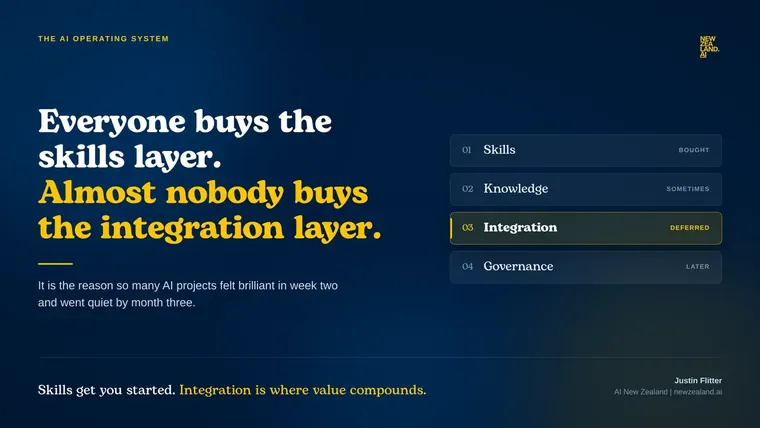
Everyone is buying the skills layer. Almost nobody is buying the integration layer.
Read article →
2026 AI Roadshow Notes
AI is no longer just about content generation. It is becoming operational infrastructure.
Read article →
Insights
What comes after LLMs now has a New Zealand face on it.
Read article →Power up your potential with practical AI skills.
Contact us to discuss how Artificial Intelligence could boost your business.