
The AI enablement playbook
The playbook for AI your whole business actually uses.
Six steps, in order, from a first safe win to work redesigned around what AI makes possible. This is the route we take clients through, the free toolkits that do the heavy lifting, and the platform that keeps the whole thing measured.
How does your business stack up? Take the free NZ AI Benchmark →
The shift
Adoption is the on-ramp. Adaptation is the destination.
Most AI strategies are adoption strategies wearing a transformation badge.
Adoption is using AI to do today's work faster. You bolt a tool onto a workflow and shave time off a task. The workflow itself does not change, and that workflow was designed around legacy tech and legacy assumptions you no longer have to honour.
Adaptation is redesigning the work itself. It asks a braver question: if AI were assumed from day one, how would we design this at all?
Here is the trap. Most of the value lives in adaptation. Most of the effort goes into adoption. So businesses end up with better screenshots and the same bottlenecks. That is AI theatre, and it is the most expensive place to get comfortable.
"If your AI rollout is making your old workflow faster, you are still doing adoption. No matter how many tools you have deployed."
Adoption.
Speeds up the work you already do. Task-level. Measured by time saved and tools deployed. Necessary, but it does not change your competitive position.
Adaptation.
Redesigns how the work is done. Operating-model level. Measured by cycle time, cost-to-serve and new capability. This is where value compounds.
You need both. But only adaptation changes the game.
Where adoption starts
Six places Kiwi businesses get their first wins.
Start where the work is repetitive, the value is obvious and the risk is low. These six earn belief across the team and buy you the permission to go deeper.
Meeting management.
Transcribe, summarise and capture actions in real time, so decisions are documented and follow-ups are clear.
Risk & compliance.
Monitor policies, compare documents and flag anomalies in compliance-heavy processes, consistently and auditably.
Content production.
Draft, repurpose and stay on brand across blogs, social media and internal comms.
Access to knowledge.
Search across emails, documents and systems for fast, context-aware answers. A company-wide knowledge concierge.
Proposals & presentations.
Generate outlines and tailor content to each client, so your people focus on insight and impact.
Research & decision making.
Analyse trends, summarise research and simulate scenarios, turning complexity into clarity for leaders.
Get one of these working properly before you attempt six.
First principles
Three principles that hold the whole thing together.
Critical thinking is your competitive moat.
As AI commoditises answers, the real advantage is human judgement, context, and the courage to challenge both the model and the status quo. Critical thinking turns generic AI outputs into distinctive decisions your competitors cannot easily copy.
Move a metric, not a use case.
Anchor every initiative to a value lever: revenue, cost-to-serve, cycle time, risk or customer experience. When AI is tied to a metric that matters, you stop doing AI theatre and start delivering measurable business impact.
Redesign your operating logic.
AI should not sit on the edge of your business. It should reshape how you sense, think, decide and act every day. Make that operating logic explicit and AI becomes trusted infrastructure, not another shiny experiment in the innovation corner.
The playbook
Six steps. Two altitudes. Done in order.
These are the six moves that take a business from scattered experiments to AI used properly, and the same six, done deeper, that carry you into adaptation. The mistake is treating them as a checklist you finish once. They are a discipline you keep levelling up, and each one has something practical attached to it.
Assign an AI Ambassador.
One person leads education and adoption, gets tools into hands safely, and gives nervous staff their first win. Make time for the person who knows your customers and your process, and bring them with you.
The ambassador becomes an AI council and a centre of enablement. Leadership drives it together, aligned to the business plan. This is not delegated: federating it out to run independently does not scale, the parts clash later.
Our free AI Champions Committee Resource Pack has the charter, the seven to nine seats, the champions network and a ninety day plan.
Set governance protocols.
A clear, organisation-wide AI policy. A statement of what you will and will not do with AI, so staff can make confident, responsible decisions.
Governance grows into agent assurance. Once agents act in production, and talk to other agents, you need a quality system: sampling, audit, and assurance profiles that tighten when an agent drifts. If you are talking about AI and not talking about cyber, you are in trouble.
The policy sections and the tool approval framework are in the Champions pack. Clients build and keep theirs in the Client Engagement Platform.
Identify practical use cases.
Workshops to find quick wins that boost productivity. Focus on a few repetitive, time-consuming tasks to build capability, get value on the board fast and build belief.
Use cases become workflow redesign. You map how a critical workflow senses, thinks, decides and acts, then rebuild it around AI rather than bolting AI on. You move a metric, not a use case.
Your whole team logs opportunities in the Client Engagement Platform, scored and ranked into a delivery order with the hours and dollars attached.
Understand your risks.
Stand up an AI committee. Review your data, IP, security and privacy against how employees could use AI tools, so AI use stays safe and compliant with regulatory requirements and industry standards.
Risk becomes a leadership discipline: setting an explicit risk appetite for how close to the frontier you will operate, and owning assurance so problems are caught before they end up in the papers. Prompts are not controls. Real controls are technical.
Three hours with your leadership team in an Executive AI Briefing is where risk appetite gets set, written down and owned.
Select the right AI tools.
A selection framework that prioritises security, scalability and integration with your data, and favours tools that serve multiple use cases. Choose well, avoid the shiny-object trap.
Tools become a system: a shared AI operating system with a governance layer, a processes layer, a knowledge layer, an integrations layer and a skills layer. And a system is run, not installed, so it is maintained and improved every month.
The free Organisational Brain Toolkit builds the knowledge layer first: eight file templates, about an hour to a working set. No tool is much use without it.
Provide ongoing AI skills training.
Practical, hands-on training so the team can use the tools and operationalise new workflows. Build confidence and capability, and power up fast adopters with more advanced skills.
You build an AI-native workforce. Roles deepen, they do not disappear. Frontline staff own agent quality, experts move from firefighting to calibrating, and leaders invest in literacy across the whole organisation.
The AI Academy is free to join: weekly AI Toolkit webinars, the Microsoft Copilot course and a growing library of templates.
Same six steps, twice. The second pass is where the value is.
Our toolkits
Four of the six steps come ready-made.
Two toolkits, covering steps 1, 2, 4 and 5 between them. We built them for clients and then gave them away, because the businesses that get AI right are the ones who do this work early. Both are free, and both are editable files rather than a PDF you can only read.
Steps 1, 2 and 4 · lead it, govern it, know the risks
The AI Champions Committee Resource Pack.
The complete programme for standing up AI governance and adoption inside a 50 to 250 person business. You need a sponsor with authority, seven to nine people who will turn up, and ninety days.
- A 115 page pack, plus every template as an editable file
- Terms of reference, seat map and the champions network
- Use case register, tool approval framework and policy sections
- A ninety day implementation plan, with an output at each stage
Step 5 · the knowledge layer
The Organisational Brain Toolkit.
Your team briefs AI from zero every single time. The fix is not a data project and it is not a new tool: it is about eight plain documents, written once, pointed at the AI your team already has.
- Eight file templates, from company profile to definition of done
- About an hour to a working set, dictated rather than written
- The 65 minute method for getting a process out of an expert's head
- Setup checklists for Claude Projects and Copilot notebooks
There is a third, on getting AI to apply your fonts, colours and layout to everything it produces. All of them live on the toolkits page.
The system underneath
Adaptation needs a system, not more tools.
The second pass through the playbook does not arrive because everyone got better at prompting. It arrives when the way your business works is encoded once, connected to your real systems, used by everyone, and improved every month. That is an AI operating system, and it is our flagship managed service.
Governance layer.
The policies and guidelines that set the guardrails for judgement and decisions: what your people are trusted to decide with AI, what comes back to a human, and where the lines sit. With clear measures for time recovered and adoption. AI drafts. Humans approve.
Processes layer.
Your standard operating procedures, owned and documented, with baseline metrics captured before anything changes, so every updated workflow shows measurable impact rather than a feeling that things are faster.
Knowledge layer.
Your methodology, templates, brand voice and past work encoded and reusable, so quality does not depend on who happens to be at the keyboard.
Integrations layer.
Connected to the systems you already run: Microsoft 365, your CRM, Teams and SharePoint. Less manual filing, less context switching, more work that finishes itself.
Skills layer.
The outputs your team produces every week, proposals, reports, client communications, minutes and advisory documents, configured once as AI workflows and available to everyone.
Most teams are live in five to nine weeks, from discovery to first workflows.
How we keep it measured
Every engagement comes with a workspace.
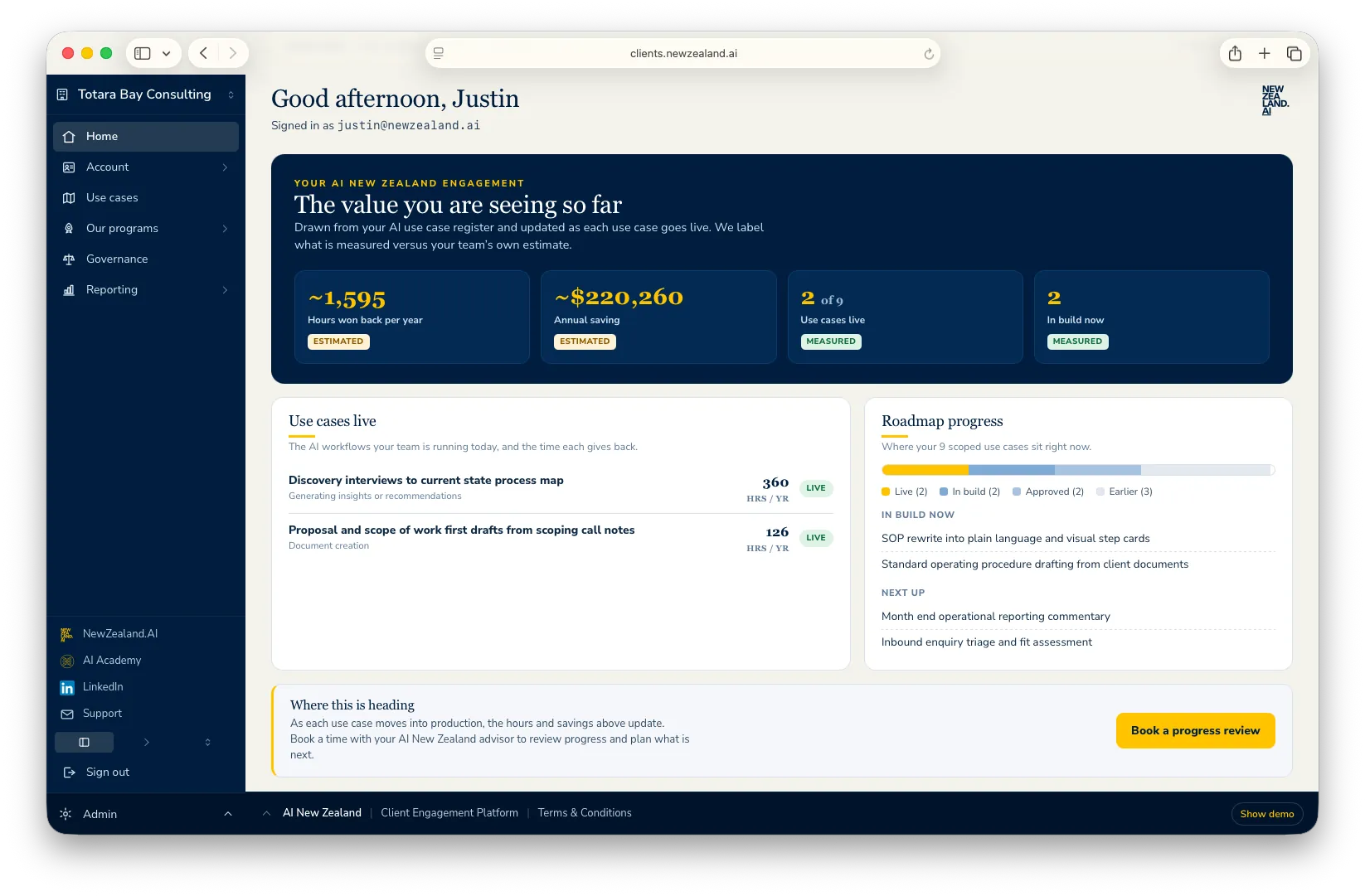
A playbook nobody can see the progress of is a document. The Client Engagement Platform is where your version of this lives: your objective, your use cases, your delivery plan, your governance documents and the value the work is returning. We designed and built it ourselves, and it is live from the day we start.
- Hours won back and dollars saved across your use cases, updating as each one goes live.
- A register your whole team fills in, scored and ranked into a delivery order.
- Delivery phases, deliverables and dates, so you can see what is under way and what is next.
- Your AI policy, guidelines and documents, kept in one secure place.
- Access you set yourself, with a one time email code instead of a password.
Where do you start?
Pick the one that sounds like a normal Tuesday.
Be honest, not aspirational. The right first move depends far less on your industry than on which of these five sentences is true in your business this week.
Start at step 1, with shared understanding. This is the easiest move on the whole playbook and the gap to your competitors widens every week you skip it. An AI Lunch & Learn gets your whole team past the fear and the folklore in an hour, and gives your ambassador something to build on.
Go straight to steps 2 and 4, governance and risk. This is the riskiest place to sit: ungoverned tools, unshared wins, and your best people quietly feeding company context into something nobody is watching. An Executive AI Briefing sets the policy, picks the value levers and gives the experiments a direction. The Champions pack is free and you can start this week.
You are at the adoption ceiling. Step 3, done properly. You have made the legacy way of working faster without asking whether the legacy way is still the right way. The move is to pick one core workflow, redesign it around AI, and put a measurable target on it. That is where the AI OS conversation usually starts.
Second pass, all six steps. You are past the point most businesses never reach. The work now is depth and rhythm: more workflows redesigned, capability lifted every month, governance that scales with you, and someone accountable for the numbers. That is exactly what the AI Operating System and the Client Engagement Platform are for.
Rare air. Step 2, at the top of its range. The discipline now is assurance: agent quality, an explicit risk appetite, and an operating rhythm to stay at the edge responsibly. Run as a managed service, that rhythm is monthly, not annual. Let us compare notes.
Wherever you landed, the next move is the same shape: one step, properly, not six at once.
Book an Executive AI BriefingHow we help
Wherever you start, there is a next step.
AI Lunch & Learn.
Demystify AI, build confidence, and get tools into hands safely. The fastest way to give your whole team a shared starting point.
Learn more →Executive AI Briefing.
Three hours with your leadership team to uncover high-impact use cases, set governance, and leave with an AI Roadmap.
Learn more →Use Case Scoping.
Find the highest-value opportunities, scope them properly, and quantify the ROI before you invest. The business case for AI, on one page.
Talk to us →AI Strategy.
A company-wide, six to nine week programme that anchors AI to your business goals and shows you how to redesign, not just speed up.
Talk to us →AI Operating System.
Our managed service, and the engine of adaptation. We build your governance, processes, knowledge, integrations and skills layers, get your first workflows live in five to nine weeks, then run and improve the system with you every month.
Explore the AI OS →Request our Client Services Pack.
The full menu: every service, format and price in one document. Email us and we will send it straight over.
Request the pack →You do not have to do this alone, and you do not have to do it all at once.
The next move
The tools are ready. Are You?
Those who implement AI in a measured and managed way will outperform those who do not. Let us help you find the one workflow worth redesigning first, then build the system that keeps you improving.