
The Four Big Ideas for 2026: Stop Chasing Tools. Start Building Advantage.
This is the year AI stops being a sideshow and starts rewriting how your business actually works. Either you design that shift on purpose, or it happens to you by accident.
Every New Zealand business now has access to the same models, the same APIs, the same shiny copilots. The differentiator is no longer tools; it is how you think, where you focus, and how your organisation operates when AI is in the loop.
Curiosity builds capability. Critical thinking deploys it with impact. Value levers focus it where it counts. Operating logic turns it into how the whole business actually runs. Together, these four ideas form a leadership advantage; AI cannot automate the human edge of judgement, context, and conviction.
This is the framework underpinning everything at newzealand.ai this year: how you learn, how you experiment, and how you scale AI beyond theatre.
Remember: The real question isn't, "Should we use AI?", that's table-stakes. It's "Are we the kind of organisation that can learn fast enough to use it well?"
1. Curiosity isn't a personality trait. It's infrastructure.
Curiosity is no longer a nice personality trait; it is a survival mechanism. The people and companies dying in the AI era are not the ones without tools – they are the ones who stopped asking better questions.
If your leaders are not visibly learning in public, trying tools in front of their teams, and saying "I don't know, let's find out", you are quietly choosing obsolescence. Curiosity must become infrastructure you deliberately build into meetings, experiments, and hiring, not an optional extra for the "keen ones".
Next steps this quarter
- Replace "Do you understand?" with "What are you curious about?" in every leadership meeting.
- Stand up a shared Curiosity Board (Slack, Miro, Notion) where anyone can post a question worth exploring about customers, workflows, or AI.
- Ring-fence 5–10% of team time for tiny AI experiments tied to real work, with show-and-tell at the end.
2. Critical Thinking is your Competitive Moat
AI has commoditised answers; your moat is the quality of your questions and your courage to challenge the outputs. Eighty percent of AI use today is lazy copypaste prompts, unquestioned outputs, zero context – that is not transformation, that is abdication.
Critical thinking is human judgement made visible: asking "why this, why now, what assumptions are we making?" and being willing to override the model when it clashes with reality. The real risk is no longer hallucination; it is humans accepting AI answers uncritically.
Next steps this quarter
- Make "Why?" standard operating procedure in every project, with a rotating devil's advocate role in key decisions.
- Bake examples of great judgement into performance reviews: who challenged an AI output, spotted context others missed, or changed direction after reflection.
- Train teams to verify AI work as rigorously as they would a junior analyst's work – trust, but verify.
3. Value Levers: Move a Metric, Not a Use Case
If you want AI value fast, stop collecting use cases and start pulling value levers. Use cases describe what tech can do; value levers define what the business must improve: revenue, costtoserve, cycle time, risk, or customer experience.
"Where can we use AI?" is the wrong question and the fastest path to AI theatre. The right question is "Which metric are we willing to be held accountable for, and what is the fastest AIassisted way to move it?".
Next steps this quarter
- Run a 60–90 minute "Value Lever Sprint" with your execs: pick 1–2 priority levers, define baselines and 90day targets, then brainstorm AI only after the lever is locked.
- Require every AI idea to answer five things on one page: lever, metric, baseline/target, P&L or risk impact, and measurement plan – no answers, no project.
- Adopt the mantra "move a metric, not a use case" as your filter for killing AI theatre and prioritising what ships.
4. Operating Logic: The Line Between Theatre and Transformation
AI does not bolt onto your business; it rewrites your operating logic. Operating logic is the invisible system that determines how you sense, think, decide, and act – what gets measured, who decides, and what you optimise for by default.
Most AI programmes do not fail because the models are bad; they fail because they are wired into 1990s operating logic. If you do not change how decisions are made, AI will simply make your existing problems bigger and faster: confusion at scale, bottlenecks at scale, bias at scale.
Next steps this quarter
- Map one highstakes workflow (onboarding, credit approval, claims, sales pipeline) using Sense–Think–Decide–Act, then mark where AI should be copilot, decision support, or narrow agent.
- Define operatinglogic guardrails: which decisions AI can influence, what needs human review, what must never be delegated, and how humans override.
- Give every AI initiative a named business owner, clear decision rights, and kill criteria before you start.
Your 90Day Challenge
Over the next 90 days, your job is not to "do more AI". Your job is to:
- Make curiosity a visible, structural part of how your teams work.
- Turn critical thinking into a daily habit, not a workshop.
- Anchor every AI effort to a value lever and a metric you are willing to defend at the board table.
- Start redesigning operating logic so AI becomes infrastructure, not a demo.
Do this, and AI becomes the engine for a smarter, faster, more trustworthy organisation – not a fad you experimented with and quietly shelved.
The tools are here; the question is whether your leadership will match them.
If you want a simple template, book an AI chat & I can share the one we use for mapping Sense–Think–Decide–Act, and the guardrails that stop "smart suggestions" turning into dumb automation.
Continue reading
More from AI New Zealand.
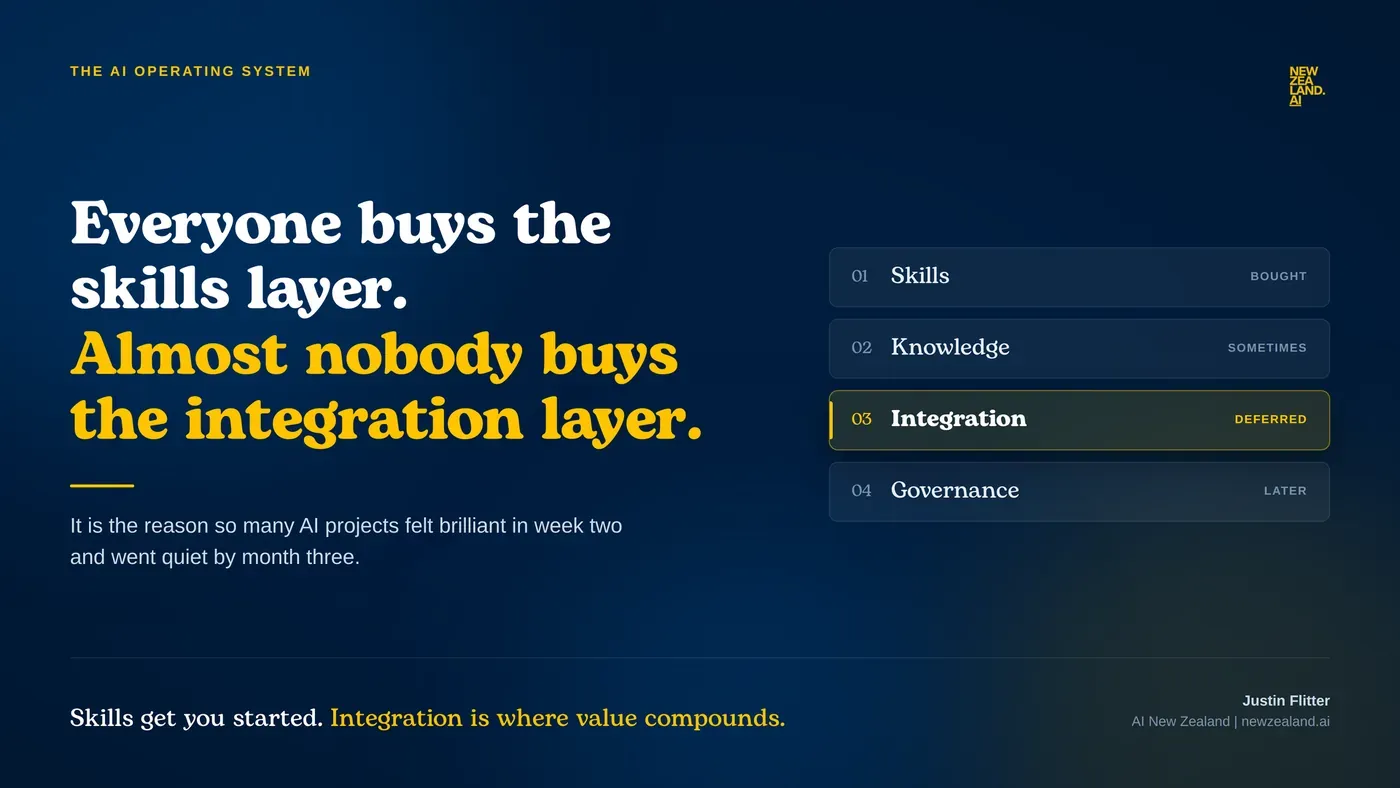
AI Operating System
Everyone is buying the skills layer. Almost nobody is buying the integration layer.
Read article →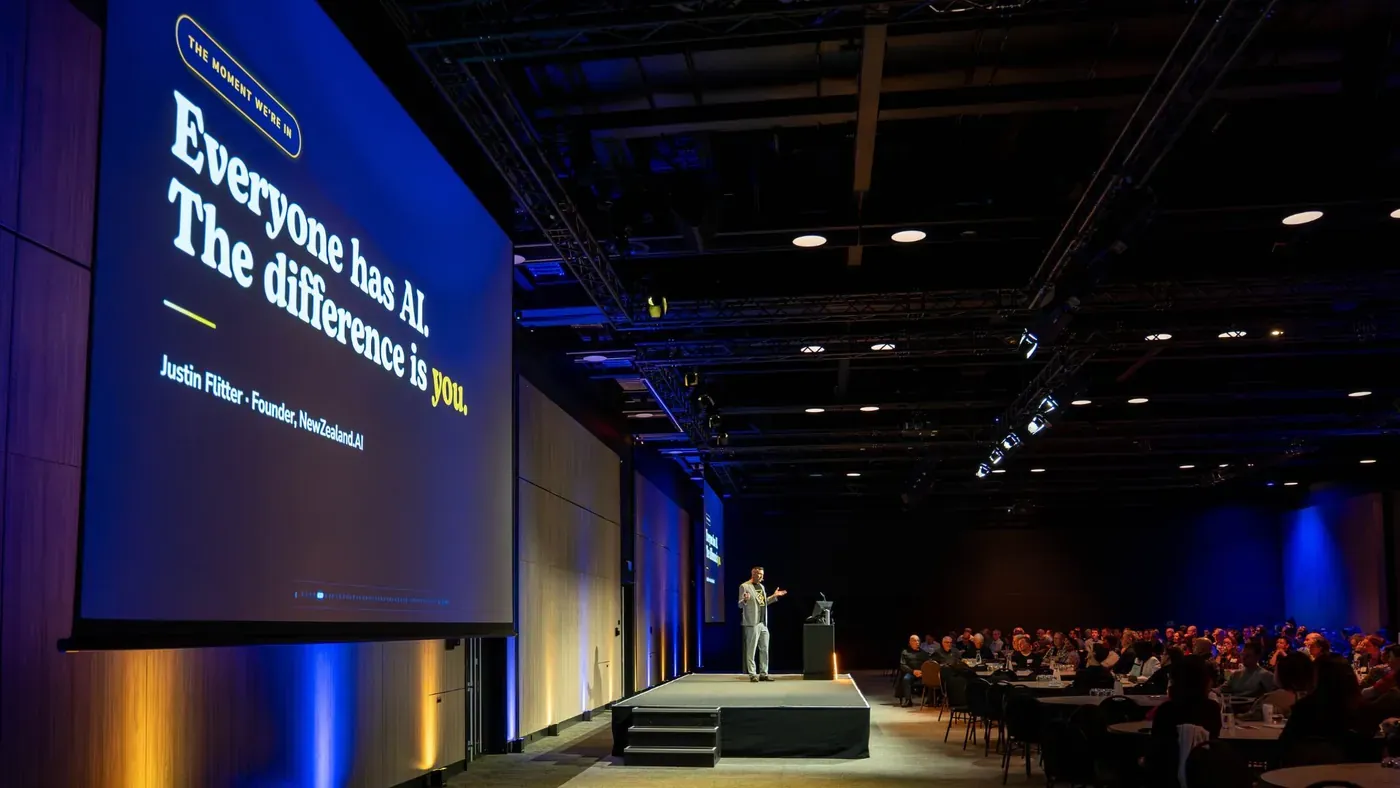
2026 AI Roadshow Notes
AI is no longer just about content generation. It is becoming operational infrastructure.
Read article →
Insights
What comes after LLMs now has a New Zealand face on it.
Read article →Power up your potential with practical AI skills.
Contact us to discuss how Artificial Intelligence could boost your business.