
"AI use cases" are a distraction. Here's what we did instead.
Here's the question: Which number are you willing to be held accountable for moving this quarter?
I'm the CFO of a residential construction business in New Zealand.
I used to think "AI strategy" meant finding clever use cases.
You know the type: "Let's use AI for estimating." "Let's use AI for health and safety." "Let's use AI for marketing." It's a grab bag of good ideas, usually delivered with a slick demo and a slide that says game-changer.
Then I looked at our month-end. Again.
We're a residential construction business. Good people, solid reputation, plenty of work.
But the finance reality is less glossy: cash gets tight, jobs drift, rework bites, and the margin we thought we had quietly evaporates somewhere between the quote and the final invoice.
That's the moment I stopped caring about use cases.
I started caring about numbers.
The problem: We weren't short on work. We were short on control.
If you've ever sat in the CFO seat of a construction firm, you'll know the feeling.
Revenue looks fine on paper, but operational noise eats profit in a dozen small ways:
- Variations get raised late or not at all:
- Subbies show up at the wrong time, or not at all
- Site notes sit in someone's phone, not in the system
- The same question gets answered six times by six people
- A job "mostly" finishes, then drags on for weeks
- We burn hours chasing information we already have, somewhere
None of that is solved by a shiny "AI use case library".
That's just new vocabulary for old chaos.
So I asked a different question in our leadership meeting:
"Which number are we willing to be held accountable for moving in the next 90 days?"
Silence.
Then some uncomfortable shifting. Good.
That's where progress starts.
The shift: From "Where can we use AI?" to "Which lever matters most?"
We picked two value levers. Not ten. Two.
Cost-to-serve (labour and admin time per build)
Cycle time (days from contract to handover)
Because in residential construction, those two levers quietly control everything else:
- Margin
- Cashflow
- Capacity
- Customer experience
- Stress levels, including mine
Use cases describe what technology can do.
Value levers define what the business must improve.
Once we agreed on the lever, the conversation changed overnight.
No more AI theatre. No more "pilot this, trial that."
We weren't buying software.
We were buying time and reducing leakage.
The story: Our "AI initiative" started with one painful Friday
It was 4:45pm. I was about to shut my laptop when our build manager called.
"We've got a claim from a client. They're saying we didn't tell them about a material substitution. They want a discount."
I asked the obvious CFO question: "What does the paperwork say?"
That's when we realised the truth. The "paperwork" was split across:
- site photos and texts
- an email thread with the supplier
- a Teams chat
- a variation draft sitting in someone's inbox
- notes from a site meeting that never made it into the job file
We weren't losing money because we lacked effort. We were losing money because our information was scattered.
And scattered information is expensive.
So instead of doing what we usually do (have a post-mortem, blame the process, promise we'll do better), I wrote two lines on the whiteboard the following Monday:
- Lever: Reduce cost-to-serve
- Metric: Admin hours per active build
Then I asked: "What's driving this number up?"
Not hypotheticals. Real friction.
The answer was immediate:
- Our project coordinators were drowning in emails and follow-ups
- PMs were rewriting the same updates for clients, suppliers, and internal teams
- Variations were inconsistent and slow because they relied on perfect documentation
- Everyone was duplicating work because nobody trusted where the latest info lived
That's not an AI use case.
That's a value leak.
What we did: One lever, one workflow, one measurable target
We didn't start with "let's implement AI".
We started with a workflow we could measure: variation management and client updates.
We set a 90-day target:
- Reduce admin time per build by 10%
- Cut average variation turnaround time from 5 days to 2
- Improve "client update consistency" (yes, we actually measured it by audit sampling)
Then we built a simple process:
1Capture the raw reality, automatically
Site supervisors already take photos and notes. The difference was this: we created a standard channel where those inputs land, tagged to the job.
No heroics. Just consistency.
2Use AI to turn chaos into a first draft
We used an AI assistant to:
- summarise site notes into structured variation drafts
- pull key details (date, location, materials, reason, impact)
- draft a client update email in our tone of voice, based on the latest job notes
Important point: AI didn't approve anything.
It prepared the work so humans could apply judgement quickly.
3Add human judgement where it matters
PMs reviewed and edited every variation and client update before it went out.
That's non-negotiable. AI commoditises answers. In construction, context is everything.
Critical thinking is your competitive moat.
Especially when a tool is confidently wrong.
4Measure the lever weekly, not quarterly
If you want AI value fast, you measure fast.
We tracked:
- admin hours logged by role and job stage
- time from "issue identified" to "variation sent"
- time from "variation sent" to "variation approved"
- rework incidents tied to communication gaps
No vanity metrics. No "number of prompts used".
Just business numbers.
The results: Not miraculous. Real.
Here's what changed within three months:
- Variation drafts stopped sitting in limbo because someone "didn't have time to write it up"
- Client updates became faster and more consistent, which reduced escalations
- PMs spent less time writing and more time managing the job
- Admin staff stopped being the organisation's human search engine
- We tightened our cashflow because variations were issued earlier and approved faster
Did we suddenly become a futuristic AI-enabled construction company?
No. We became a slightly more disciplined business that moved two numbers in the right direction. And that's the whole point.
AI didn't transform us.
It removed friction.
The lesson: Use cases are easy to collect. Value is harder.
Use cases are comforting because they feel productive.
You can brainstorm them all day and still avoid the hard work of choosing what matters.
Value levers force decision-making:
- Which metric?
- What baseline?
- What target?
- Who owns it?
- How will we measure it?
What changes next Monday?
When you anchor AI to a lever, you don't "pilot AI".
You move a number that matters.
If you're a CFO (or any leader), start here
If I could go back and give myself a cheat sheet, it would be this:
- Pick 1–2 levers only. (Revenue, cost-to-serve, cycle time, risk, customer experience.)
- Name the metric and baseline. If you can't measure it, it's a hobby.
- Set a 90-day target. Long enough to matter. Short enough to focus.
- Choose one workflow where that lever leaks value.
- Use AI to compress the boring parts. Drafting, summarising, extracting, standardising.
- Keep humans in the loop for judgement. Especially in high-trust industries.
Curiosity is the antidote to obsolescence.
But curiosity without accountability is just tinkering.
So here's the question I'm asking you the same way I asked our team:
Which number are you willing to be held accountable for moving this quarter?
Continue reading
More from AI New Zealand.
AI Operating System
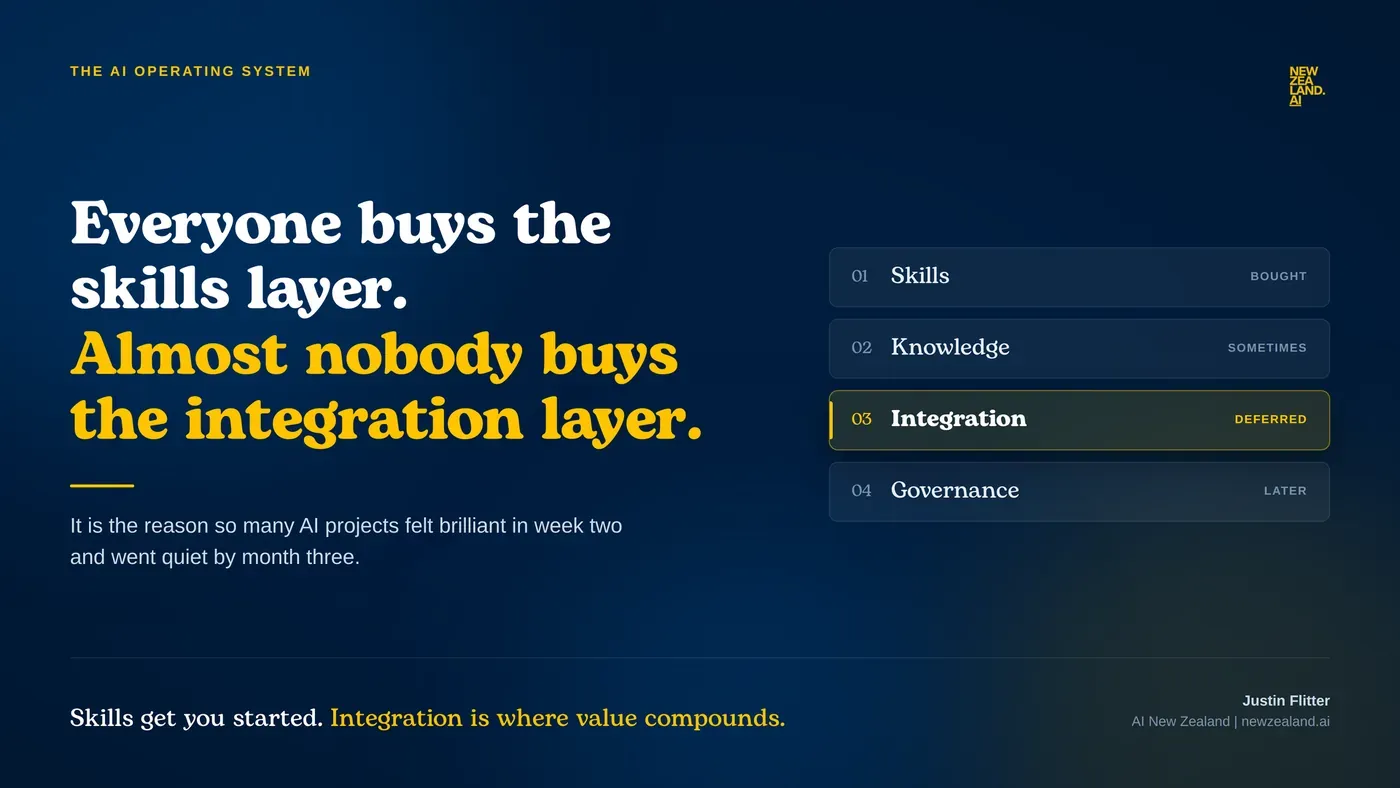
Everyone is buying the skills layer. Almost nobody is buying the integration layer.
Read article →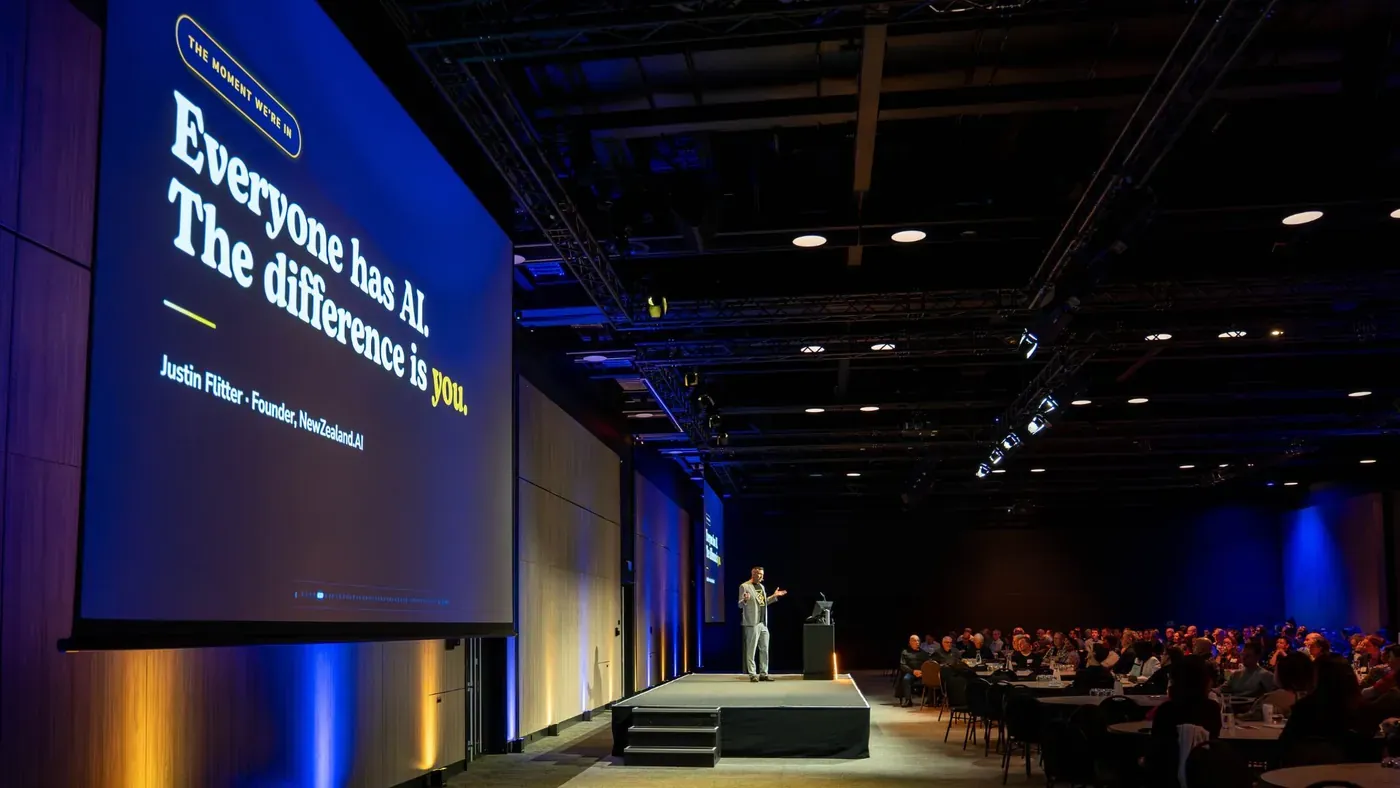
2026 AI Roadshow Notes
AI is no longer just about content generation. It is becoming operational infrastructure.
Read article →
Insights
What comes after LLMs now has a New Zealand face on it.
Read article →Power up your potential with practical AI skills.
Contact us to discuss how Artificial Intelligence could boost your business.