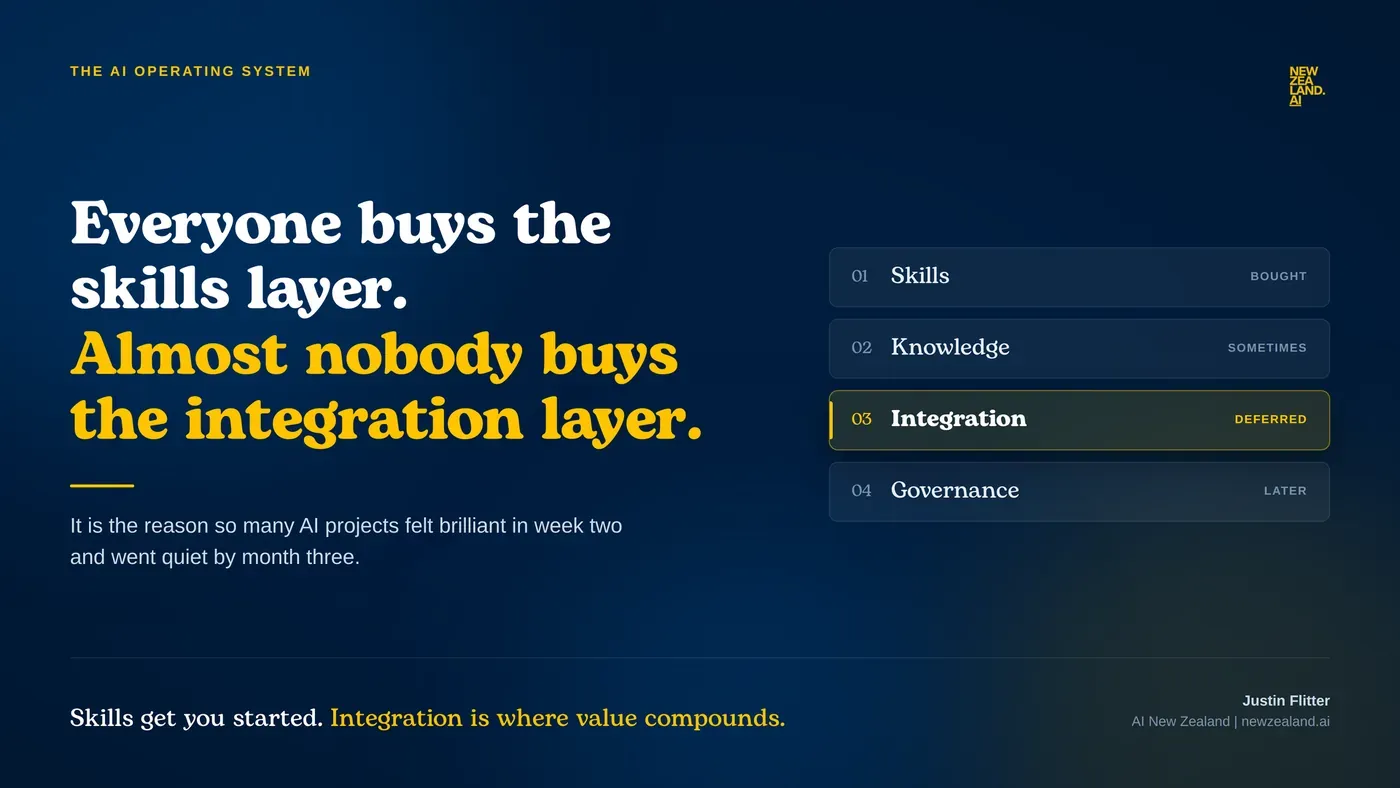
Everyone has AI in the loop. The difference is the operating model.
AI is no longer just about content generation. It is becoming operational infrastructure.
For two years, "using AI" mostly meant generating content. A faster email. A tidier slide. A blog post in your own voice. Useful, but shallow.
Across the Great New Zealand AI Roadshow, a different story kept showing up on stage. AI is moving out of the chat window and into the plumbing of the business.
Justin Flitter, founder of AI New Zealand, named the shift. "A year ago, this was 'ask and act'," he told the room. "Now we can delegate the whole process to agents and skills: to research, to create, and to generate the output." The punchline landed hard: "Just having AI in the loop is not what sets you apart."
Just having AI in the loop is not what sets you apart.Justin FlitterFounder, AI New Zealand
That reframes the work. Richard Kenyon, Associate Director of AI and Automation at Datacom, drew the line most businesses miss. "Adoption is using AI to automate the way we work today," he said. "It doesn't really make sense to automate the way we work today, because that's based on legacy tech. It's based on legacy processes." In his telling, infrastructure is no longer fixed. "A modern IT infrastructure is one that you are continuously changing, because we can."
Once agents run real work, they need real engineering. Kenyon calls agent assurance "a new budget line item": sampling, audit and version control for software that drifts like a factory line.
And infrastructure that acts has to be governed like infrastructure, not coached like a chatbot. Raymond Schippers from Check Point was blunt. The instructions you send an agent "are just suggestions and guardrails, like asking your teenage children to clean a room. It might work. It might not." Real control is technical: least privilege, human review, rollback.
The stakes are operational, not cosmetic. Anchali Anandanayagam, Partner at Hudson Gavin Martin, pointed to Air Canada, held liable when its chatbot invented a policy that never existed. Her line for every board: "You can't outsource your accountability to these tools."
None of this is really a technology problem. Asa Cox, founder of Numa, has run AI adoption work with more than 100 Kiwi businesses. His verdict is the one every leader needs to hear: "The technology is ready, the people are not."
The technology is ready, the people are not.Asa CoxFounder, Numa
This is the move. Not better screenshots. An operating model where AI senses, thinks, decides and acts inside your systems, with your context encoded once and used by everyone.
The differentiator was never the model. It is the operating model.
The tools are ready. The infrastructure question is whether you are.
Build the operating model, not just the screenshots.
See where the Roadshow conversation goes next, or start mapping your own use cases and roadmap with the team at AI New Zealand.