
From AI Theatre to Real Impact: A NZ Financial Services Story.
The real question wasn't, "Should we use AI?" It was, "Are we the kind of organisation that can learn fast enough to use it well?"
I'm the CEO of a mid-sized financial services business in New Zealand. Justin asked if we could share our story, I asked to remain anonymous.
We're not a startup. We're not a legacy dinosaur either. We're that familiar Kiwi middle ground: regulated, responsible, customer-first, and quietly allergic to risk. Which is exactly why AI landed on our doorstep like an overconfident salesperson.
Everyone had an opinion.
Some people wanted to buy everything.
Others wanted to ban it from the building like it was an invasive species.
Both reactions missed the point.
The real question wasn't, "Should we use AI?" It was, "Are we the kind of organisation that can learn fast enough to use it well?"
The problem wasn't the tech. It was our thinking
Our first AI conversations were classic "AI theatre".
A vendor demo here. A glossy slide deck there. Lots of talk about transformation. Not much change in how work actually happened. We were surrounded by impressive outputs and still unsure what to trust.
And in financial services, "unsure" is just another word for "no".
Here's the uncomfortable truth: most organisations don't struggle with AI because they lack tools. They struggle because they haven't built the human habits required to use the tools responsibly.
Curiosity is the antidote to obsolescence.
But curiosity without judgement is just expensive experimentation.
That's where critical thinking earns its keep.
The moment it got real
A customer emailed in with a complaint about fees. The kind of message that arrives already hot and stays hot until someone deals with it. We had a backlog. Our service team was stretched. We were trying to keep response times down without burning people out.
A well-meaning manager suggested we trial an AI tool to draft replies.
It sounded sensible. It also sounded dangerous.
So we ran a controlled experiment.
We took 50 real complaint emails and asked the AI to draft responses using our publicly available policies and a brief on our tone of voice.
Then we sat down with three people:
- A senior customer service rep who knows what upset customers actually need to hear
- A compliance lead who knows what we can and can't say
- A product manager who understands the fee structures and edge cases
We didn't ask, "Is this good?"
We asked, "Where is this wrong?"
That question changed everything.
The AI drafts were... surprisingly decent. Warm tone. Clear structure. Confident language.
And that was the problem. The confidence.
In three of the 50 emails, the draft promised outcomes we couldn't guarantee. In a couple more, it used language that would be fine in casual conversation but risky in a regulated environment.
In one case, it subtly misunderstood the customer's situation and offered an explanation that would have escalated the complaint.
It wasn't malicious.
It was just confidently wrong.
That day, my view of AI snapped into focus.
AI commoditises answers. Human judgement becomes premium.
Curiosity built the capability
Once we stopped treating AI like magic and started treating it like a junior analyst with a lot of confidence and not enough context, our approach matured quickly.
We got curious, but in a disciplined way.
We started small:
- We created a simple "AI usage guideline" written in plain English, not legalese
- We trained teams on how to write good briefs (context in, quality out)
- We set up a fortnightly show-and-tell where staff shared wins and failures
- We tracked time saved, error rates, and customer sentiment, not vibes
Within six weeks, we weren't "doing AI". We were building an organisation that learns.
The capability grew fast. Not because AI was amazing. Because our people were.
And importantly, curiosity didn't just live in innovation meetings.
It showed up in everyday work:
- "What's the real bottleneck here?"
- "What assumptions are we making?"
- "What would happen if we tried this with one team for two weeks?"
Those are curiosity questions.
They're also business questions.
Critical thinking deployed it with impact
Then came the bigger test.
Our credit team wanted to use AI to help summarise customer documents for internal review.
On paper, it was a no-brainer. The time savings looked massive. The team was excited. Leadership was tempted to approve it quickly.
I pushed pause.
Not because I'm anti-AI. Because I've been around long enough to know that "massive time savings" is how organisations talk themselves into avoidable risk.
So we ran it through a critical thinking filter. Three questions:
- What's the decision being made, and what's the risk if it's wrong? Summaries would influence lending decisions. Wrong summary, wrong decision. High stakes.
- What data is involved, and where does it go? Customer documents contain sensitive personal information. We needed clarity on storage, retention, access, and vendor terms.
- What's the minimum viable version of this that still adds value? Instead of "AI summarises everything," we started with "AI drafts a summary that a human must verify, with mandatory source quotes attached."
That last part mattered.
We required the AI output to include citations: "This sentence comes from this paragraph in this document." No citation, no trust. That single design choice turned AI from a shortcut into a thinking partner.
We also added a red-team step where someone tried to break the process: upload messy documents, contradictory info, missing pages. We assumed reality would be worse than the demo.
Reality always is.
When we finally rolled it out, the impact was real: faster reviews, less cognitive load, better consistency, and no spike in errors. Not because the AI was perfect. Because the system around it was.
That's critical thinking.
Not cynicism. Not slowing down for the sake of it. Just judgement, applied with intellectual courage.
What I learned as a CEO
AI didn't change our business overnight.
It changed how we think about improvement.
Curiosity made our team willing to explore. It gave people permission to learn in public, to ask "dumb" questions, and to run small experiments without fear of looking behind the curve.
Critical thinking made those experiments safe, useful, and scalable. It forced us to interrogate outputs, challenge assumptions, and build guardrails that match the reality of regulated work.
One without the other is a problem.
Curiosity without critical thinking becomes chaos.
Critical thinking without curiosity becomes stagnation.
Together, they build something rare.
A competitive moat.
Action steps: if you lead a team, start here
If you're a leader in New Zealand financial services (or any regulated industry), don't start by asking, "What AI tool should we buy?"
Start with this:
- Ask better questions in meetings. Swap "Do you understand?" for "What are you curious about?" once a week. Watch what changes.
- Pilot one workflow, not a whole strategy. Pick one real process that's causing frustration. Run a two-week experiment. Measure time saved and risk introduced.
- Make human judgement non-negotiable. Require review, verification, and context checks. Treat AI as a draft machine, not an authority.
- Reward the people who spot what's wrong. The person who says, "This output looks confident but it's missing context" is saving you money and reputation.
Celebrate that.
Curiosity is the antidote to obsolescence.
Critical thinking is your competitive moat.
And in a world where AI commoditises answers, the winners won't be the organisations with the most tools.
They'll be the ones with the best judgement.
Curiosity builds capability.
Critical thinking deploys it with impact.
That's the play.
Continue reading
More from AI New Zealand.
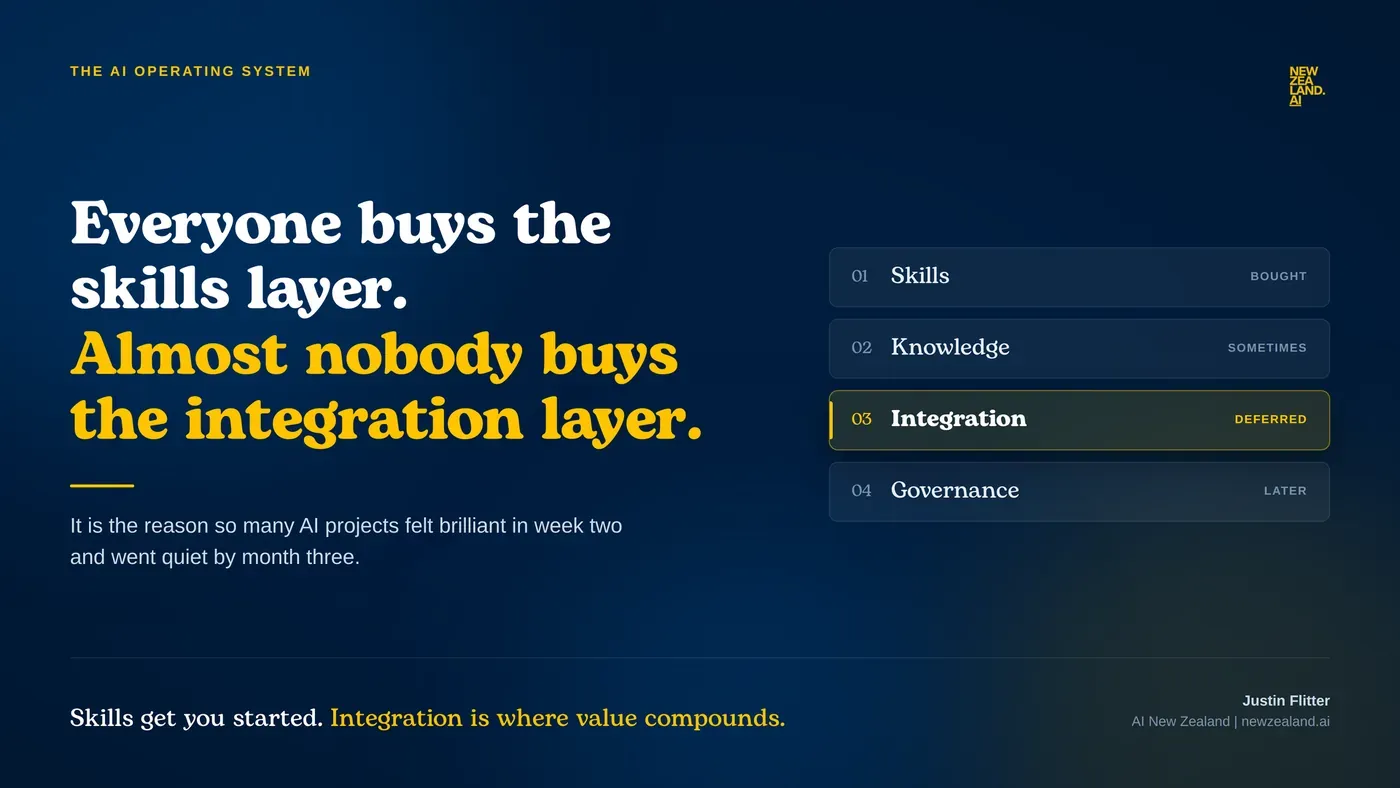
AI Operating System
Everyone is buying the skills layer. Almost nobody is buying the integration layer.
Read article →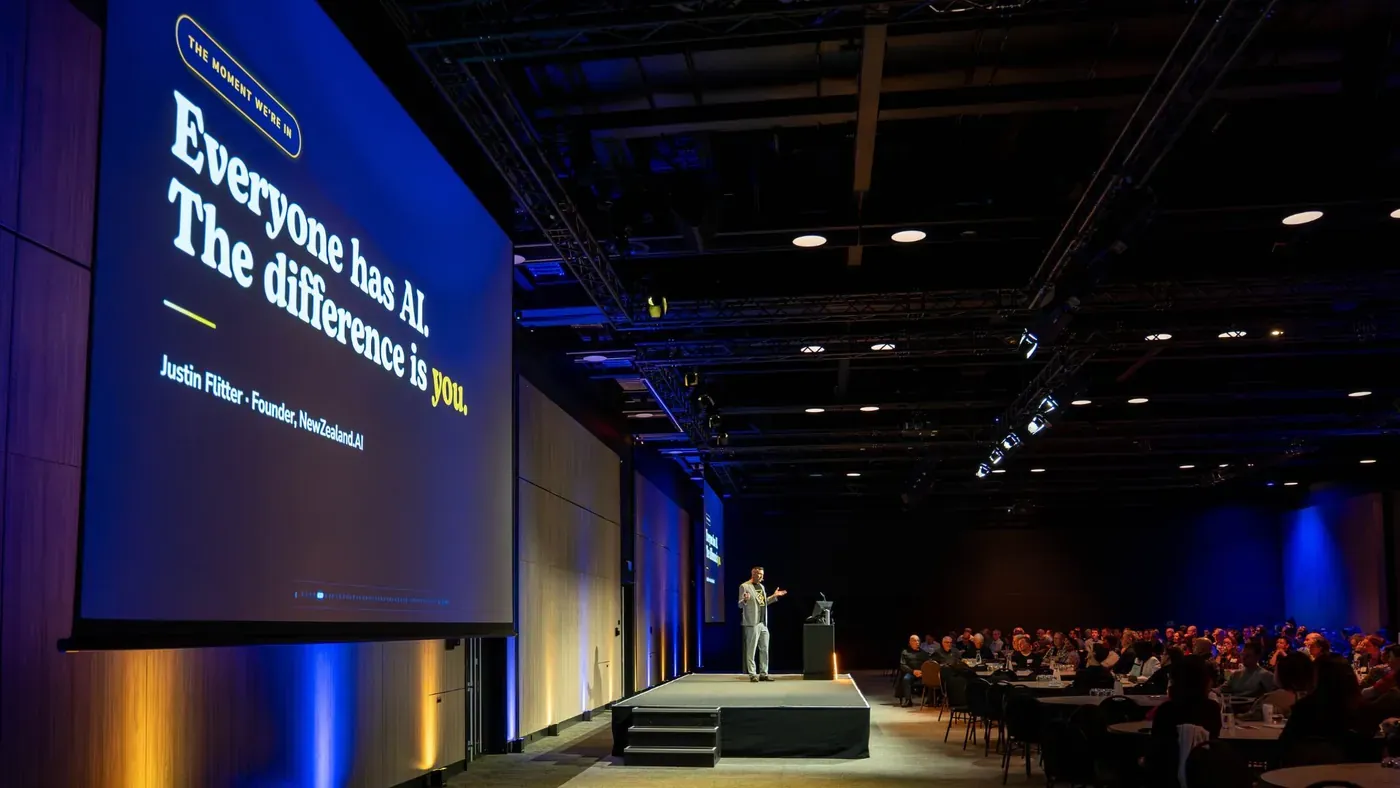
2026 AI Roadshow Notes
AI is no longer just about content generation. It is becoming operational infrastructure.
Read article →
Insights
What comes after LLMs now has a New Zealand face on it.
Read article →Power up your potential with practical AI skills.
Contact us to discuss how Artificial Intelligence could boost your business.