
AI Gave Us the Answer. Critical Thinking Saved the Deal.
Critical thinking is your competitive moat. Not as a nice idea.
I'm the CMO of a software development business in New Zealand. We build custom platforms for mid-market organisations - the kind that have real complexity, real customers, and real consequences when you get it wrong.
And lately, like every other leadership team, we've had a new colleague in the room.
AI.
It shows up with confidence. It writes faster than any human. It turns messy notes into neat decks and neat decks into neat plans. It's unbelievably helpful.
It's also often wrong in the only way that matters.
Not factually wrong.
Contextually wrong.
The pitch we "almost" won.
A few months back, we were in late-stage conversations with a New Zealand services business looking to rebuild a customer portal and integrate it with their back-office systems.
Big project. High visibility. The kind of work you want on your website, your case studies, and your quarterly report.
We'd done the workshops. We'd mapped the stakeholders. We'd even made friends with the CFO (always a good sign).
Then the client went quiet.
Not dead quiet. More like "we're suddenly very busy, thanks for the doc" quiet.
So we did what modern teams do. We asked AI to help.
We fed it the meeting notes, the discovery outputs, and our proposed scope. We asked it to produce a follow-up strategy: objection handling, likely concerns, messaging angles, and a re-engagement email sequence.
The output was... good. Really good.
It recommended we position around speed to value, reduced operational effort, and a cleaner customer experience. It suggested a crisp email with a soft close and three optional next steps. It even created a short one-page "why us" summary that looked like something a senior marketer had written on a great day.
It felt like an answer.
And that's the trap.
AI commoditises answers. Everyone can get a decent follow-up email now. Everyone can get a plausible strategy slide.
Everyone can sound smart on the internet.
The real question is: Is it the right answer for this situation, with these people, at this time?
That's not an AI problem.
That's a judgment problem.
The moment our Head of Delivery got uncomfortable.
Before we hit send, I did what I've trained myself to do in the last year: I pulled someone from a different part of the business into the loop.
Not to "approve the copy".
To interrogate the thinking.
Our Head of Delivery skimmed the AI-generated plan and said, "This is tidy... but it assumes the client's problem is speed and effort."
He paused.
"I don't think that's their real problem."
Now, he wasn't guessing. He'd spent six years implementing systems for organisations like this. He'd lived through the politics, the workarounds, the late-night escalations, the 'we didn't realise finance did it that way' surprises.
Deep domain knowledge. Lived experience. The stuff you don't get in a transcript.
He pulled up one line from our notes that the AI had treated as background noise:
"We've been burned before with a vendor who promised integration was simple."
The AI had filed that under generic "risk objection".
My colleague read it as trauma.
Different interpretation. Different reality.
So we rewrote our entire approach.
Not the email. The strategy.
Asking better questions (instead of sending better emails)
We got on the phone with the client sponsor and didn't lead with our shiny solution. We led with a question:
Last time you got burned, what actually happened?"
It turned out the previous vendor hadn't just missed deadlines. They'd built something that looked right in demos, then fell apart under real usage.
Data mismatches.
Manual reconciliations.
Frontline staff inventing spreadsheets to cope.
Executives being promised one thing and getting another.
The sponsor said, "It was embarrassing."
That one word told us everything.
This wasn't a sales cycle about features. It was a decision about professional risk.
And suddenly, the AI's suggested message about "speed to value" wasn't just unhelpful. It was dangerous. It signaled we didn't understand the stakes.
So we shifted.
We positioned our team around integration proof, risk reduction, and delivery governance.
We offered a short technical deep dive with their internal IT lead, not as a flex, but as a trust-building move.
We shared a real story where we discovered ugly data truth early and adjusted before it became a headline.
The tone changed too.
Less "Here's what we can build."
More "Here's how we'll make sure it doesn't become your next headache."
We won the project.
But the bigger win was what we learned about ourselves.
The uncomfortable truth: AI makes it easier to be average.
If we'd followed the AI output, we would have sent a perfectly reasonable follow-up. It would have sounded professional. It would have ticked the boxes.
And we probably would have lost.
Not because the email was bad.
Because it was generic.
That's the thing leaders need to get clear on: when AI commoditises answers, "good" becomes table stakes.
The differentiator shifts up the stack.
To judgment.
To context.
To the ability to challenge what sounds plausible and ask, "What assumption is hiding in here?"
Critical thinking is your competitive moat. Not as a nice idea.
As an operational advantage.
What critical thinking looked like in that moment.
It wasn't a philosophy discussion. It was practical.
Here's what we actually did that changed the outcome:
- We treated the AI output as a draft, not a decision. Helpful starting point. Not truth.
- We interrogated the assumptions. What is this plan assuming the client cares about most? Is that actually true?
- We pulled in lived experience early. The person who has seen this movie before will spot the twist.
- We asked a human question AI couldn't. "What happened last time?" isn't a prompt trick. It's empathy and curiosity in a business suit.
- We acted decisively once the context changed. Critical thinking isn't endless analysis. It's the courage to change course.
That last point matters.
Because plenty of teams spot the issue and still do nothing.
They stick with the safe plan.
They send the generic email.
They avoid the awkward conversation.
That's not a capability gap.
That's an intellectual courage gap.
Human judgment is becoming premium (and you can build it)
If you're leading a sales, marketing, or customer team right now, you don't need more AI usage.
You need better thinking around AI usage.
That means building a culture where people are rewarded for challenging outputs, not just producing them faster.
Where someone can say, "I don't buy it," without being treated like they're slowing things down. Where you make space for the inconvenient question.
Because the future isn't AI versus humans.
It's humans who apply judgment versus humans who outsource it.
And the organisations that win won't be the ones with the best prompts.
They'll be the ones with the best judgment.
Action step: run the "AI Interrogation" habit this week
Pick one AI-generated output your team is about to ship - an email sequence, a campaign plan, a proposal, a customer response.
Then ask three questions in a 10-minute huddle:
- What is this assuming?
- What could be contextually wrong even if the facts are right?
- Who in our organisation has lived experience that should challenge this?
Do that consistently and you'll build the only advantage that won't get commoditised.
The moat isn't the model.
It's the mind behind it.
Continue reading
More from AI New Zealand.
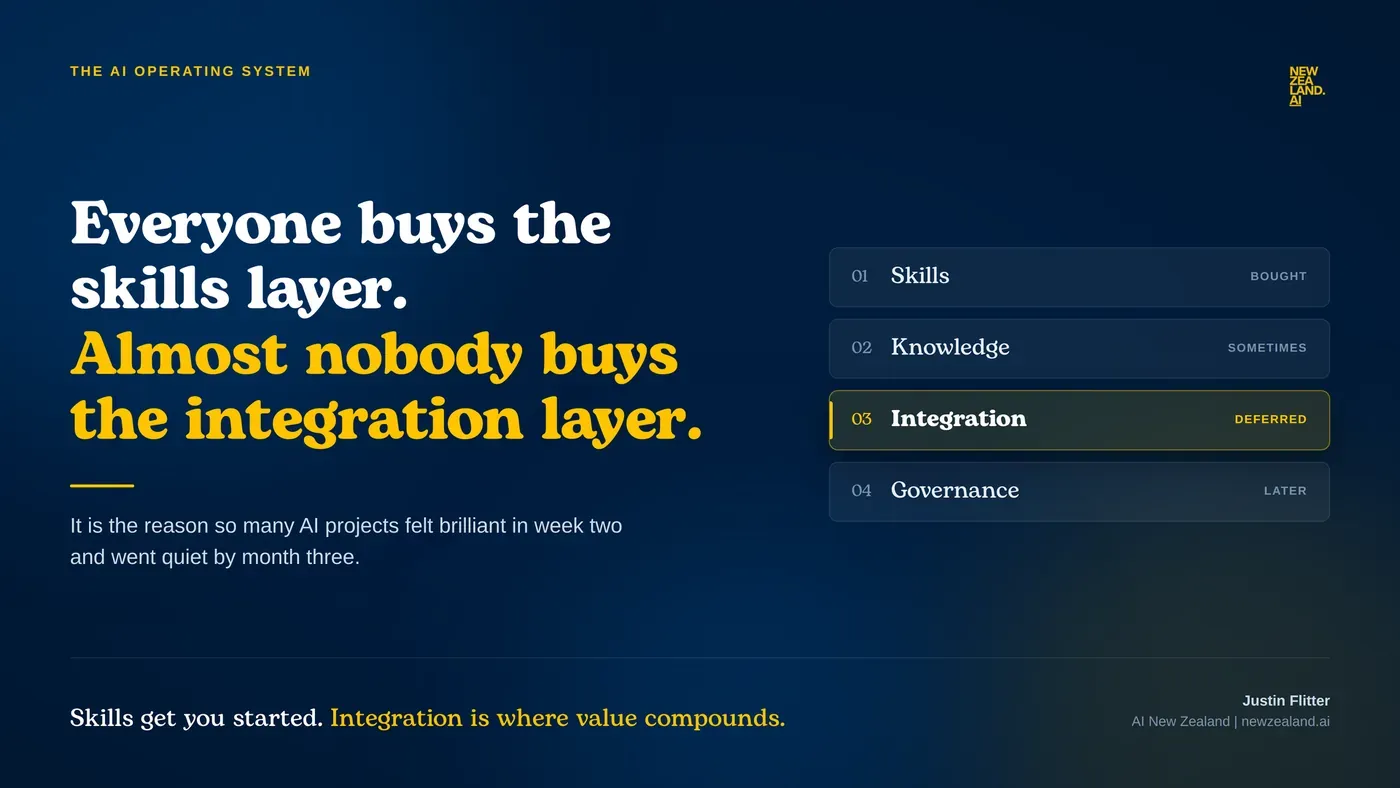
AI Operating System
Everyone is buying the skills layer. Almost nobody is buying the integration layer.
Read article →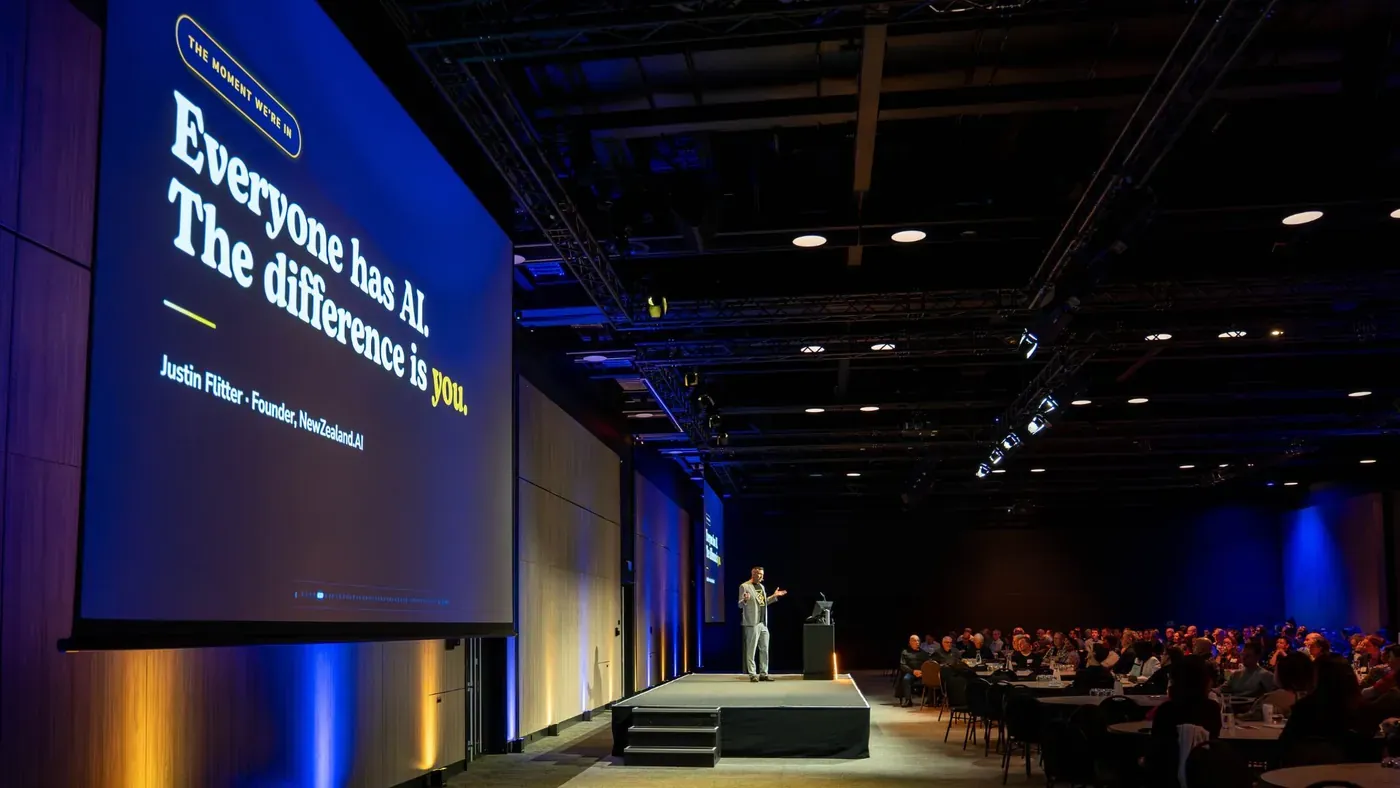
2026 AI Roadshow Notes
AI is no longer just about content generation. It is becoming operational infrastructure.
Read article →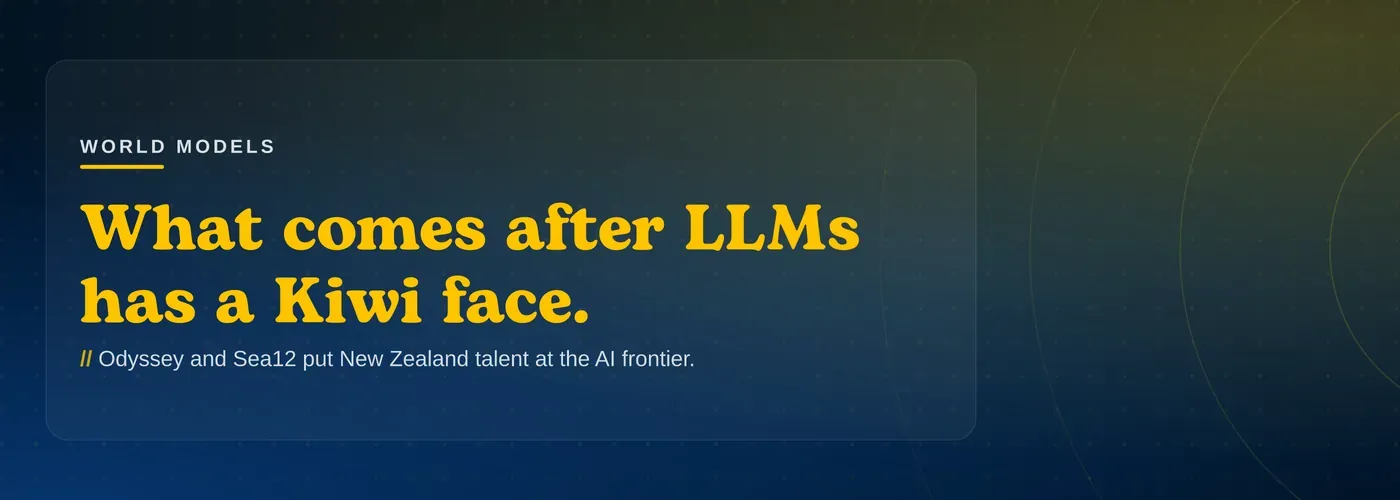
Insights
What comes after LLMs now has a New Zealand face on it.
Read article →Power up your potential with practical AI skills.
Contact us to discuss how Artificial Intelligence could boost your business.