
AI doesn't fix a broken process. It just accelerates it.
If your business senses the wrong signals, thinks in the wrong places, decides too slowly, and acts without feedback, AI simply makes you faster at doing the wrong thing.
I used to think "AI transformation" meant buying a tool, running a pilot, and waiting for the ROI graph to politely climb to the right.
That's what the sales decks implied, anyway.
I'm the GM of Operations at a mid-sized manufacturing business in New Zealand.
We make components that end up inside other people's products, which means our customers don't care about our internal dramas.
They care about delivery dates, quality, and whether we can handle the next urgent change without falling over.
And if I'm honest, for a while there, we were falling over. Regularly.
The problem wasn't information. It was how we turned it into action.
We weren't short on data. We were drowning in it.
- Orders came through email, calls, and the odd spreadsheet someone "just quickly updated".
- Production ran off an ERP system that was fine, as long as nothing unexpected happened. Which it did. Daily.
- Quality data existed, somewhere, but it took a mini-archaeological dig to find the right batch notes.
- Our most accurate forecasting tool was still "Dave's gut feel", and Dave was two years from retirement.
We tried bolting AI on top of that mess.
We bought a shiny forecasting add-on. It looked smart in demos. It was... less impressive in the real world.
Because the real world included missing fields, inconsistent part names, late updates, and a dozen micro-decisions happening in people's heads, not systems.
That's when I learned the hard lesson:
AI doesn't fix a broken operating logic. It just accelerates it.
If your business senses the wrong signals, thinks in the wrong places, decides too slowly, and acts without feedback, AI simply makes you faster at doing the wrong thing.
AI theatre. Better screenshots. Same bottlenecks.
The turning point: one late shipment, one brutal customer call.
The moment it really clicked was a Thursday afternoon in winter.
We had a key customer waiting on a shipment. Not a "nice to have" order, a line-stopping part. We had told them it would be out the door by midday.
At 1:30pm I got the call. They weren't yelling. That was the worst part. They were calm in that "we're updating our supplier list" kind of way.
I walked onto the floor and did what I always do in those moments: I started asking questions.
- Where is the job up to?
- What's holding it up?
- Who owns the decision to swap priorities when a hot order lands?
- Why didn't we know this earlier?
The answers were painful.
Everyone was doing their best. They were also operating inside an invisible system of assumptions:
- Planning will catch that.
- Stores will tell us if we're short.
- Quality will flag it if it's off.
- The supervisor will make the call.
Except "planning" was one person juggling six fires. "Stores" found out too late. "Quality" found it, but didn't know who to tell. And the supervisor didn't want to override anyone without backup, because last time they did, it became a political mess.
It wasn't incompetence. It was operating logic.
The system that determines how we sense, think, decide, and act, whether we've made it explicit or not.
Ours was basically "hope and heroics".
The solution: we stopped asking "what AI tool should we buy.
Instead, we asked a better question:
How do we want this business to sense, think, decide, and act when AI is in the loop?
We picked one high-stakes workflow to redesign: order changes and urgent jobs. The stuff that wrecked our week.
We ran a workshop with production, planning, quality, stores, and customer service. I kept it simple and a bit blunt.
On the whiteboard, I wrote four headings:
- Sense, what signals do we need early?
- Think, what interpretation, rules, and judgement gets applied?
- Decide, who decides, based on what criteria, and how fast?
- Act, what happens next, and how do we learn if it worked?
At first everyone wanted to jump to solutions. I didn't let them.
We mapped the current reality. And it was ugly, but also clarifying. We could finally see where work went to disappear.
Then we redesigned it.
Sense: we created one source of truth for "what just changed"
We stopped letting change requests live in inboxes.
Every change request became a structured entry: order number, part, quantity delta, required date, customer criticality, and "why".
No drama. No novel-length emails. Just the signal.
Think: we made judgement visible (and teachable)
This was the magic bit.
We documented the rules we were already using in our heads:
- What counts as line-stopping?
- What lead times are real, not theoretical?
- What substitutions are safe?
- What jobs must not be interrupted once started?
Then we built a lightweight AI assistant to summarise each change request, pull the relevant history (previous issues with that customer/part), and suggest options.
Not decisions. Options.
Because humans still own judgement. Human judgement becomes premium when AI commoditises answers.
Decide: we changed decision rights (and it was uncomfortable)
Previously, decisions happened through a game of organisational ping-pong.
Now, we set a rule: urgent job triage happens at 10:00am and 2:00pm daily. Fifteen minutes. Standing meeting.
The decision-maker is the shift manager with planning and quality present. Customer service is in the loop. If it impacts a key account, sales can join, but they don't get veto power just because they're loud.
Most importantly: we wrote down escalation paths. If something is above a threshold (cost, risk, customer impact), it escalates to me. Otherwise, it gets decided on the spot.
No more waiting for permission. No more "I thought someone else was handling it."
Act: we built feedback into the workflow, not into someone's memory
Every urgent change now has a simple close-out:
- What did we decide?
- Did it ship on time?
- Did it create a defect, rework, or downtime?
- What would we do differently next time?
That feedback loop feeds the knowledge base the AI assistant draws from. The system gets smarter because we designed it to learn, not because the model is magical.
What changed wasn't the tool. It was the operating logic.
Within a month, the difference was obvious.
Not because we suddenly became a "high-performing AI organisation".
But because:
- People trusted the process.
- Decisions happened faster.
- Everyone could see the same information at the same time.
- The business stopped relying on heroics.
And here's the part that surprised me: morale improved.
When operating logic is unclear, people feel like they're failing even when they're working hard. When it's explicit, they can win. They can improve it. They can teach it to new starters. They can scale it.
AI didn't replace our team.
It made the best parts of our team, experience, judgement, context, repeatable.
Why it matters: AI is a force multiplier, not a rescue boat.
If your operating logic is messy, AI multiplies the mess.
If it's clear, measurable, and designed for learning, AI becomes infrastructure.
That's the difference between:
- a pilot that looks good in a slide deck, and
- an operating model that actually runs better on Monday morning.
Most businesses don't need "more AI use cases".
They need to decide, deliberately, how decisions get made when AI is in the room.
Because the real strategy question isn't "Which tool should we buy?"
It's: "How do we want this business to sense, think, decide, and act in an AI-rich world?"
Action steps: if you're leading ops, do this next week.
Pick one workflow that regularly causes pain
- Choose something with real consequences: delivery slippage, quality escapes, overtime blowouts, customer churn.
Map the Sense–Think–Decide–Act loop with the people doing the work
- Not managers guessing. The actual humans in the loop.
Make decision rights explicit
- Who decides what, how fast, with what information, and what gets escalated.
Add AI only after the logic is clear
- Use AI to summarise, retrieve context, and propose options. Keep humans accountable for judgement.
Build the feedback loop
- If you're not capturing outcomes, you're not learning. If you're not learning, you're doing AI theatre.
If you want a simple template, Justin can share the one he uses for mapping Sense–Think–Decide–Act, and the guardrails that stop "smart suggestions" turning into dumb automation.
Continue reading
More from AI New Zealand.
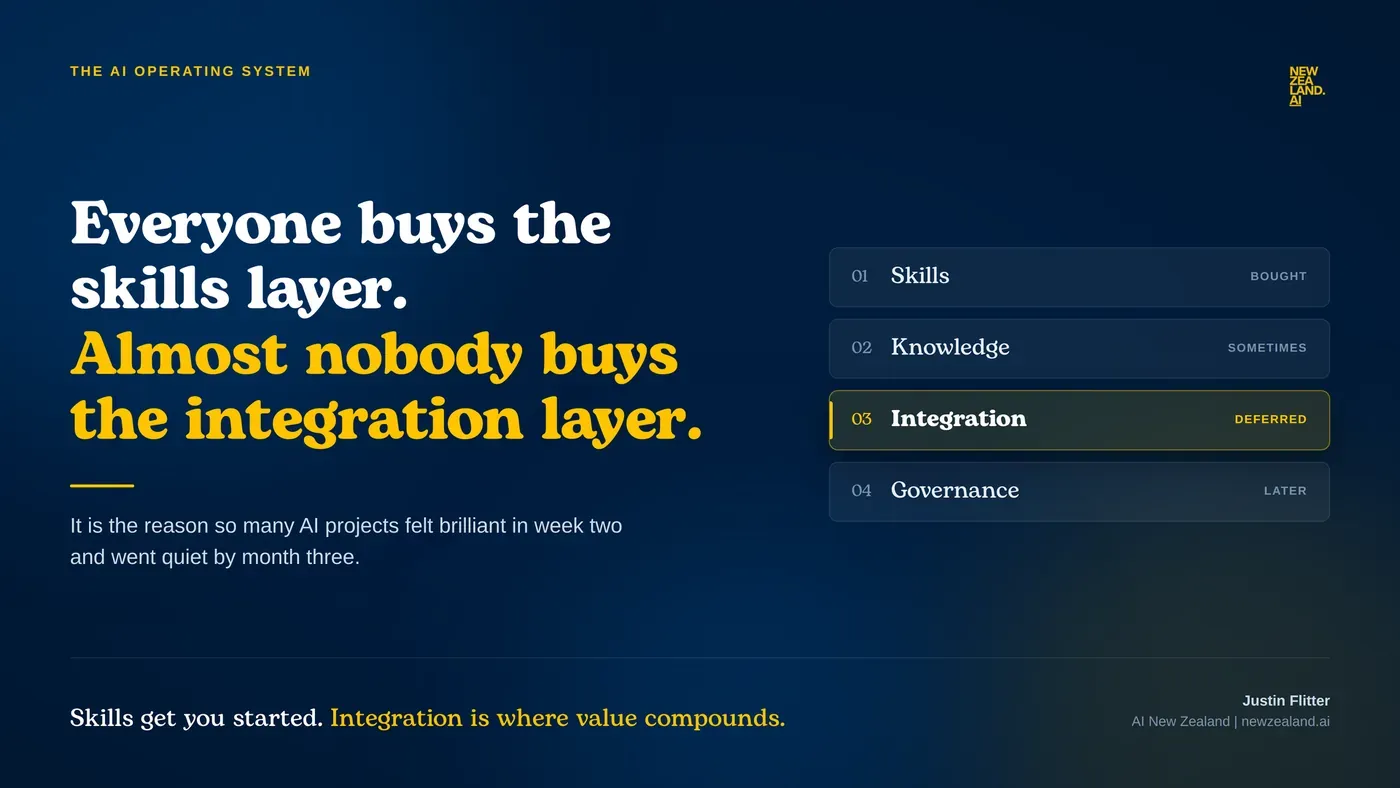
AI Operating System
Everyone is buying the skills layer. Almost nobody is buying the integration layer.
Read article →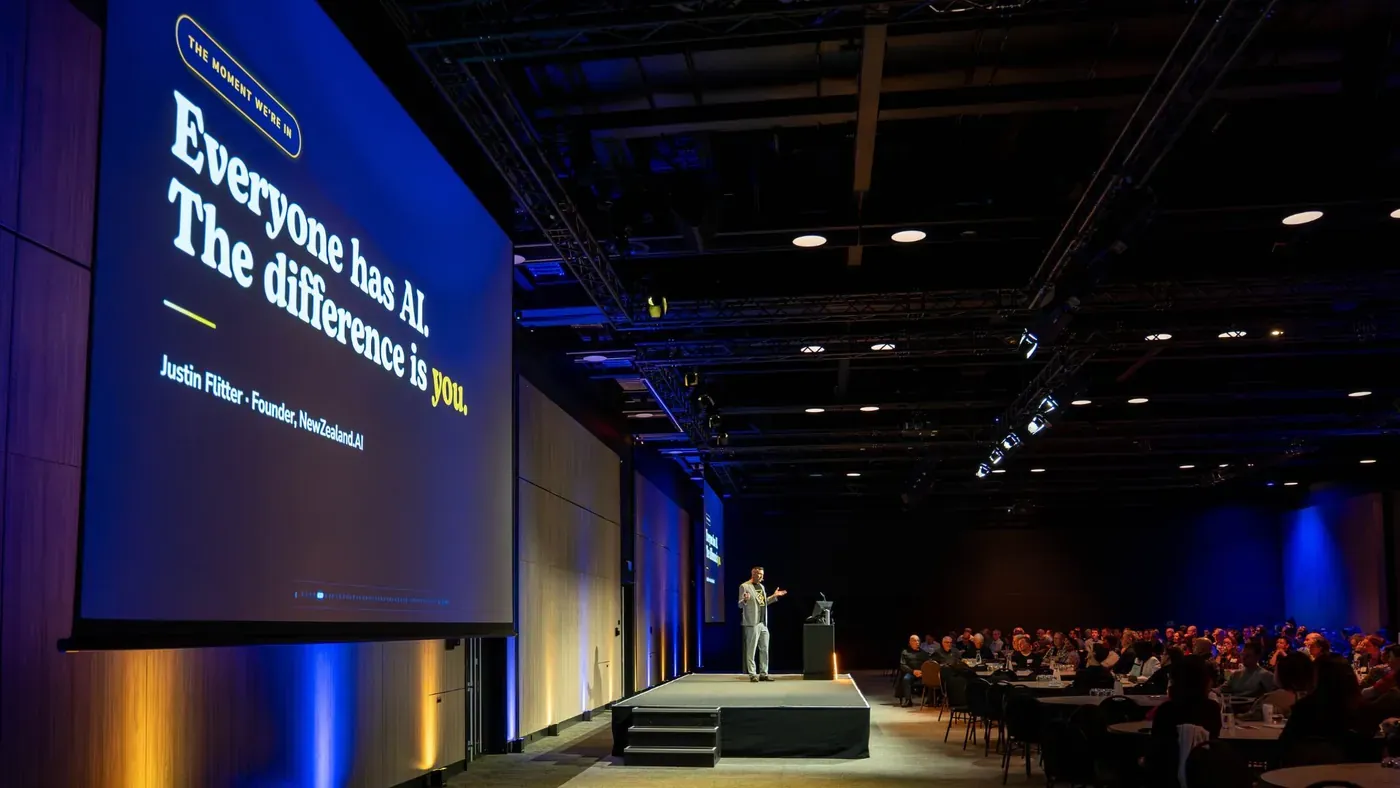
2026 AI Roadshow Notes
AI is no longer just about content generation. It is becoming operational infrastructure.
Read article →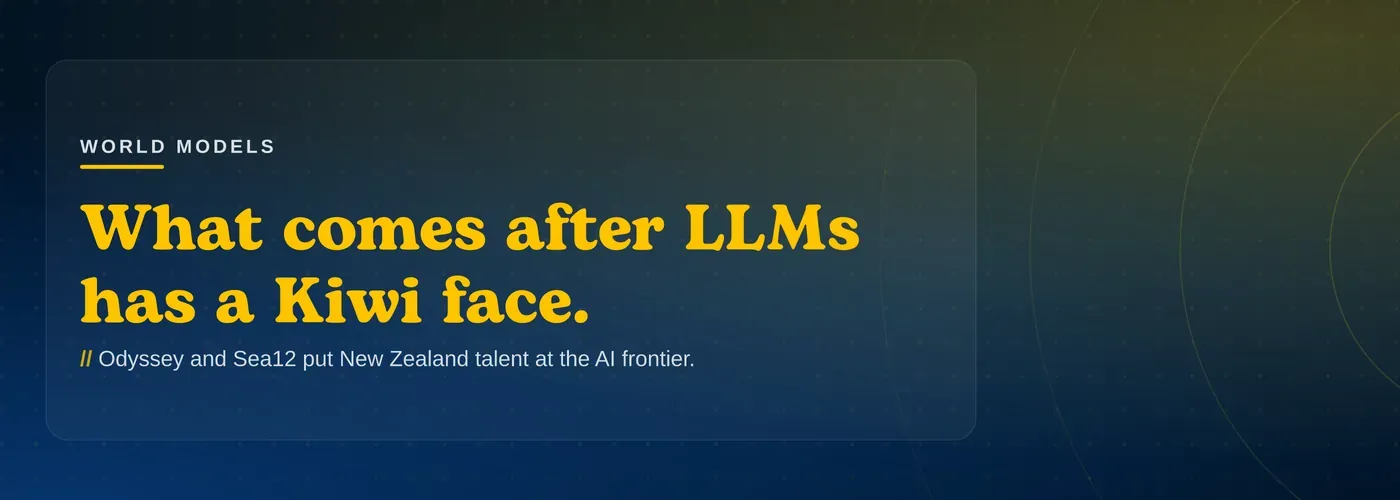
Insights
What comes after LLMs now has a New Zealand face on it.
Read article →Power up your potential with practical AI skills.
Contact us to discuss how Artificial Intelligence could boost your business.