
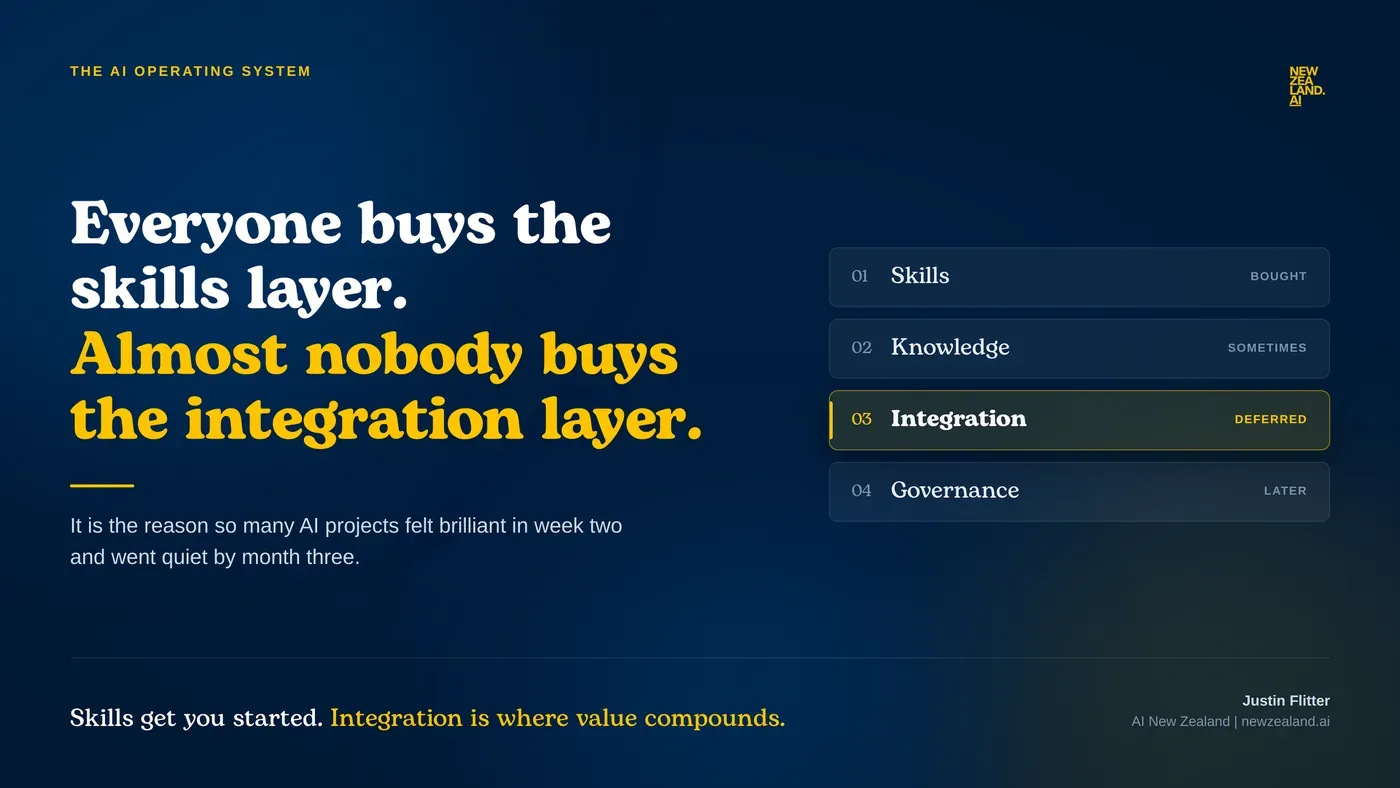
Integration is the layer nobody buys. It's the only one that pays.
Most AI programmes in New Zealand right now are one training session and a lot of hope.
The session goes well. People leave energised. A few of them go home and do something genuinely impressive with it.
Then six weeks later you ask how it is going and the answer is a slightly awkward "yeah, good, when I remember".
That is not a motivation problem, and it is definitely not a people problem.
It is a design problem. The AI is sitting in a different place from the work.
The tab tax
Think about what actually happens when AI lives in its own browser tab.
Someone is in the job management system, or the practice software, or the ledger, doing a task they do every week.
To use AI they have to stop, switch, copy the relevant context out, paste it in, prompt, read, and paste the result back where it belongs.
Every step is small. None of them is hard. Together they cost a little act of willpower, and they cost it every single time.
Willpower is not a strategy. Some weeks your team has it. Most weeks they have a deadline, a sick kid, and a client chasing a variation.
So usage does not spread. It concentrates in the two or three people who were always going to push through the friction. Their output gets sharper. Everyone else drifts back to how they did it before.
The gap inside your own business widens, quietly, month after month.
That's not an adoption problem. It's an operating model problem.
The four stages, and where most firms are stuck
There is a fairly reliable arc that businesses move through.
- Individual experimentation. A few people are using AI on the side of their actual job. Results vary wildly and nothing is shared.
- Policies and basic training. A workshop runs. A policy lands. Behaviour barely shifts.
- Scattered tool adoption. Copilot is switched on, someone has ChatGPT, someone else prefers Claude. This stage feels like progress and is actually the riskiest one. It is hard to govern and harder to measure.
- A shared AI operating system. Your methodology, your voice and your workflows encoded once, connected to your real systems, used by everyone, improved every month.
Almost every business I talk to is somewhere in stages two and three. And almost every one of them is planning more of stage two, because training is the thing that is easy to buy.
Stage four is where the value compounds.
The bridge between them is integration.
What integration actually means
An AI operating system has four layers.
- Skills are the workflows configured for the outputs your team produces every week. Proposals. Client updates. Reports. Meeting minutes.
- Knowledge is your methodology, templates, past work and tone of voice, captured once so quality does not depend on who happens to be at the keyboard.
- Integration is the connection to the systems where work actually lives. Microsoft 365, SharePoint, your CRM, Teams, your industry platform.
- Governance is the permissions, the versioning and the guardrails. AI drafts. Humans approve.
Firms buy Skills readily because it feels like progress and you can see it in a calendar invite. Some buy Knowledge. Integration gets deferred, because it sounds like an IT project with a business case attached.
It usually is not. Integration rarely means a rebuild. It means one workflow, one connection, one point where the AI reaches the system of record instead of a person copying and pasting into it.
A scene you will recognise
A mid-sized services business, around twenty staff, upper North Island. Good people, busy, well run.
They had done the training. Two of the team were flying. The rest had gone quiet.
The weekly bottleneck was not glamorous. It was turning site notes and email threads into client-ready updates. Roughly a day and a half of someone's week, spread across five people in fifteen minute chunks nobody was counting.
The fix was not a better prompt. It was connecting the drafting workflow to the place the source material already lived, so the AI could see the notes and the past updates without anyone assembling a context pack first.
The task did not disappear. It became review instead of production. AI drafts, a human applies judgement, the update goes out sharper than it used to and hours earlier.
Not miraculous. Real.
The economics, plainly
Indicatively, we see somewhere in the order of $10,000 of recovered value per person per year when a team moves from scattered tools to a connected system. Treat that as a planning number, not a promise. Your mix of work will move it either direction.
The important part is not the figure. It is where the figure comes from. It does not come from people being better at prompting. It comes from removing the friction between the thinking and the system, so the good work happens by default rather than by effort.
The sweet spot is roughly 25 to 50 staff. Big enough to feel the cost of inconsistency, small enough to change how things run without a committee.
What to do next week
None of this needs a budget round to start.
- Count the copy and pastes. Sit with one person doing one recurring task with AI. Every copy and paste is a place the work is leaking.
- Pick the single workflow with the most handoffs, not the one with the most enthusiasm behind it.
- Ask what the AI would need to see to do the first draft properly. That answer is your integration spec, and it is usually shorter than people expect.
- Name the number. Cycle time, cost to serve, hours to client-ready. One lever, with a baseline. Move a metric, not a use case.
- Set the guardrail before you connect anything. What the AI may draft, what a human must approve, what it must never touch on its own.
The shift to make
The next competitive edge for New Zealand businesses will not come from one person being brilliant at prompting.
It will come from firms that have connected AI to how they actually work, so the capability belongs to the business rather than to whoever happened to attend the workshop.
Skills get you started. Integration is where value compounds.
That's an operating system. That's the move.
Continue reading
More from AI New Zealand.

Power up your potential with practical AI skills.
Contact us to discuss how Artificial Intelligence could boost your business.