
AI Doesn't Fix Broken Plumbing. It Floods the House.
The invisible foundation every business needs before AI can deliver real value.
Most businesses talking about AI are not short on ambition. They're short on infrastructure. Not servers and GPUs, the operational infrastructure that determines whether information flows or gets stuck.
Document management that lives in people's heads. Data trapped in inboxes. Meeting decisions that never make it into any system. Standard operating procedures that don't exist, or exist but nobody follows.
This is the real AI readiness gap. And no amount of prompt engineering will close it.
What's Changing, and What's at Risk
- Data silos are not just inconvenient, they're expensive. IDC research shows companies lose 20–30% of revenue annually to inefficiencies caused by disconnected systems. McKinsey estimates data silos cost businesses US$3.1 trillion globally in lost productivity.
- Shadow AI is already inside your organisation. 68% of employees use free-tier AI tools via personal accounts, with 57% inputting sensitive company data. That's not innovation, it's uncontrolled IP leakage.
- Manual information processing is a hidden tax. Workers lose an average of 12 hours per week searching for information trapped in silos. People hired simply to export data from one system, modify it, and import it into another, a never-ending cycle of copy, paste, reconcile.
- Meeting intelligence is leaking out the door. Notes jotted on paper. Free transcription tools sending recordings to third-party servers that may train public AI models. Vendor terms that allow data to be shared with affiliates. Every unmanaged meeting tool is a confidentiality risk.
- AI amplifies whatever it finds. If your data is scattered, inconsistent, and ungoverned, AI will generate scattered, inconsistent, and ungoverned outputs, faster. AI doesn't fix broken processes. It accelerates them.
The question is not "Which AI tool should we buy?" It's "Is our organisation structured so that AI can actually find, trust, and use our information?"
The Infrastructure Gap, What Businesses Get Wrong
When leaders say "infrastructure" they think about IT hardware. That's not the infrastructure holding most businesses back. The real gaps are operational:
1. No single source of truth
Critical documents, contracts, invoices, proposals, standard operating procedures, live in Outlook inboxes, personal drives, and desktop folders. Nobody can find the latest version. Nobody knows which version is authoritative. When AI agents try to retrieve information, they find nothing, because the information isn't in any system AI can access.
2. No document and data management standards
Employees aren't saving files to SharePoint or a centralised system because no one has told them to. There's no standard naming convention, no folder structure, no retention policy. It's not a technology problem, it's a governance gap. And it means your organisational knowledge is held hostage by individual habits.
3. Cobbled-together systems with disparate data
The typical mid-size business runs dozens of disconnected apps. CRM, accounting, project management, HR, email, file storage, none of them talking to each other. People become the integration layer. Their job is to be the human API: export from system A, reformat in Excel, import into system B. It's fragile, error-prone, and completely invisible on any balance sheet.
4. Meeting intelligence disappears
Decisions made in meetings rarely make it into a system of record. Handwritten notes get lost. Free transcription tools create transcripts that sit on third-party servers, disconnected from your organisational knowledge, exposed to vendor data-use policies, and unavailable when an AI assistant could actually use them. This is both an IP leakage risk and a knowledge management failure.
5. No governance for AI tool use
Without sanctioned tools and clear policies, employees will, and do, use whatever free AI tool they can find. They paste customer data into ChatGPT. They upload contracts to unvetted summarisation tools. They don't do this maliciously. They do it because no one gave them a better option.
The Four Foundations of AI-Ready Infrastructure
Before any AI tool can deliver real business value, four operational foundations must be in place. Think of these as the plumbing, wiring, and building code that make the house functional, long before you choose the furniture.
Foundation 1: Sense, One Source of Truth
- Centralise documents in a governed system (e.g. SharePoint, Google Drive, or equivalent) with clear folder structures, naming conventions, and access controls.
- Automate extraction: invoices, contracts, and key documents should flow into the system without relying on individuals to remember to save them.
- Establish a retention and version control policy. If people can't trust the system has the latest version, they won't use it.
Foundation 2: Think, Connected and Clean Data
- Audit your systems. Map where data lives, how it moves between systems, and where humans are acting as the integration layer.
- Prioritise integration over replacement. Connect your existing tools through automation platforms (e.g. Zapier, Power Automate, make.com) before buying new ones.
- Establish data quality standards. AI outputs are only as reliable as the data they draw from. Garbage in, garbage out, just faster.
Foundation 3: Decide, Governance and Guardrails
- Publish an AI acceptable use policy. Specify which tools are sanctioned, what data can and cannot be shared with AI, and who is responsible for reviewing AI-generated outputs.
- Replace shadow AI with sanctioned alternatives. If your people need meeting transcription, give them a tool that keeps data inside your organisation, not one that sends it to a third party to train public models.
- Define decision rights: what AI can draft, what humans must review, and what must never be delegated.
Foundation 4: Act, Standard Operating Procedures
- Document the workflows that matter most. Start with 3–5 high-volume, high-value processes and write them down.
- Train your people. Not on AI tools, on the operational disciplines that make AI tools effective: where to save files, how to name them, when to use which system.
- Build feedback loops. Measure whether the foundations are being followed, and refine them quarterly.
Three Decisions You Need to Make This Quarter
- Appoint an owner for information architecture. Not an IT project, a business accountability. Someone must own how your organisation stores, structures, and governs its documents and data. Without an owner, nothing changes.
- Audit and standardise your document management. Pick your platform (most New Zealand businesses already have SharePoint or Google Drive). Define the folder structure, naming conventions, and access policies. Communicate them. Enforce them. This is the single highest-ROI action most organisations can take before investing in AI.
- Publish an AI governance policy. Specify sanctioned tools. Ban the use of free-tier personal AI accounts for company data. Provide clear guidance on what information can be shared with AI and what cannot. Make the policy short, practical, and enforceable.
AI commoditises answers. Human judgement becomes premium.
But judgement needs information it can trust. And right now, most organisations can't even find theirs.
Fix the infrastructure. Then let AI do what it does best.
Continue reading
More from AI New Zealand.
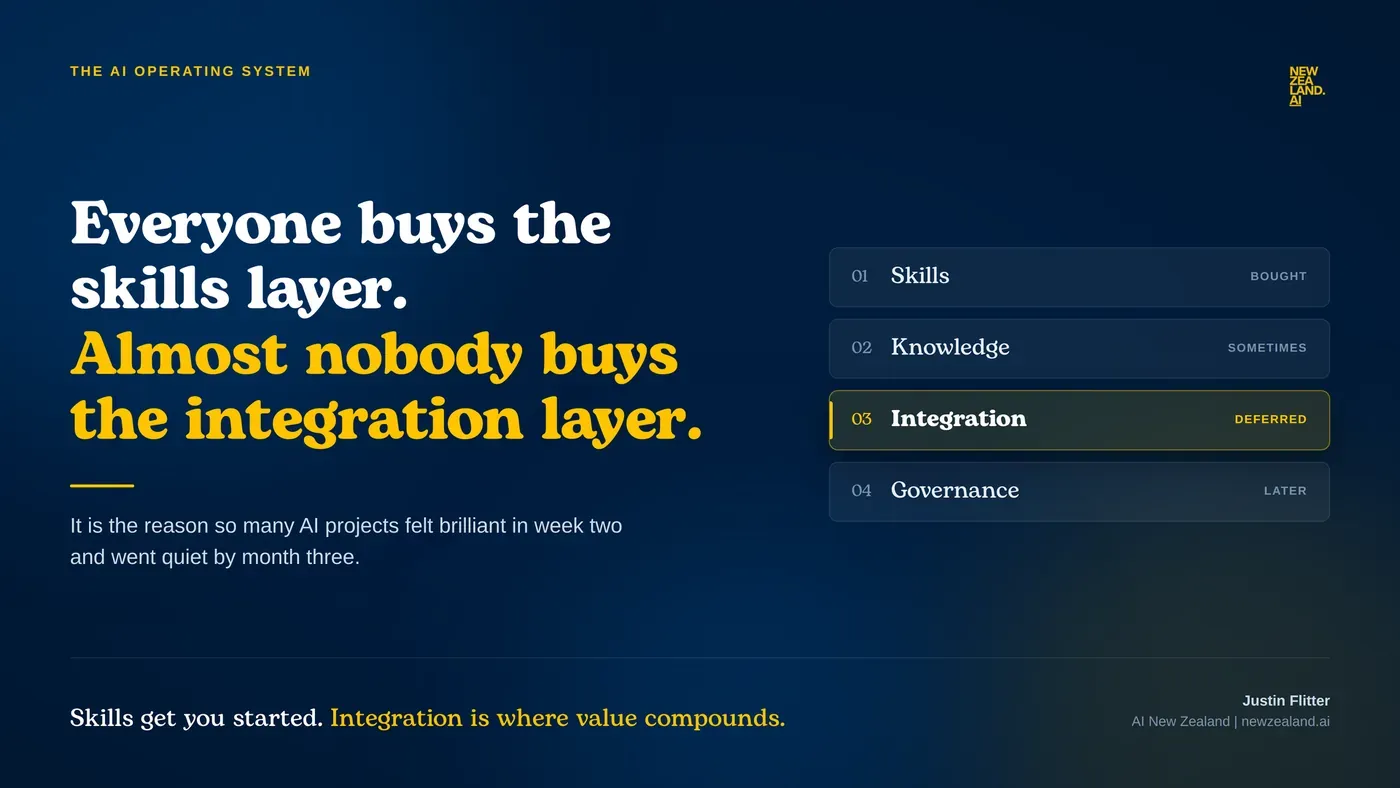
AI Operating System
Everyone is buying the skills layer. Almost nobody is buying the integration layer.
Read article →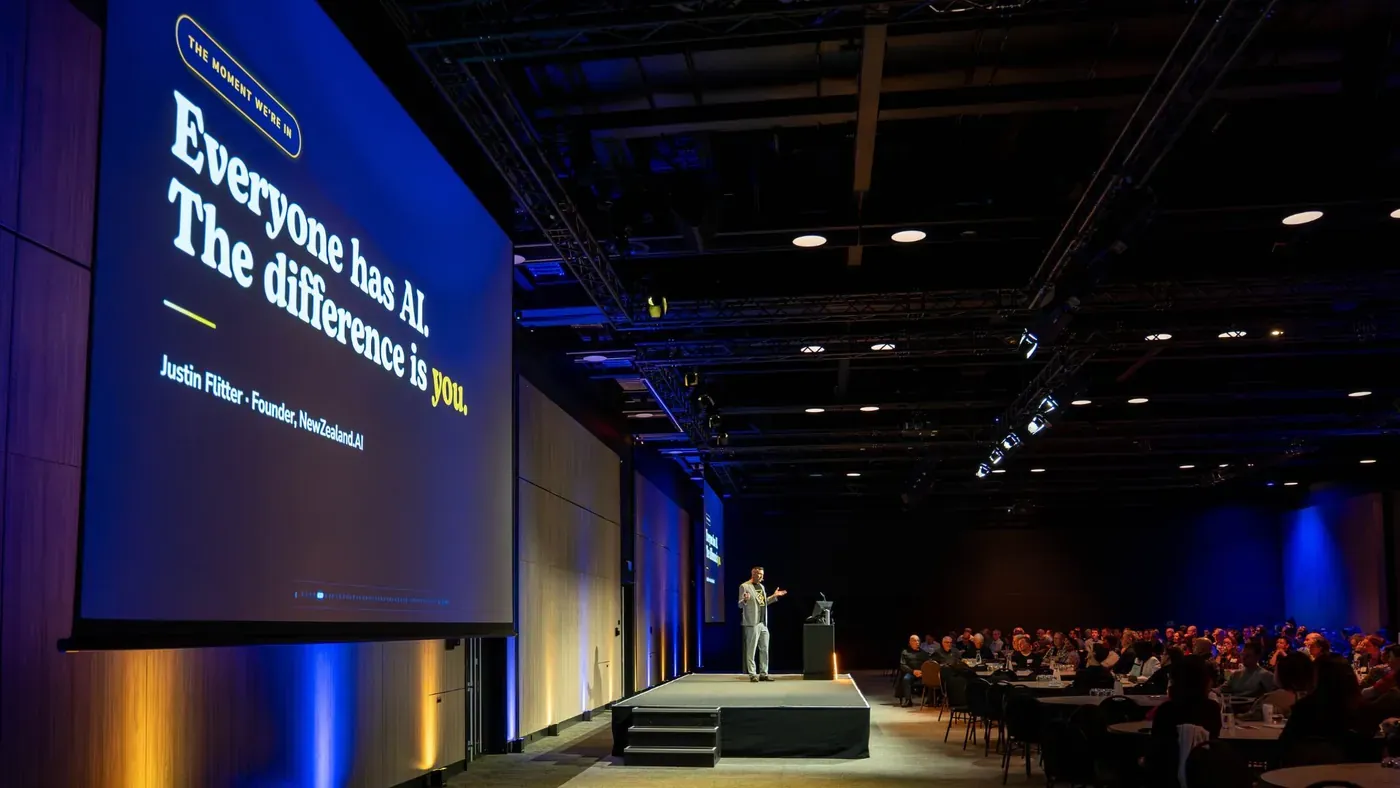
2026 AI Roadshow Notes
AI is no longer just about content generation. It is becoming operational infrastructure.
Read article →
Insights
What comes after LLMs now has a New Zealand face on it.
Read article →Power up your potential with practical AI skills.
Contact us to discuss how Artificial Intelligence could boost your business.