
How to Choose AI Tools for Your Business: A 2026 Comparison Framework for New Zealand Leaders
3 February 2026
How to Choose AI Tools for Your Business: A 2026 Comparison Framework for New Zealand Leaders
The vendor called it "AI-powered transformation." The CFO called it "another subscription we can't measure."
Both were right.
Across New Zealand in early 2026, business leaders face a peculiar challenge: AI tools are everywhere, vendor promises are bold, and yet most organisations still can't answer the question that actually matters - which number will this move, and by how much?
This isn't a buying guide. It's a framework for making AI tool decisions that survive contact with your actual business - the one with tight margins, seasonal demand swings, compliance requirements, and people who already have full workloads.
The question isn't "What can this AI do?" It's "What must our business improve, and is this the right tool to move that specific metric?"
The Real Problem: Tools Before Thinking
According to Stats NZ's 2025 Digital Technologies Survey, 43% of New Zealand businesses reported experimenting with AI tools in 2024–2025. Yet fewer than 18% could demonstrate measurable business outcomes tied to those experiments.
The gap isn't capability. It's clarity.
Most AI tool selection processes start in the wrong place:
- Vendor demos showcasing features
- Peer pressure ("Our competitor just announced they're using X")
- IT teams evaluating technical specifications
- Executives asking "What's our AI strategy?"
None of these start with the question that matters: What specific business outcome are we trying to improve?
The Cost of Tool-First Thinking
A mid-sized NZ manufacturing business spent $47,000 on an AI-powered inventory forecasting tool in 2025. The tool was technically excellent. It integrated with their ERP system. It produced beautiful dashboards.
But their real bottleneck wasn't forecast accuracy, it was the three-day lag between forecast changes and procurement adjustments. The AI made better predictions, but the operating logic stayed the same. Forecasts still sat in email chains waiting for approval.
Cycle time didn't budge. Working capital stayed locked up. The tool worked perfectly. The business outcome didn't move.
That's the trap.
The Four-Question Framework: Before You Evaluate Any Tool
Before you compare features, pricing, or vendor claims, answer these four questions. If you can't answer them clearly, you're not ready to choose a tool.
Question 1: Which Value Lever Are You Moving?
AI tools don't create value in the abstract. They move specific business metrics. There are five core value levers every AI initiative should target:
- Revenue – Increase sales, improve conversion, expand customer lifetime value
- Cost-to-serve – Reduce operational cost per transaction, customer, or unit delivered
- Cycle time – Compress time from trigger to outcome (quote to cash, inquiry to resolution, variation to approval)
- Risk – Reduce error rates, compliance failures, fraud, safety incidents
- Customer experience – Improve satisfaction, retention, NPS, effort scores
Pick one primary lever. Name the specific metric. Define the baseline and target.
Example (good):
- Lever: Cycle time
- Metric: Days from customer variation request to approved quote
- Baseline: 4.2 days (measured Q4 2025)
- Target: Under 2 days within 90 days
- Owner: GM Operations
Example (bad):
- "Improve customer service with AI"
- "Increase efficiency"
- "Transform our operations"
If you can't name the metric, you can't measure success. And if you can't measure success, you can't choose the right tool.
Question 2: What's the Real Bottleneck?
AI accelerates workflows. If the workflow is broken, AI scales the breakage.
A New Zealand professional services firm implemented an AI meeting transcription tool in late 2025. Transcripts were accurate and fast. But the real bottleneck wasn't capturing what was said - it was deciding what to do with it.
Meeting notes piled up. Action items stayed unclear. Accountability didn't improve. The tool worked. The operating logic didn't.
Before choosing any tool, map the current workflow:
- Where does work wait?
- Where do errors happen?
- Where does judgement get applied?
- Where do handoffs break down?
According to Deloitte's 2025 AI Adoption Report for Asia-Pacific, 62% of failed AI implementations were attributed to "process and workflow misalignment," not technical failure.
The AI didn't fail. The business wasn't ready.
Question 3: Where Does Human Judgement Stay in the Loop?
In 2026, AI boundaries are clearer than ever:
- AI drafts → humans approve
- AI structures → humans verify
- AI flags → humans decide
Any tool that removes human judgement from high-stakes decisions introduces risk. Any tool that buries human judgement in volume introduces fatigue.
The question isn't "Can AI do this?" It's "Should AI do this, and where does human oversight happen?"
Critical thinking is your competitive moat.
AI commoditises answers. Judgement is what differentiates your business from every competitor using the same tools.
When evaluating tools, ask:
- What does the AI influence vs. what does it decide?
- Where are override and escalation paths?
- How is human judgement made visible and teachable?
- What happens when the AI is confidently wrong?
A 2025 Stanford HAI study found that professionals using AI without structured review processes were 34% more likely to accept contextually incorrect outputs - outputs that were factually accurate but strategically wrong.
Not factually wrong. Contextually wrong.
That's the risk.
Question 4: How Will You Measure This Weekly?
Quarterly ROI reviews are AI theatre. By the time you realise something isn't working, you've lost three months and momentum.
Measurement must be:
- Weekly (at minimum, daily for high-velocity workflows)
- Tied to the value lever (the metric you named in Question 1)
- Owned by someone (not "the AI team", the business owner accountable for that metric)
No vanity metrics. No "number of prompts used." Just business numbers.
Example measurement plan:
- Lever: Cost-to-serve (customer support)
- Metric: Average handle time per inquiry
- Baseline: 8.3 minutes (Dec 2025)
- Target: Under 6 minutes by March 2026
- Tracking: Weekly dashboard, reviewed every Monday with support lead
If you can't commit to weekly tracking, the initiative isn't a priority. And if it's not a priority, don't buy the tool.
The 2026 AI Tool Landscape: What's Actually Different
The AI tool market in 2026 is maturing rapidly. Here's what's changed from 2023–2024:
Consolidation and Integration
Standalone point solutions are giving way to integrated suites.
According to Gartner's 2026 AI Market Forecast, 58% of enterprise AI spending is now on platforms that combine multiple capabilities (e.g., Microsoft Copilot, Google Workspace AI, Salesforce Einstein).
What this means for NZ businesses:
- Favour tools that integrate with your existing tech stack (Microsoft 365, Google Workspace, Xero, MYOB, Salesforce)
- Evaluate whether a general-purpose AI assistant (ChatGPT Enterprise, Claude for Work) meets 70%+ of your needs before buying niche tools
Watch for vendor lock-in - can you export data and switch if needed?
Regulation and Compliance
New Zealand's Privacy Act 2020 applies to AI-generated outputs. The Commerce Commission's 2025 guidance on AI and consumer protection clarified liability for AI-driven decisions in customer-facing contexts.
What this means:
- Tools handling personal data must meet NZ privacy standards
- Audit trails and explainability matter more in regulated industries (finance, health, legal)
- If you're in a high-stakes domain, prioritise tools with citation and source-tracking (e.g., AI that shows its work)
Cost Structures Are Shifting
Pricing models in 2026 range from per-seat subscriptions to usage-based (per API call, per token, per transaction). A PwC New Zealand survey found that 41% of businesses underestimated AI tool costs by more than 30% in their first year due to usage-based pricing surprises.
What this means:
- Model realistic usage before committing
- Factor in training, integration, and change management costs (often 2–3× the license cost)
- Start small, measure, scale - don't over-commit upfront
- Tool Comparison Framework: Evaluating Your Shortlist
Once you've answered the four questions, you're ready to evaluate specific tools.
Use this framework to compare options.
Capability Fit (40% weighting)
- Does it directly address the value lever you named?
- Does it integrate with your current systems (CRM, ERP, email, Slack, etc.)?
- Can it handle NZ-specific context (spelling, regulations, time zones, business norms)?
Operating Logic Fit (30% weighting)
- Where does human judgement stay in the loop?
- Can you configure approval, override, and escalation workflows?
- Does it make decisions transparent and auditable?
Measurement and Control (20% weighting)
- Can you track the metric you care about weekly?
- Does it provide usage data, error rates, and outcome tracking?
- Can you export data for independent analysis?
Cost and Risk (10% weighting)
- What's the total cost (license + integration + training + ongoing management)?
- What's the exit cost if it doesn't work?
- Does the vendor have NZ presence or support in NZ-friendly time zones?
Common AI Tool Categories and When to Use Them
Here's a practical breakdown of common AI tool categories, mapped to value levers and use cases relevant to New Zealand businesses.
Generative AI Assistants (ChatGPT, Claude, Gemini, Copilot)
Best for:
- Drafting content (emails, reports, proposals, policies)
- Structuring unstructured information (meeting notes, research, customer feedback)
- Rapid prototyping (business cases, process maps, brainstorming)
Value levers: Cycle time, cost-to-serve
NZ context: Works well for professional services, marketing, HR, legal drafting. Requires strong critical thinking to catch contextual errors.
Watch out for: Over-reliance without review; confidently wrong outputs in specialised domains.
Customer Service AI (Zendesk AI, Intercom, Ada, Freshdesk AI)
Best for:
- Handling high-volume, repetitive inquiries
- Routing and triaging support tickets
- Providing 24/7 first-response capability
Value levers: Cost-to-serve, customer experience, cycle time
NZ context: Effective for e-commerce, SaaS, utilities, telcos. Ensure escalation to humans for complex or sensitive issues.
Watch out for: Generic responses that frustrate customers; lack of NZ-specific knowledge (public holidays, regional nuances).
Sales and CRM AI (Salesforce Einstein, HubSpot AI, Pipedrive AI)
Best for:
- Lead scoring and prioritisation
- Email automation and follow-up sequencing
- Forecasting and pipeline analysis
Value levers: Revenue, cycle time
NZ context: Useful for B2B sales teams, real estate, recruitment. Works best when CRM data is clean and current.
Watch out for: Garbage in, garbage out - AI can't fix poor data hygiene.
Document and Knowledge AI (Notion AI, Glean, Guru, SharePoint AI)
Best for:
- Searching internal knowledge bases
- Summarising long documents (contracts, reports, research)
- Answering employee questions from company content
Value levers: Cycle time, cost-to-serve (internal)
NZ context: High value for organisations with dispersed teams, complex compliance docs, or high onboarding costs.
Watch out for: Requires well-organised, up-to-date source content; hallucination risk if sources are incomplete.
Process Automation AI (UiPath AI, Automation Anywhere, Microsoft Power Automate AI)
Best for:
- Automating repetitive data entry, reconciliation, reporting
- Extracting information from invoices, forms, emails
- Triggering workflows based on conditions
Value levers: Cost-to-serve, cycle time, risk (error reduction)
NZ context: Strong fit for finance, logistics, government services, insurance. ROI often clear and measurable.
Watch out for: Brittle if underlying processes change frequently; requires IT support for setup and maintenance.
Industry-Specific AI (legal AI, medical AI, accounting AI, etc.)
Best for:
- Specialised tasks requiring domain knowledge (contract review, diagnostic support, tax compliance)
Value levers: Risk, cycle time, cost-to-serve
NZ context: Evaluate NZ regulatory alignment carefully (e.g., legal AI trained on US law may not apply). Favour NZ vendors or those with local partnerships.
Watch out for: High cost, long integration timelines, vendor lock-in.
Your 7-Day Action Plan: Choosing the Right AI Tool
Here's what to do this week to move from vendor demos to real decisions:
Pick one value lever. Choose revenue, cost-to-serve, cycle time, risk, or customer experience. Name the specific metric you'll move.
Define baseline and target. Measure where you are now. Set a 90-day target that's ambitious but realistic.
Map the current workflow. Draw out the steps, handoffs, wait times, and decision points. Identify the real bottleneck.
Clarify human-in-the-loop boundaries. Decide what AI influences, what requires review, and what stays human-only.
Shortlist 2–3 tools. Use the comparison framework (capability fit, operating logic fit, measurement, cost/risk). Favour tools that integrate with your existing stack.
Run a 30-day pilot. Test with a small team on a real workflow. Track the metric weekly. Adjust or kill fast.
Scale or stop. If the metric moves, scale. If it doesn't, stop and reassess. Don't let sunk cost drive bad decisions.
The Bottom Line: Tools Don't Create Value - Decisions Do
Over the next 12 months, New Zealand businesses will spend millions on AI tools. Some will move metrics. Most will sit unused or underutilised.
The difference won't be the tool. It'll be the thinking that came before the purchase.
AI doesn't fix broken processes. It accelerates them. AI doesn't replace judgement. It commoditises answers and makes human judgement premium.
The businesses that win in 2026 won't be the ones with the most AI tools. They'll be the ones that ask better questions:
- Which number are we moving?
- Where's the real bottleneck?
- Where does human judgement stay in the loop?
- How will we measure this weekly?
Answer those questions first. Then choose the tool.
And if you can't answer them, you're not ready to buy anything.
"AI use cases" are a distraction. Here's what we did instead.
From AI Theatre to Real Impact: A NZ Financial Services Story.
Contact us to discuss how Artificial Intelligence could boost your business.
Continue reading
More from AI New Zealand.
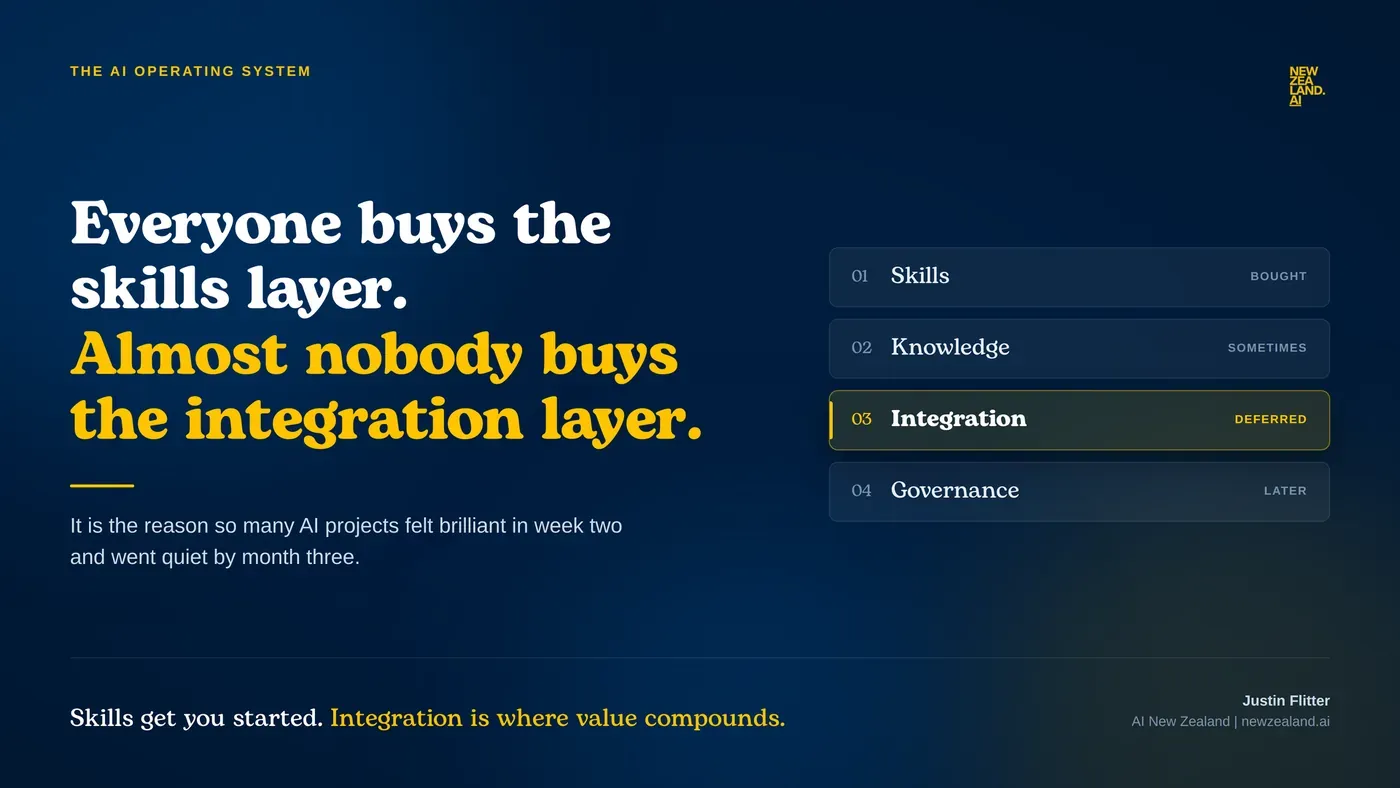
AI Operating System
Everyone is buying the skills layer. Almost nobody is buying the integration layer.
Read article →
2026 AI Roadshow Notes
AI is no longer just about content generation. It is becoming operational infrastructure.
Read article →
Insights
What comes after LLMs now has a New Zealand face on it.
Read article →Power up your potential with practical AI skills.
Contact us to discuss how Artificial Intelligence could boost your business.