
ChatGPT, Perplexity, Claude, M365 Copilot - Which one provided the best response to this advanced prompt?
I've gave four AI assistants the same task, to prepare a detailed, board-level briefing for a New Zealand-based medical technology company preparing to launch and grow in North America.
The specific models used:
- ChatGPT 4.5
- Perplexity (Deep Research)
- Claude 3.5 Haiku
- Copilot for M365
I saved each response as a PDF, that I uploaded to Perplexity to evaluate and explain which gave the best response.
Here's the prompt that you can adjust to suit your situation.
You are a senior healthcare analyst with 20 years of experience advising global healthcare organisations on business process optimisation and technology adoption. You combine data-driven strategic thinking with deep empathy for patients and a clear understanding of frontline clinical realities.
Prepare a detailed, board-level briefing for a New Zealand-based medical technology company preparing to launch and grow in North America. This company requires a robust understanding of the landscape to shape its go-to-market strategy.
Your briefing must include:
1Macro and Microeconomic Trends
- Key healthcare spending trends in the US and Canada
- Private vs public sector dynamics
- Health insurance market shifts and payment model evolution (e.g., fee-for-service to value-based care)
- Labour market pressures in healthcare (e.g., nursing shortages, burnout, unionisation)
2Geo-Political Factors
- Impact of upcoming elections and political sentiment on healthcare reform
- Cross-border regulations and trade considerations for medical tech imports
- Key legislation influencing procurement, privacy, and interoperability
3Technology Landscape
- Trends in AI, digital health, remote monitoring, EHRs, and data interoperability
- Current adoption barriers and enablers in clinical and operational settings
- Major players and potential partners or competitors
4Strategic Recommendations
- Market entry strategies (e.g., regional focus, partnership pathways, regulatory navigation)
- Go-to-market positioning aligned with unmet needs of healthcare providers and patients
- Operational readiness considerations for compliance, talent, and customer success
- Suggestions for differentiating in a highly competitive innovation ecosystem
Use data, case studies, and real-world examples where relevant. Maintain a tone that is strategic, empathetic, and commercially astute.
Here are the individual responses.
Here's the evaluation from Perplexity (Reasoning with R1)
The three AI-generated briefings each offer distinct strengths in preparing a New Zealand medical technology company for North American market entry. Here's an evaluation of their approaches and effectiveness:
### 1. Copilot Response (Search Result 1)
Strengths:
- Provides comprehensive regulatory detail, including specific compliance requirements under the Drug Supply Chain Security Act and CMS Interoperability Rule[1]
- Offers clear operational guidance with specific regional recommendations (California/Ontario) and partnership pathways[1]
- Balances US/Canada comparisons effectively throughout all sections[1][3]
Weaknesses:
- Lacks forward-looking projections beyond 2024
- Less emphasis on workforce unionization trends emerging in North America
- Limited discussion of political lobbying strategies
---
### 2. ChatGPT Response (Search Result 2)
Strengths:
- Strong commercial focus with specific partnership targets (Kaiser Permanente, UnitedHealthcare)[2]
- Highlights actionable market entry metrics (35% value-based payments, 20% nurse vacancy rates)[2]
- Provides crisp competitive analysis of major players and potential collaborators[2]
Weaknesses:
- Underdeveloped analysis of Canadian provincial differences
- Minimal discussion of supply chain logistics
- Limited treatment of intellectual property considerations
---
### 3. Claude Response (Search Result 3)
Strengths:
- Presents most sophisticated economic modeling ($6.2T US healthcare projection by 2028)[3]
- Addresses emerging labor dynamics including unionization trends and workforce militancy[3]
- Integrates system-level efficiency analysis with $200-500B savings potential[3]
Weaknesses:
- Less granular compliance detail than Copilot
- No specific regional entry sequencing
- Limited discussion of reimbursement mechanisms
---
### Best Overall Response: Claude (Search Result 3)
Rationale for Selection:
- 1. Strategic Depth: Projects market conditions through 2028 with detailed workforce and financing model analysis, critical for board-level planning[3]
- 2. Systemic Perspective: Identifies $200-500B efficiency potential through care model innovation, aligning with MedTech value propositions[3]
- 3. Labor Insights: Unique coverage of unionization trends and workforce militancy impacting implementation[3]
- 4. Financial Rigor: Breaks down public/private financing ratios with hybrid model projections[3]
While Copilot excels in regulatory detail and ChatGPT in commercial partnerships, Claude's combination of long-term forecasting, labor trend analysis, and system-wide efficiency modeling provides the most complete foundation for strategic decision-making.
The briefing successfully bridges macroeconomic trends with operational realities, particularly valuable for a board assessing multi-year market entry commitments.
Key Improvement Opportunity: All responses would benefit from deeper analysis of:
- Intellectual property protection strategies
- Indigenous health system considerations (particularly in Canada)
- Post-market surveillance requirements
- Comparative medical device approval timelines (FDA vs Health Canada)
Continue reading
More from AI New Zealand.
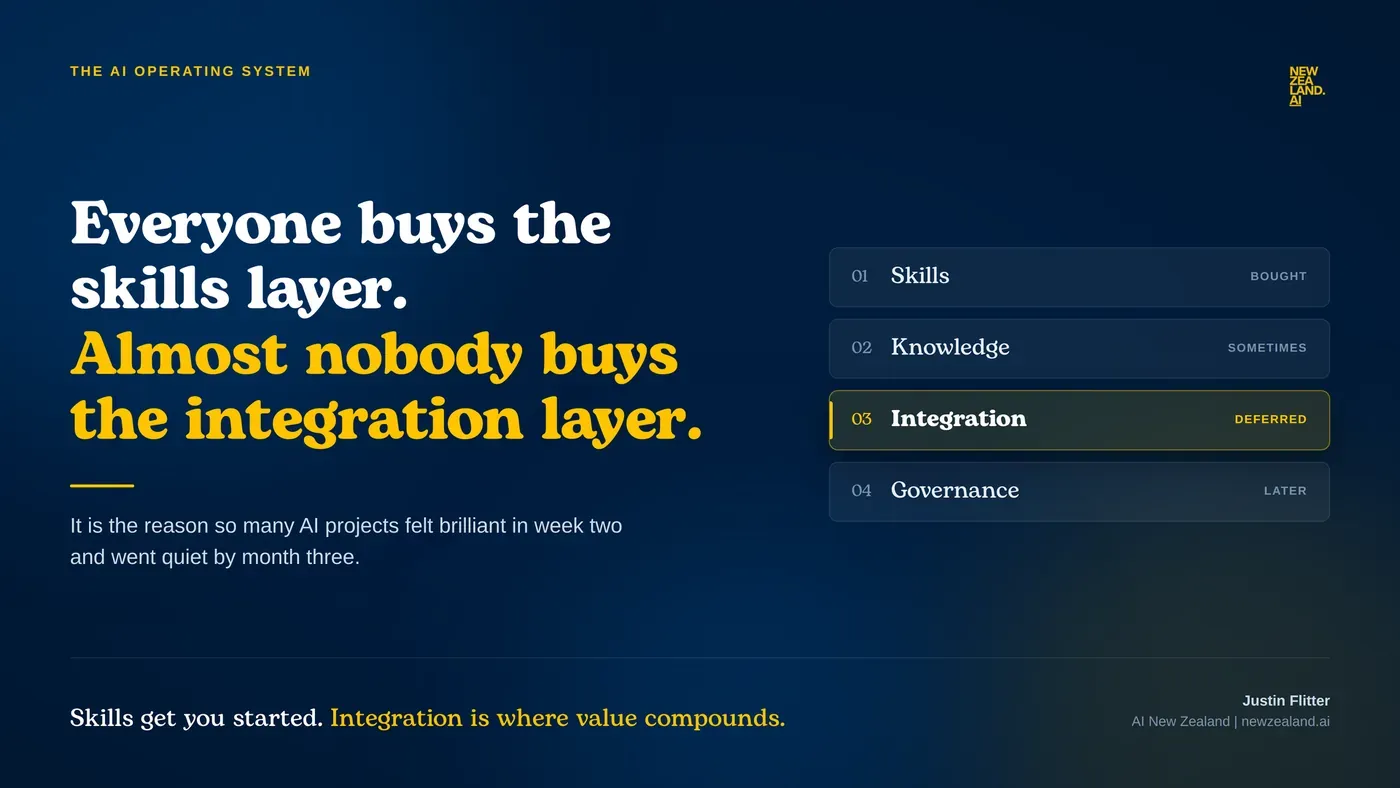
AI Operating System
Everyone is buying the skills layer. Almost nobody is buying the integration layer.
Read article →
2026 AI Roadshow Notes
AI is no longer just about content generation. It is becoming operational infrastructure.
Read article →
Insights
What comes after LLMs now has a New Zealand face on it.
Read article →Power up your potential with practical AI skills.
Contact us to discuss how Artificial Intelligence could boost your business.