
CEO Briefing: What is Clawdbot (now Moltbot), is it safe to use at work?
OpenClaw / Moltbot / Clawdbot / Clawd Bot
A selfhosted personal AI "gateway" that you run on your own machine (often a Mac mini) and then talk to via WhatsApp, Telegram, Slack, etc.
It routes your messages to various LLMs (Claude, ChatGPT, Gemini, local models), adds memory, notifications, and tool orchestration on top.
OpenClaw is the latest proof that "AI that acts" is arriving faster than most organisations' governance can keep up. Treat them as signals, not solutions, and build your trust infrastructure before you build autonomy.
This video is well worth a watch.
OpenClaw is open-source software that turns AI from a reactive chatbot into an always-on agent that can take actions on your behalf, typically running on your own hardware and connecting through everyday messaging channels.
Architecturally, it behaves like a local "gateway" between cloud models (for reasoning) and your private data (on the machine), often with persistent memory so it can carry context across sessions.
The standout feature is "proactive" behaviour (a heartbeat) where the agent can wake itself up, monitor situations, and message you first, which meaningfully increases both usefulness and blast radius.
Why this matters to NZ CEOs
If an agent can read inboxes, touch calendars, access files, and send messages, it is no longer an IT experiment, it's operational delegation, which moves accountability straight to the CEO and board.
From an NZ Privacy Act perspective, once personal information is involved you're expected to have safeguards that are "reasonable in the circumstances" to prevent loss, unauthorised access, misuse, or disclosure.
NZ leaders should assume regulators and customers won't care that "the agent did it", they'll care whether your organisation put sensible controls around an autonomous system interacting with sensitive data.
The opportunity this presents
The upside is real: autonomous agents can compress coordination costs and cycle time by taking on repetitive digital work (triage, scheduling, follow-ups, summaries) across channels your teams already use.
The strategic win isn't "cool automation", it's execution leverage: leaders can shift capacity from admin to customer value, while building repeatable workflows that scale across teams.
Done well, this becomes a competitive advantage because AI commoditises answers, but organisations with strong judgement and guardrails can safely turn those answers into actions.
The impact on risk and governance
The core risk is prompt injection: untrusted content (emails, web pages, messages) can smuggle instructions that hijack the agent into leaking data or taking unintended actions.
Security researchers increasingly frame "agent danger" as a design pattern problem: when an agent simultaneously, consumes untrusted inputs, has access to sensitive data/systems, and can take actions, the likelihood and impact of compromise spikes.
Then there's commercial risk: autonomous loops can burn tokens and rack up unpredictable API costs, so CFO-grade spend controls need to be part of governance, not an afterthought.
OpenClaw (AI-to-AI social posting) is more performance art than business capability, and the governance question is simple: are you paying to generate noise, or investing in systems that move a metric?
OpenClaw previously called Clawdbot and Moltbot is a self-hosted AI assistant designed to run on your own machine (Mac/Windows/Linux) and operate through chat apps like WhatsApp, Telegram, Slack, Signal and iMessage.
It's built for "agentic" work: reading and writing files, browser control (filling forms, extracting data), and even executing commands, with options to sandbox or restrict access.
The official security guidance is blunt: there is no perfectly secure setup, so the goal is to deliberately limit who can trigger it, what it can touch, and where it can act.
This is the "digital employee" moment: a tool that can take real actions inside your workflows, not just draft content, which means CEOs can finally link AI adoption directly to operational throughput and customer experience.
The moment an AI agent can access customer emails, staff calendars, files, and internal systems, it becomes a Privacy Act issue as much as a productivity play, especially around safeguarding personal information.
Because Moltbot can integrate across many services and store local transcripts, you need an NZ-appropriate governance stance on data handling, access control, and auditability, not just "let the IT team try it".
Questions CEOs should be asking
- Where would an autonomous agent actually move a value lever for us (revenue, cost-to-serve, cycle time, risk, customer experience), and what metric will we hold it to?
- What are our "no-go zones" for agent access (customer PII, finance, payroll, production systems), and who signs off on exceptions?
- How do we defend against indirect prompt injection when the agent reads untrusted content like emails and websites?
- What actions require human approval (sending external messages, running code, purchasing, changing customer records), and how do we prevent approval fatigue?
- What is our cost and usage control model (token budgets, spending caps, anomaly alerts) so an "agent loop" can't quietly turn into a finance incident?
- If this agent causes a privacy breach, can we evidence "reasonable safeguards" and respond fast?
Steps CEOs should take next
Immediately (next 2–4 weeks): run a constrained pilot with read-only access wherever possible, strict scope, and clear human-in-the-loop gates for any irreversible action (external messaging, system changes, code execution).
Immediately: implement "trust boundaries" as policy, treat all untrusted inputs as hostile, and assume prompt injection attempts will occur, because attackers can hide instructions in content the model reads.
Medium term (30–90 days): create an agent governance standard (approved tools/connectors, access control model, logging and review, incident response playbook) aligned to NZ privacy expectations for reasonable safeguards.
Medium term: only scale what moves a number, and kill anything that turns into "agent theatre" (including AI-to-AI content farms) unless it serves a defined customer, operational, or risk outcome.
So is Moltbot safe to use at work?
For most NZ organisations: These tools are not safe for broad rollout, and not safe for sensitive workflows on day one. For a controlled pilot with tight access controls, minimal permissions, and clear governance: safe enough to trial, especially for low-risk use cases like summarisation and internal drafting.
Curiosity builds capability. Critical thinking deploys it with impact.
In 2026, capability alone won't cut it, because everyone can spin up an agent. Judgement, governance, and disciplined value levers are the CEO edge AI can't automate.
Continue reading
More from AI New Zealand.
AI Operating System
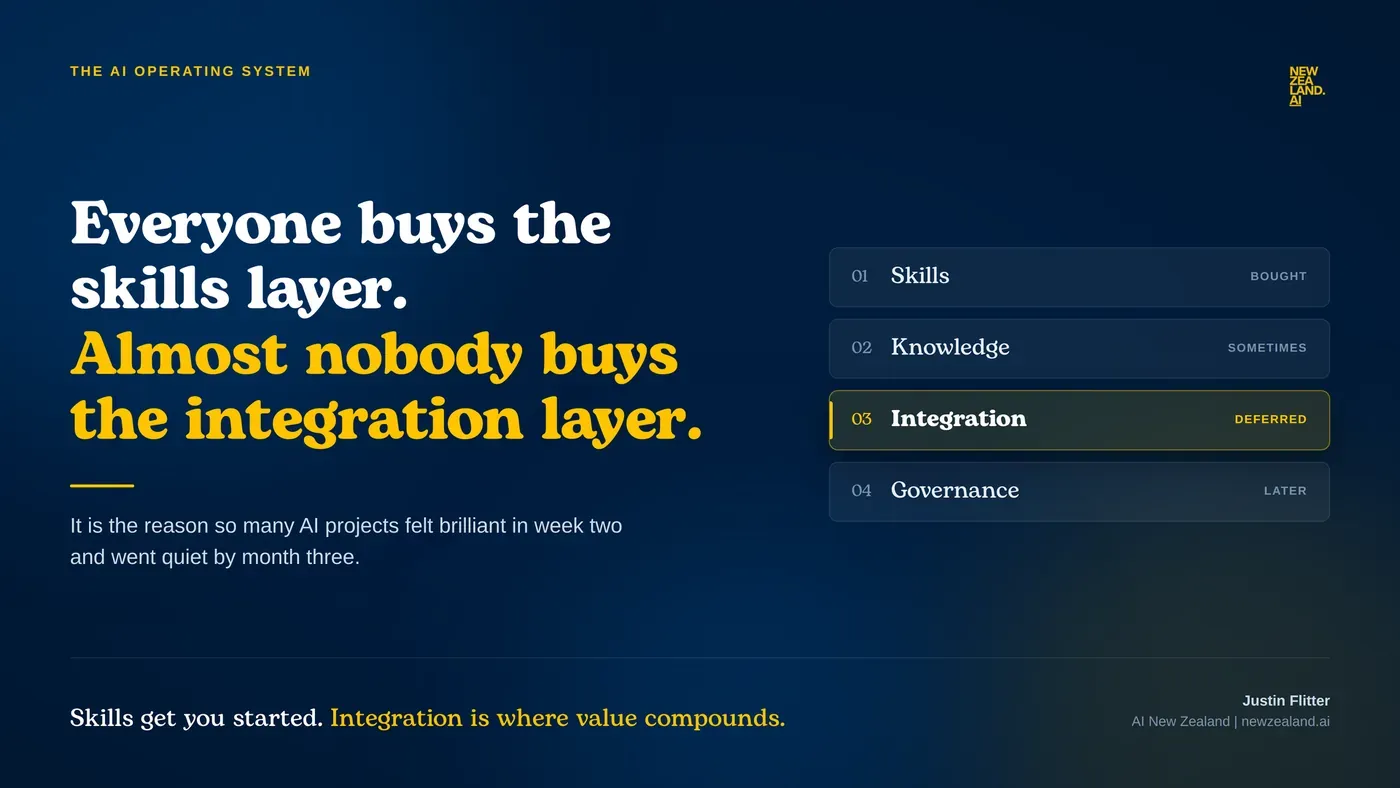
Everyone is buying the skills layer. Almost nobody is buying the integration layer.
Read article →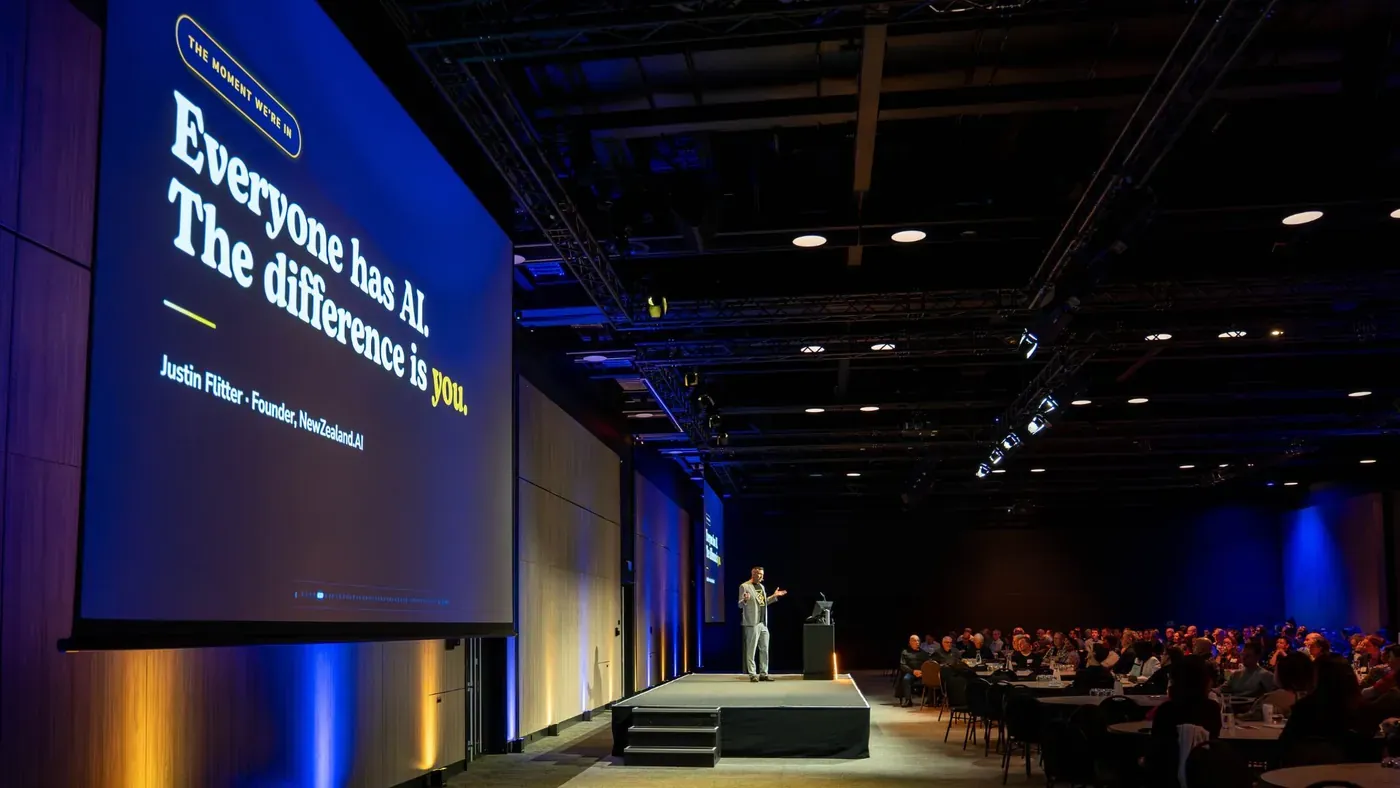
2026 AI Roadshow Notes
AI is no longer just about content generation. It is becoming operational infrastructure.
Read article →
Insights
What comes after LLMs now has a New Zealand face on it.
Read article →Power up your potential with practical AI skills.
Contact us to discuss how Artificial Intelligence could boost your business.