
Curiosity is the antidote to obsolescence
These are the frameworks that will shape how we think, advise, and challenge New Zealand businesses this year.
Most businesses are treating AI like it's a shopping trip.
They're comparing tools, collecting "use cases", and asking for demos like the next feature drop is going to save them. It won't. Not because AI isn't powerful, but because capability is becoming cheap. Everyone has access to the same models, the same interfaces, the same shiny "AI-powered" buttons.
The differentiator is no longer access.
It's thinking.
This year, I'm anchoring everything I advise and teach around three big ideas. They're simple. They're uncomfortable. And if you get them right, they'll keep you relevant while the AI tide keeps rising.
Most organisations don't have an AI problem.
They have an incuriosity problem.
They assume learning is what you do in a workshop once a year, then you get back to "real work". In an AI-driven world, that mindset doesn't just slow you down. It quietly makes you obsolete. Because the gap between thriving and struggling isn't determined by what you know today, it's determined by your hunger to understand what comes tomorrow.
Curiosity isn't a personality trait. It's a survival mechanism.
The businesses struggling right now aren't those without the right tools. They're the ones who've stopped asking good questions. They've trained their teams to be efficient, compliant, and busy, then act surprised when no one explores what's possible.
Curiosity is cultivated. Deliberately. Systematically. Culturally.
What this looks like in practice:
- In meetings, replace "Any questions?" with "What are you curious about?"
- Give teams permission to explore without needing a 30-page business case
- Reward questions that reveal blind spots, not just answers that sound confident
Because in 2026, the only truly obsolete skill is believing you already know enough.
Critical thinking is your competitive moat
AI commoditises answers.
That's the part most leaders still haven't internalised.
When anyone can generate a strategy doc, a proposal, a customer email sequence, and a board update in 90 seconds, "output" stops being impressive. The market gets flooded with plausible, polished, confidently-written mediocrity. And the risk isn't just sameness.
The risk is confident wrongness at scale.
Critical thinking is what stands between your organisation and AI theatre. It's the fusion of domain knowledge, lived experience, and intellectual courage - the willingness to challenge both AI outputs and conventional wisdom, then act decisively on what you learn.
Human judgment becomes premium.
And here's the uncomfortable truth: a lot of AI usage today is lazy. Copy-paste prompts. No context. No interrogation. No accountability. That's not innovation. That's outsourcing your thinking and calling it productivity.
If you want a moat, build judgment.
What this looks like in practice:
- Make "Why?" a standard operating procedure: why this, why now, what assumptions?
- Rotate a devil's advocate role so questioning becomes normal, not political
- Treat AI drafts as step one: "AI draft human judgment discussion decision"
AI can give you options. It can't give you conviction. That part is on you.
Stop chasing use cases. Pull value levers.
"Use cases" are where AI programs go to die.
Not because they're wrong, but because they're usually backwards.
Use cases describe what technology can do. Value levers define what the business must improve - revenue, cost-to-serve, cycle time, risk, customer experience. If you start with use cases, you end up with a long list of pilots and a short list of results.
If you start with value levers, you don't "pilot AI".
You move a number that matters.
This is the shift I want more New Zealand leadership teams to make this year: stop asking "Where can we use AI?" and start asking "Which metric are we willing to be held accountable for, and what's the fastest AI-assisted path to move it?"
Because the board doesn't fund curiosity forever.
It funds outcomes.
What this looks like in practice:
- Pick 1–2 value levers only (not ten) and assign an owner
- Set a baseline metric and a 90-day target
- Build an "AI value intake" gate: every idea must name the lever, the metric, and the measurement plan
You don't need more ideas. You need sharper priorities.
How these three ideas connect
Curiosity builds capability.
Critical thinking deploys it with impact.
Value levers make it real.
That's the narrative for the year.
Curiosity stops you becoming a dinosaur. Critical thinking stops you becoming a copycat. Value levers stop you becoming a science project. Together, they create the leadership advantage AI can't automate: judgment, context, and conviction.
Clear next steps (do this in the next 30 days)
If you want this to be more than a nice read and a motivating LinkedIn quote, here's the move.
1) Run a 60-minute "Value Lever Sprint"
Get your leadership team in a room (or on a call). Decide:
- The one lever you most need to move this quarter (cost-to-serve, sales cycle time, churn, risk, customer experience)
- The baseline number
- The 90-day target
- The owner
No tech talk until that's done.
2) Install a weekly curiosity habit
Pick one:
- A shared Curiosity Board where anyone can post a question worth exploring
- 10 minutes in every team meeting for "What surprised us this week?"
- A standing rule: "If AI is involved, someone must ask what we might be missing."
Small rituals scale. Big speeches don't.
3) Create a "human judgment checkpoint" for AI work
Make it policy that anything AI generates gets a quick human test:
- What's the claim?
- What evidence supports it?
- What context is missing?
- What could go wrong if we act on this?
You're not slowing down. You're building a moat.
This year, I'm not interested in AI hype, tool lists, or frantic experimentation with no scoreboard.
I'm interested in helping New Zealand businesses think better, move faster, and stay relevant.
If you want to build an organisation that doesn't just use AI, but wins with it, start here.
- Curiosity is the antidote to obsolescence.
- Critical thinking is your competitive moat.
- Move a metric, not a use case.
Continue reading
More from AI New Zealand.
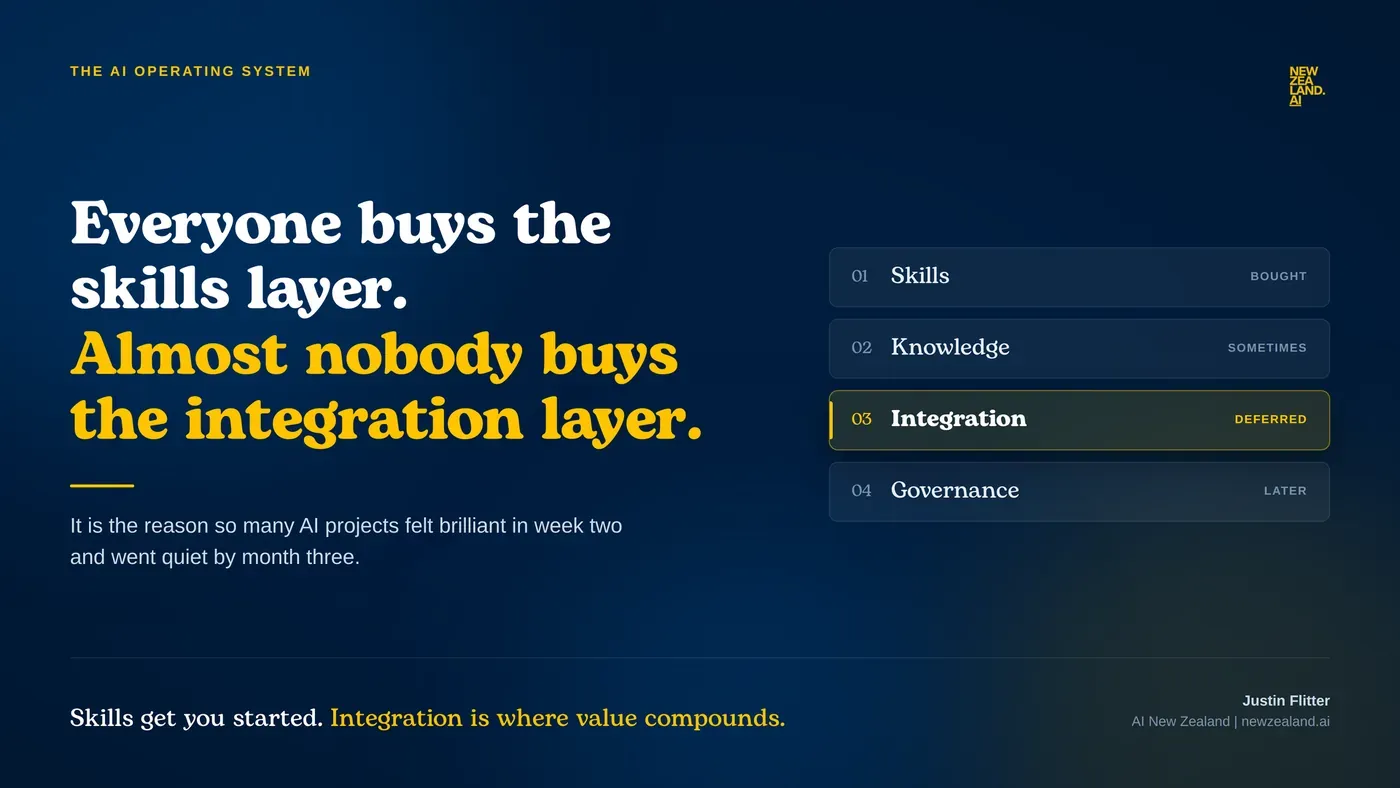
AI Operating System
Everyone is buying the skills layer. Almost nobody is buying the integration layer.
Read article →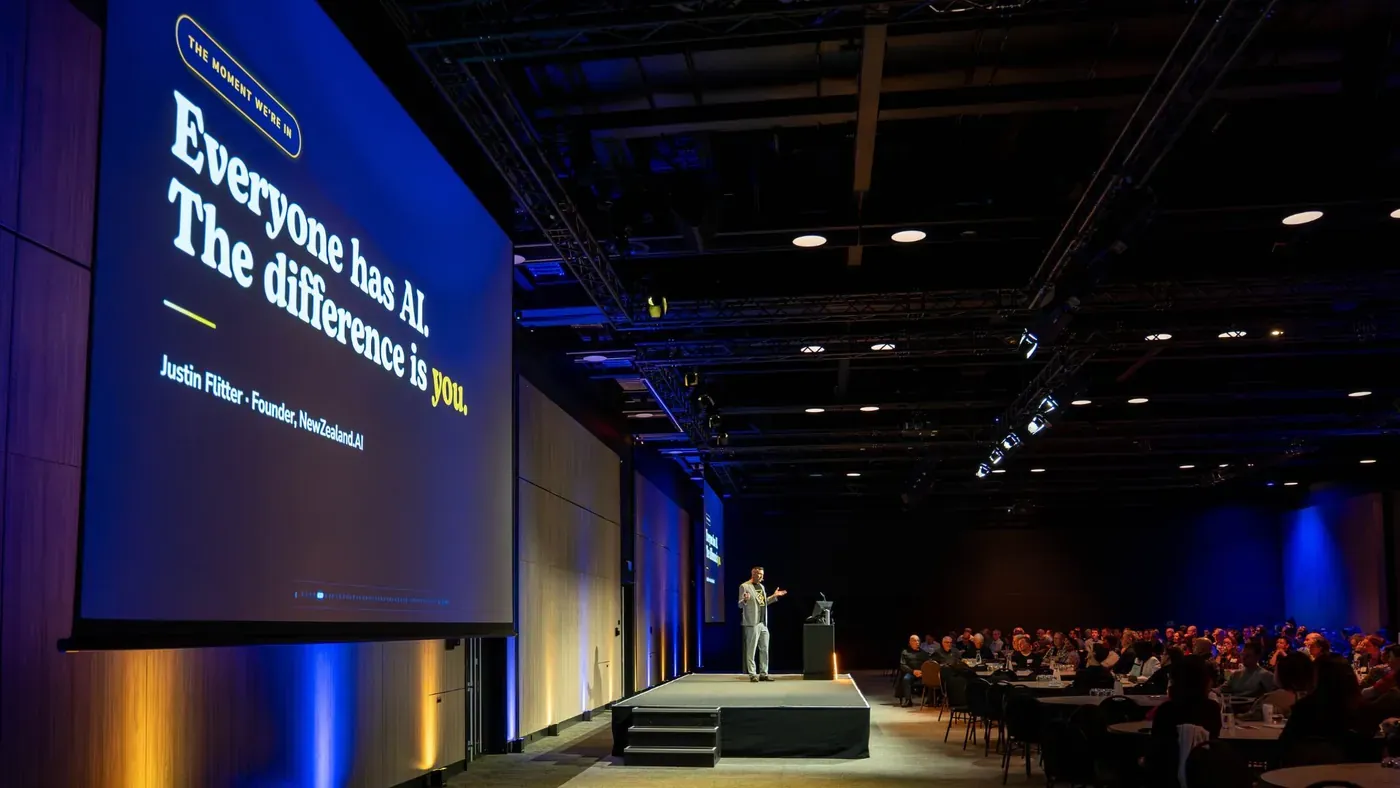
2026 AI Roadshow Notes
AI is no longer just about content generation. It is becoming operational infrastructure.
Read article →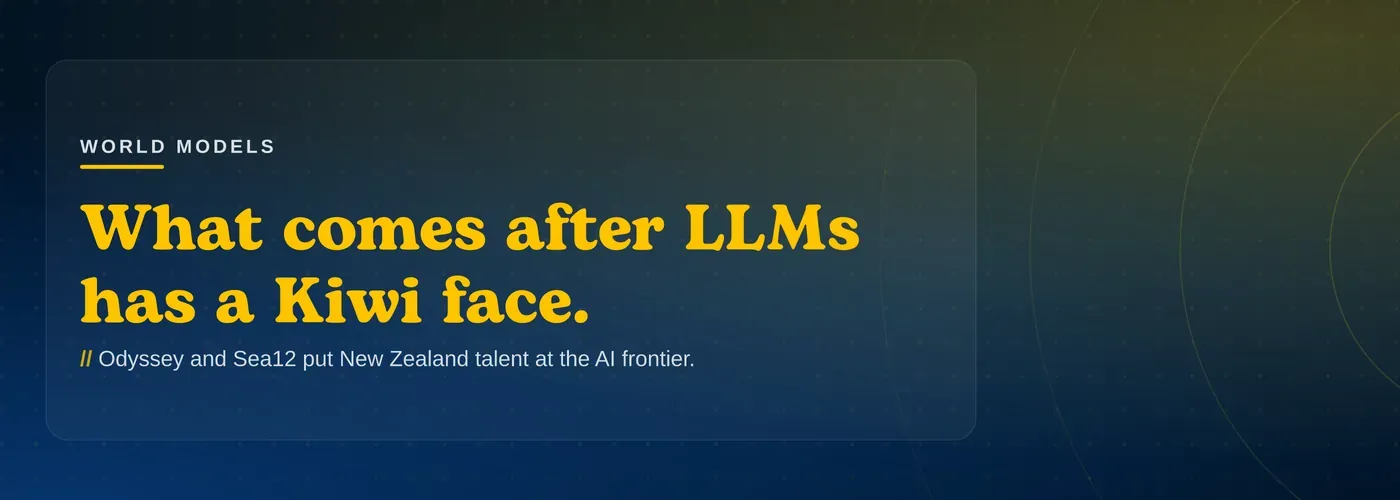
Insights
What comes after LLMs now has a New Zealand face on it.
Read article →Power up your potential with practical AI skills.
Contact us to discuss how Artificial Intelligence could boost your business.