
The Four Platforms You Need to Know
AI platforms are releasing new functionality that's changing the way we work.
This is not an incremental improvement - it's a seismic leap. Here's what your business needs to understand right now.
Twelve weeks ago, the best-practice approach to using AI in your business was: open a chat window, type a prompt, upload your document, review the output.
That approach still works. But it's now the manual labourer's method, the equivalent of faxing when your competitors are running automated pipelines.
In the first quarter of 2026, four major platforms crossed a threshold that most New Zealand leaders haven't yet registered. They stopped being AI assistants you talk to. They became AI workers you delegate to.
The shift isn't a feature update. It's a change in the fundamental operating logic of how AI sits inside a business.
The businesses racing ahead aren't using better prompts. They are enabling their people to understand context protocols, build persistent memory, and hand off multi-step work to AI agents that run while they sleep.
This briefing covers four platforms that define what 'capable AI' looks like today.
What Changed in 90 Days
The shift can be summarised in three moves:
The platforms below are the ones setting the new standard. Each one matters. Together, they define the gap that is opening right now between AI-theatre businesses and AI-operational businesses.
Claude Cowork - Agentic AI for knowledge workers
What it is
Claude Cowork is Anthropic's answer to one question: what happens when you take the most powerful coding agent in the world (Claude Code, used by 115,000 developers) and give it to everyone else? Launched in January 2026 and built in approximately ten days, using Claude Code itself, Cowork brings autonomous, multi-step AI execution to non-technical knowledge workers.
Instead of a chat, you get a task queue. Instead of a response, you get finished deliverables, formatted documents, organised files, synthesised research, Excel spreadsheets with working formulas, PowerPoint presentations.
What it does
- Reads from and writes to your local files without manual uploads or downloads
- Breaks complex work into subtasks and coordinates parallel sub-agents simultaneously
- Runs long-duration tasks without timeouts, you describe the outcome, step away, and return to finished work
- Supports scheduled tasks, recurrent workflows that run automatically on your behalf
- Integrates with Anthropic's Skills framework: structured, reusable task instructions that give Claude persistent operating context
- Built with prompt injection detection and file deletion protection
Why it matters for NZ leaders
- Anthropic engineers now use Claude in 60% of their own work (up from 28% a year ago) and report 50% productivity gains. Claude Code's codebase is roughly 90% written by Claude itself. This is acceleration made visible.
- 'Feeling less like back-and-forth communication and more like leaving messages for a colleague.' That framing is deliberate. This is not a tool you operate, it is a colleague you brief.
- The business implication: one person producing the output of three to five people is no longer a thought experiment. It is Anthropic's daily reality.
- For NZ SMEs and professional services firms: the cost-to-serve lever is being reset. Businesses that understand how to brief Cowork well will outcompete those that don't.
Attend the AI Toolkit Webinar #Let Claude Do the Work While You Think on Friday April 10th to see Claude Cowork in action.
Microsoft Copilot Cowork - Enterprise-grade agentic execution in M365
What it is
Copilot Cowork is Microsoft's enterprise answer to Claude Cowork, built in close collaboration with Anthropic and powered by the same Claude agentic framework. The key difference: where Claude Cowork runs locally on your device, Copilot Cowork runs in the cloud, inside your Microsoft 365 tenant, with full enterprise data protection.
This is Wave 3 of Microsoft 365 Copilot, the move from 'chat that helps' to 'agent that acts.' It is powered by Work IQ: a contextual layer that grounds tasks in your emails, meetings, messages, files, and data across Outlook, Teams, Excel, and the full M365 suite.
What it does
- Delegates multi-step work across M365, you describe an outcome, Copilot creates a plan, executes it in the background, and checks in at clear approval points
- Calendar management: reviews your schedule, flags conflicts, proposes and applies changes, including sending prep documents before meetings
- Meeting preparation: pulls from emails, files, and past meetings to produce briefing documents, supporting analysis, and client-ready decks
- Work IQ provides full organisational context, not just fragments of your data, but the whole picture
- Runs within Microsoft's security, governance, identity, and compliance framework, enterprise-safe by default
- Broad availability via the Frontier programme from late March 2026; general availability of Agent 365 from 1 May 2026
Why it matters for NZ leaders
- If your organisation already runs Microsoft 365, this is the most immediately deployable agentic AI capability available today. There is no new infrastructure. No new vendor relationship. It runs inside what you already have.
- The collaboration with Anthropic is significant: Microsoft is no longer betting exclusively on OpenAI. It is building a multi-model advantage. The best model for the job, regardless of who built it.
- For NZ enterprise and mid-market leaders: your IT team and your operations managers need to be in a room this month discussing what Copilot Cowork means for your current M365 investment.
- The operating question is not 'should we use this?' You are already paying for most of it. The question is 'how do we redesign our workflows to use it well?'
Perplexity Computer - Multi-model workflow orchestration
What it is
Launched 25 February 2026, Perplexity Computer is the most ambitious leap in this briefing. It is not a single AI. It is an orchestration layer that coordinates 19 AI models simultaneously, including GPT, Claude, Gemini, and Grok, selecting the best model for each specific step in a workflow.
It runs in an isolated compute environment with access to a real filesystem, a real browser, and real tool integrations. Tasks can run for hours. Or months. You can run dozens of Perplexity Computers in parallel, asynchronously, while you focus on other things.
What it does
- Automatically selects the right AI model for each sub-task (e.g. Gemini for deep research, Grok for speed, Claude for long-context recall)
- Creates and coordinates sub-agents dynamically when it encounters a problem it cannot solve alone
- Executes entire workflows, not just tasks, that can span hours or months without requiring ongoing input
- Operates within an isolated compute environment with filesystem, browser, and tool access
Why it matters for NZ leaders
- This is what 'AI operating logic' looks like at its most advanced. You don't choose a model. You describe an outcome. The system routes intelligently.
- For NZ business leaders: the relevant question is not 'can we afford this?' It is 'what workflows in our business currently take a week that this could execute in an afternoon?'
- The Comet browser integration means Perplexity Computer can operate web-based workflows, filling forms, extracting data, navigating interfaces, that previously required a human at a keyboard.
Attend the AI Toolkit Webinar #Your AI Agent That Actually Does the Work on Perplexity Computer on March 20th.
OpenClaw - Open-source personal AI agent
What it is
OpenClaw is an open-source AI agent platform that runs on your own machine, laptop, server, or cloud instance. Built by Peter Steinberger and acquired by OpenAI in February 2026, it went from zero to 68,000 GitHub stars in 72 hours, making it one of the fastest-growing open-source projects in history.
Think of it as a 24/7 AI worker that lives on your infrastructure. It connects to your files, your chat apps (WhatsApp, Slack, Teams, Discord), your browser, and over 50 third-party tools. It remembers everything across sessions. And it acts, autonomously, while you sleep.
What it does
- Runs persistently in the background, not just when you open a chat window
- Maintains long-term memory of your preferences, projects, and past interactions via plain Markdown files (no black-box database)
- Executes multi-step tasks: reading from one platform, processing, and acting across multiple systems in a single automated sequence
- Supports 100+ community-built 'AgentSkills', modular capabilities it can autonomously extend
- Isolates context per channel (WhatsApp conversations don't contaminate Slack context)
- Fully model-agnostic: run on GPT, Claude, Gemini, or local models
Why it matters for NZ leaders
- OpenAI acquired it not for the AI capability, but for the workflow infrastructure. That is the signal: the race has moved from smarter models to smarter orchestration.
- For NZ businesses, this is the DIY version of an enterprise AI platform, free, private, and powerful. The catch: it requires technical setup.
- More importantly, the operating logic it represents, persistent, context-aware, multi-step AI execution, is the architecture every major platform is now racing to match.
- Your people need to understand what context protocols are. OpenClaw is the most transparent demonstration of how they work.
The Signal Behind All Four
These four platforms are not four different bets. They are four different expressions of the same architectural shift.
Prompting an AI and uploading your docs is now the manual way of using AI. The gap between those who know that and those who don't is widening every week.
The Real Risk
It is not that these tools will replace your people. It is that businesses whose people know how to use them will move at a pace yours cannot match.
The constraint is not access. Every tool in this briefing is available to any New Zealand business today. The constraint is capability, specifically, whether your people understand the operating logic these platforms require.
That means understanding:
- What a context protocol is and why it matters
- How to structure work so an agent can execute it without constant supervision
- How to apply human judgement at the right checkpoints, not all checkpoints
- How to measure whether AI execution is delivering against a business lever, not just producing output
Three Decisions You Need to Make
01 - Which workflows will we redesign first?
Not which tools to buy. Which processes to rebuild around agentic execution. Name two. Assign an owner. Set a 90-day target metric.
02 - Who is accountable for AI capability uplift?
Learning to brief an agent is a skill. It is not the same as learning to prompt a chatbot. Your people need structured capability building.
03 - What are our guardrails?
Where does AI draft and a human approves? Where does AI execute and a human reviews? Where does a human decide, full stop? Write it down. Make it policy.
The businesses getting this right are not doing more AI projects. They are redesigning how work happens, with AI in the operating logic from the start.
That is a capability question, not a technology question.
Continue reading
More from AI New Zealand.
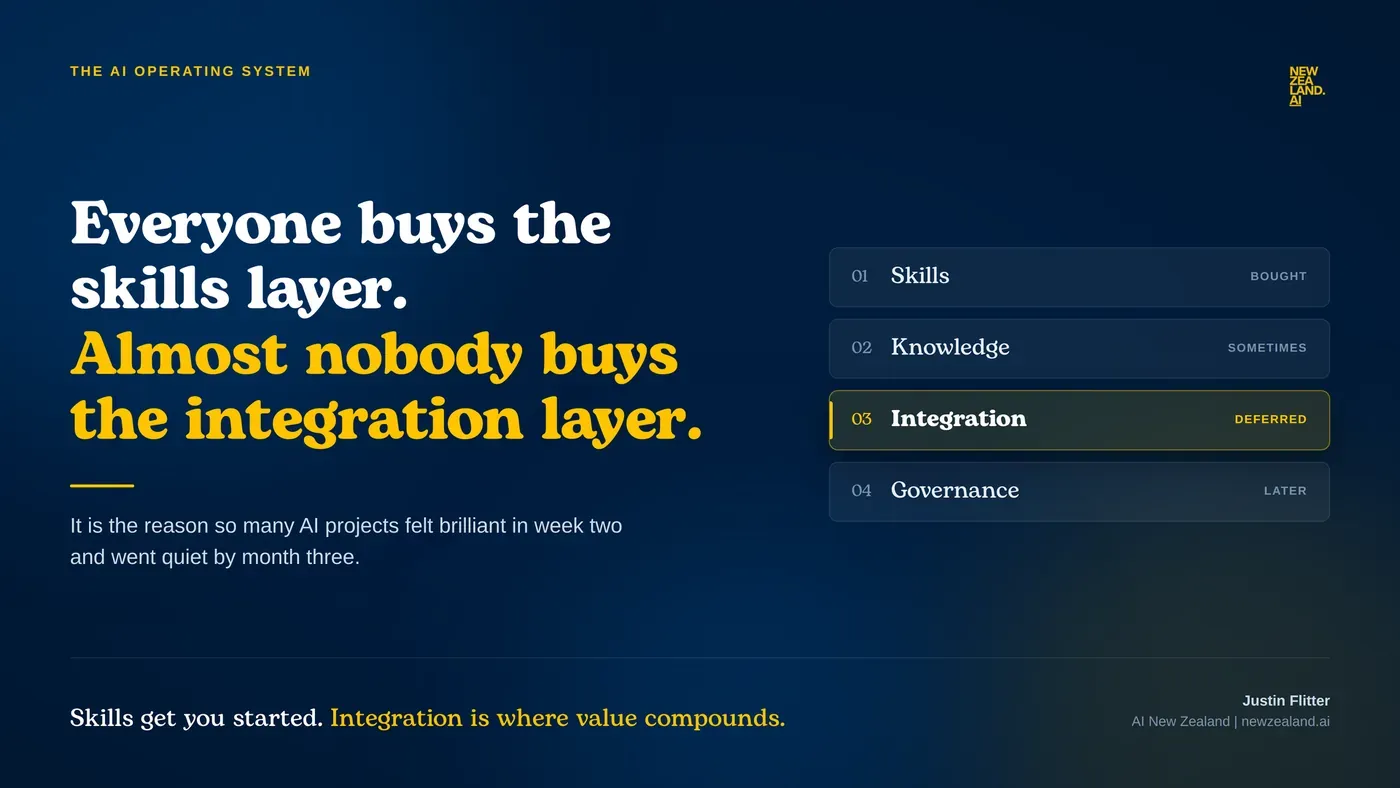
AI Operating System
Everyone is buying the skills layer. Almost nobody is buying the integration layer.
Read article →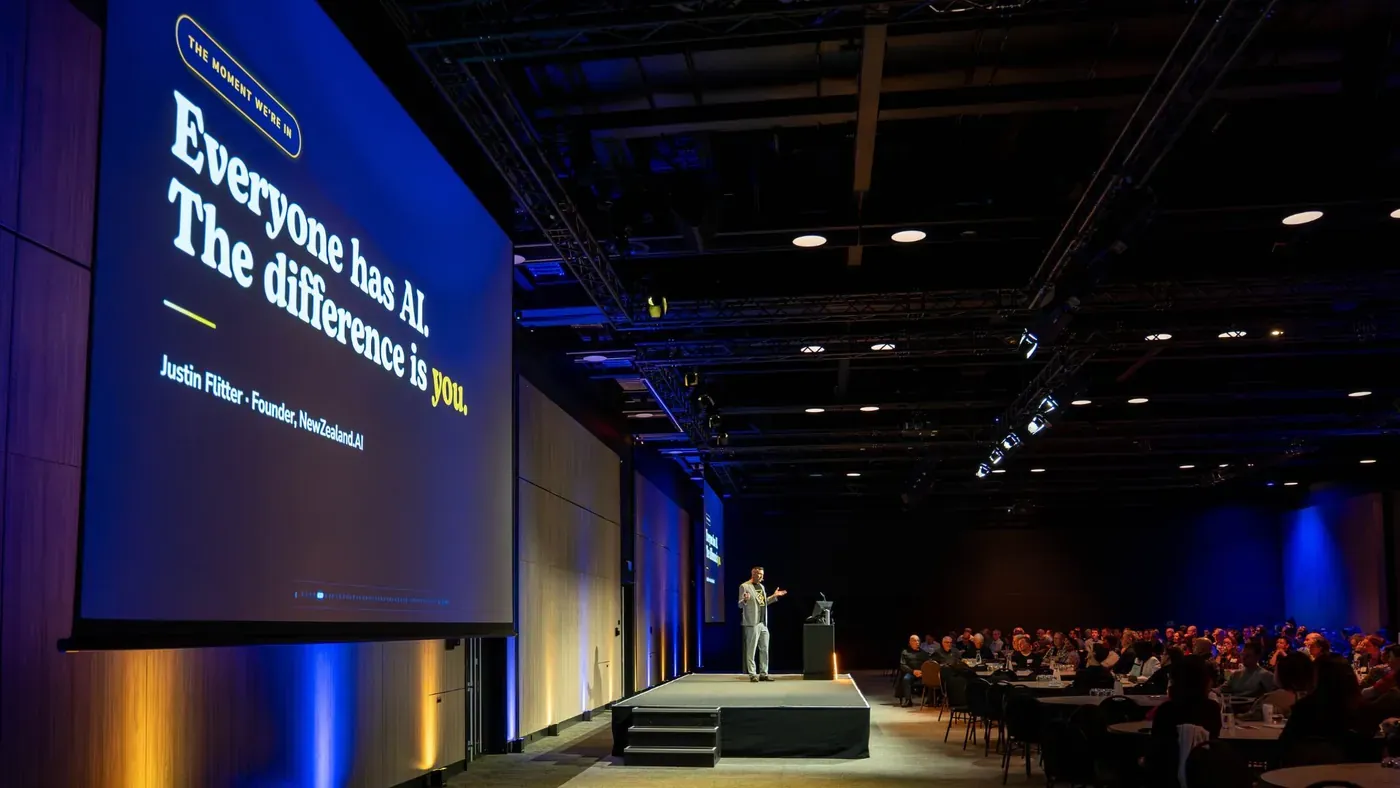
2026 AI Roadshow Notes
AI is no longer just about content generation. It is becoming operational infrastructure.
Read article →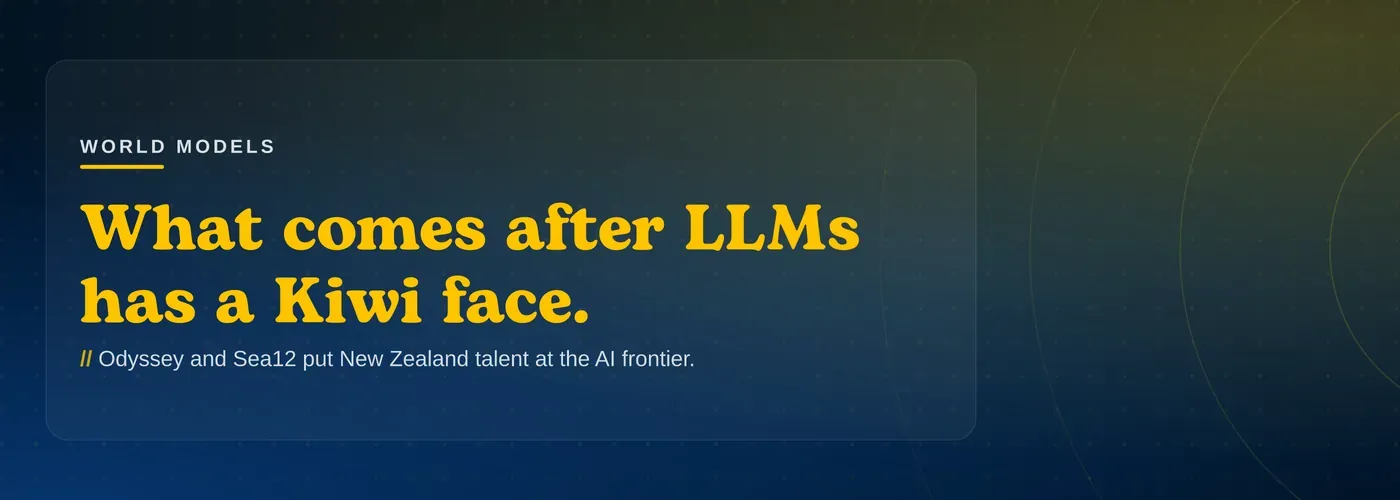
Insights
What comes after LLMs now has a New Zealand face on it.
Read article →Power up your potential with practical AI skills.
Contact us to discuss how Artificial Intelligence could boost your business.