
AI Glossary: 100+ Terms Every NZ Business Leader Should Know.
Most AI glossaries read like vendor brochures. Lots of definitions. Not much help when you're trying to figure out what's real, what's hype, and what actually matters for your business.
This one is different.
Every term here includes the definition and the NZ business context you need to interrogate claims, spot AI theatre, and ask better questions. Because in 2026, the competitive advantage isn't knowing what AI can do - it's knowing what questions to ask when someone tells you what AI should do.
Critical thinking is your moat. This glossary is your toolkit.
Foundation Concepts
AI (Artificial Intelligence)
Definition Systems that perform tasks typically requiring human intelligence, pattern recognition, decision-making, language processing, prediction.
NZ business context When someone pitches "AI", ask: "Which specific task does this handle, and what judgement does my team still own?" AI is a category, not a capability. The question isn't whether to use AI, it's where human judgement stays in the loop and where automation actually moves a business metric.
Machine Learning (ML)
Definition A subset of AI where systems learn patterns from data without being explicitly programmed for every scenario.
NZ business context ML needs clean, relevant data to learn from. For NZ businesses, this means: Do you have enough historical data? Is it representative of current conditions? Can you measure whether the model is learning the right patterns or just amplifying existing bias? ML is only as good as the data and the judgement applied to its outputs.
Generative AI
Definition AI systems that create new content, text, images, code, audio, based on patterns learned from training data.
NZ business context Generative AI (like ChatGPT, Claude, Gemini) drafts, structures, and suggests. It doesn't verify, approve, or guarantee accuracy. For NZ businesses, this means establishing clear workflows: AI generates, humans review, humans decide. Never let generative AI operate without a review step in regulated, customer-facing, or high-stakes contexts.
Large Language Model (LLM)
Definition AI models trained on vast amounts of text data to understand and generate human-like language. Examples: GPT-4, Claude, Gemini, Llama.
NZ business context LLMs are pattern-matching engines, not knowledge databases. They predict likely word sequences based on training data. Ask: "Is this answer contextually right for our business, or just statistically plausible?" LLMs can be confidently wrong. Your team's job is to catch it.
Natural Language Processing (NLP)
Definition The branch of AI focused on understanding, interpreting, and generating human language.\
NZ business context NLP powers chatbots, email sorting, sentiment analysis, and document summarisation. For NZ businesses, the key question is: "Does this understand our context, industry jargon, Kiwi English, regional nuances, or is it optimised for US/UK datasets?" Test before you trust.
Neural Network
Definition A computing architecture modelled loosely on the human brain, using interconnected nodes (neurons) to process information and learn patterns.
NZ business context You don't need to build neural networks, but you need to know they underpin most modern AI. The practical question: "Can we explain how this system reached its conclusion?" Many neural networks are black boxes. If you're in a regulated industry (finance, health, insurance), explainability matters.
Deep Learning
Definition A subset of machine learning using multi-layered neural networks to process complex data like images, speech, and unstructured text.
NZ business context Deep learning powers image recognition, voice assistants, and advanced diagnostics. It requires significant compute power and large datasets. For most NZ SMEs, you'll consume deep learning via APIs (Google Vision, AWS Rekognition) rather than building it in-house. Ask: "What's the cost, and does it move a lever?"
Algorithm
Definition A set of rules or instructions a computer follows to solve a problem or complete a task.
NZ business context Every AI system runs on algorithms. The question isn't whether an algorithm is involved, it's whether the algorithm reflects your business logic, your risk tolerance, and your values. Algorithms can encode bias, prioritise the wrong outcomes, or optimise for metrics that don't matter. Interrogate the rules, not just the results.
Model
Definition The trained AI system that makes predictions, classifications, or generates outputs based on learned patterns.
NZ business context A "model" is the output of training an AI system on data. For NZ businesses: Who trained it? On what data? When? Models trained on international datasets may not reflect NZ market conditions, customer behaviour, or regulatory requirements. Always test models in your context before deploying.
Training Data
Definition The dataset used to teach an AI model patterns, relationships, and behaviours.
NZ business context Training data determines what the model learns. If your training data is biased, incomplete, or outdated, your model will be too. For NZ businesses, ask: "Does this data reflect our customers, our market, our operating environment?" And: "Who owns this data, and what are the privacy implications?
Inference
Definition The process of an AI model making predictions or generating outputs based on new input data after training is complete.
NZ business context Inference is when the AI does its job, analysing a customer query, flagging a risk, drafting a response. For NZ businesses, the cost and speed of inference matter. Some models are expensive to run at scale. Ask: "What's the per-query cost, and does the value justify it?"
Capabilities & Techniques
Prompt Engineering
Definition The practice of designing and refining input instructions (prompts) to get better outputs from AI models.
NZ business context Prompt engineering is now a core professional skill. The quality of your question determines the quality of the answer. For NZ businesses, this means: Train your team to write clear, context-rich prompts. Test variations. Document what works. Poor prompts = poor outputs, even with powerful models.
Fine-Tuning
Definition The process of taking a pre-trained AI model and further training it on a specific dataset to improve performance for a particular task or domain.
NZ business context Fine-tuning makes a general model more useful for your business - teaching it your industry terminology, your customer language, your processes. For NZ businesses, this requires clean domain-specific data and technical expertise. Ask: "Is fine-tuning necessary, or can we achieve the same result with better prompts and retrieval?"
Retrieval-Augmented Generation (RAG)
Definition A technique that combines AI generation with real-time retrieval of relevant information from a knowledge base or database, improving accuracy and reducing hallucinations.
NZ business context RAG lets you ground AI outputs in your own documents, policies, and data - without retraining the entire model. For NZ businesses, this is often the most practical path to accurate, context-aware AI. Ask: "What's our source of truth, and how do we keep it current?" No citation, no trust.
Embeddings
Definition Numerical representations of words, sentences, or documents that capture semantic meaning, allowing AI to understand similarity and context.
NZ business context Embeddings power search, recommendation, and retrieval systems. For NZ businesses, this means you can find documents, customer queries, or products based on meaning, not just keywords. The practical question: "Does this improve findability and relevance for our team and customers?"
Vector Database
Definition A database optimised for storing and querying embeddings (vectors), enabling fast semantic search and retrieval.
NZ business context Vector databases underpin RAG systems and AI-powered search. For NZ businesses deploying internal knowledge systems or customer support AI, vector databases are the infrastructure. Ask: "What's the hosting cost, and who manages updates to the knowledge base?"
Tokenisation
Definition The process of breaking text into smaller units (tokens) that AI models can process. Tokens can be words, subwords, or characters.
NZ business context Tokens determine cost and capacity. Most LLM pricing is per token (input + output). For NZ businesses, this means: Long documents = higher costs. Verbose prompts = higher costs. Ask: "What's our average token usage per query, and what's the monthly cost at scale?"
Context Window
Definition The maximum amount of text (measured in tokens) an AI model can process in a single interaction - input plus output.
NZ business context Context windows limit how much information you can feed into an AI at once. As of early 2026, leading models support 128K–200K tokens (roughly 100–150 pages). For NZ businesses, this means you can process entire reports, contracts, or transcripts in one go - but you'll pay for it. Ask: "Do we need the full document, or can we retrieve relevant sections?"
Zero-Shot Learning
Definition An AI model's ability to perform a task it wasn't explicitly trained for, based on general knowledge and instructions.
NZ business context Zero-shot means you can ask an LLM to do something new without providing examples. For NZ businesses, this is powerful for ad-hoc tasks - summarising a report, drafting an email, translating jargon. But: zero-shot outputs are less reliable than few-shot. Always review.
Few-Shot Learning
Definition Providing an AI model with a few examples of a task to improve its performance on similar tasks.
NZ business context Few-shot prompts improve accuracy and consistency. For NZ businesses, this means: If you want AI to draft customer responses in your tone, show it 3–5 examples. If you want it to extract data in a specific format, provide sample outputs. Few-shot is your quality control lever.
Transfer Learning
Definition Reusing a model trained on one task to improve performance on a related task, reducing the need for large datasets and training time.
NZ business context Transfer learning is why you don't need to train an LLM from scratch. Pre-trained models (GPT, Claude, Gemini) already understand language, reasoning, and general knowledge. For NZ businesses, you build on top of these models via prompts, fine-tuning, or RAG. Ask: "What's the fastest path to value, prompts, retrieval, or fine-tuning?"
Reinforcement Learning from Human Feedback (RLHF)
Definition A training method where human evaluators rank AI outputs, and the model learns to prioritise responses that align with human preferences.
NZ business context RLHF is how models like ChatGPT learn to be helpful, harmless, and honest. For NZ businesses deploying custom AI, RLHF means: You can teach the model your preferences - tone, risk tolerance, compliance standards - by rating outputs. This requires ongoing human input and clear evaluation criteria.
Supervised Learning
Definition A machine learning approach where the model is trained on labelled data - input-output pairs where the correct answer is known.
NZ business context Supervised learning powers predictive models - credit scoring, fraud detection, demand forecasting. For NZ businesses, this requires historical data with known outcomes. Ask: "Do we have enough labelled examples? Is the data representative of current conditions? Who labels new data as the business evolves?"
Unsupervised Learning
Definition A machine learning approach where the model identifies patterns, clusters, or anomalies in data without labelled examples.
NZ business context Unsupervised learning is useful for exploratory analysis - customer segmentation, anomaly detection, trend identification. For NZ businesses, this can surface insights you didn't know to look for. But: the model finds patterns, not explanations. Your team still needs to interpret and validate findings.
Classification
Definition A machine learning task where the model assigns inputs to predefined categories (e.g., spam/not spam, high risk/low risk).
NZ business context Classification powers email filtering, loan approvals, quality control, and triage systems. For NZ businesses, the key question: "What happens when the model gets it wrong?" Build review workflows for edge cases and high-stakes decisions.
Regression
Definition A machine learning task where the model predicts a continuous numerical value (e.g., sales forecast, customer lifetime value, delivery time).
NZ business context Regression helps NZ businesses forecast demand, estimate costs, and predict outcomes. The trap: models assume the future resembles the past. If market conditions shift, your regression model may be confidently wrong. Always monitor actual vs. predicted and retrain when drift occurs.
Clustering
Definition An unsupervised learning technique that groups similar data points together based on patterns or characteristics.
NZ business context Clustering helps NZ businesses segment customers, identify product affinities, or group support tickets by theme. The output is descriptive, not prescriptive. Your team must decide: "What do we do with these clusters? Which ones matter? Which drive value?"
Anomaly Detection
Definition Identifying data points or patterns that deviate significantly from the norm, often used for fraud detection, quality control, or predictive maintenance.
NZ business context Anomaly detection flags unusual transactions, equipment failures, or customer behaviour. For NZ businesses, this is a high-value, low-risk AI use case - AI flags, humans investigate. Ask: "What's the false positive rate, and can our team handle the alert volume?"
Business Application
Automation
Definition Using AI to perform repetitive tasks without human intervention, data entry, scheduling, report generation, invoice processing.
NZ business context Automation is where AI delivers the fastest ROI, if the process is stable and well-defined. For NZ businesses, ask: "Is this process broken? If so, fix it first. AI automates the process you give it, including the inefficiencies." Automate the right thing, or you'll just scale the problem.
Augmentation
Definition Using AI to enhance human capabilities, providing recommendations, drafting content, surfacing insights, while humans retain decision-making authority.
NZ business context Augmentation is the sweet spot for most NZ businesses in 2026. AI drafts, structures, flags, and suggests. Humans review, refine, approve, and decide. This approach keeps judgement in the loop while accelerating work. Ask: "What does AI prepare, and what do humans decide?"
Orchestration
Definition Coordinating multiple AI systems, tools, and workflows to achieve a business outcome, often involving both automation and human-in-the-loop steps.
NZ business context Orchestration is operating logic in action. For NZ businesses, this means designing how AI and humans work together across a process, customer inquiry → AI triage → human review → AI draft response → human approval. Ask: "Who owns each step? What are the handoffs? Where does judgement happen?"
Agentic AI
Definition AI systems that can plan, execute multi-step tasks, use tools, and adapt based on feedback, often with minimal human intervention.
NZ business context Agentic AI is emerging in 2026 but still experimental for most NZ businesses. These systems can book meetings, research competitors, or manage workflows autonomously. The risk: reduced visibility and control. Ask: "What's the blast radius if this agent makes a mistake? What's our override path?"
Copilot
Definition An AI assistant embedded in workflows to provide real-time suggestions, automate subtasks, and accelerate work (e.g., Microsoft Copilot, GitHub Copilot).
NZ business context Copilots are augmentation tools, they draft emails, generate code, summarise meetings. For NZ businesses, the value depends on adoption and workflow integration. Ask: "Does this reduce cycle time or cognitive load? Are people actually using it? What's the cost per seat vs. productivity gain?"
Chatbot / Conversational AI
Definition AI systems that interact with users via text or voice, handling queries, providing information, or completing transactions.
NZ business context Chatbots can deflect routine inquiries, freeing human teams for complex cases. For NZ businesses, the trap is deploying a chatbot that frustrates customers with rigid scripts or poor understanding. Ask: "What's the escalation path to a human? What's the resolution rate? What's the customer satisfaction score?"
Predictive Analytics
Definition Using historical data and machine learning to forecast future outcomes, sales, churn, demand, risk.
NZ business context Predictive analytics helps NZ businesses anticipate rather than react. The key: predictions are probabilities, not certainties. Ask: "What's the confidence interval? What happens if the forecast is wrong? How often do we retrain the model as conditions change?"
Prescriptive Analytics
Definition AI that recommends specific actions to achieve desired outcomes, often combining prediction with optimisation.
NZ business context Prescriptive analytics suggests: "Do this to reduce churn" or "Adjust pricing here to maximise margin." For NZ businesses, this is powerful, but only if recommendations are explainable and aligned with strategy. Ask: "Why is the system recommending this? Does it account for constraints we care about (brand, compliance, customer experience)?"
Sentiment Analysis
Definition Using NLP to determine the emotional tone of text, positive, negative, neutral, often applied to customer feedback, reviews, or social media.
NZ business context Sentiment analysis helps NZ businesses monitor brand perception, prioritise support tickets, or identify dissatisfaction early. The trap: sarcasm, context, and cultural nuance often confuse sentiment models. Ask: "What's the accuracy rate? Are we reviewing flagged cases, or trusting the score blindly?"
Recommendation Engine
Definition AI systems that suggest products, content, or actions based on user behaviour, preferences, or similarity to others.
NZ business context Recommendation engines drive e-commerce upsells, content engagement, and personalised experiences. For NZ businesses, the question is: "Does this improve customer experience and revenue, or just push inventory?" Monitor for filter bubbles and ensure recommendations align with customer value, not just algorithmic convenience.
Optical Character Recognition (OCR)
Definition Technology that converts images of text (scanned documents, photos, PDFs) into machine-readable text.
NZ business context OCR unlocks data trapped in paper or image formats, invoices, contracts, forms. For NZ businesses, modern OCR (powered by AI) handles handwriting, complex layouts, and multiple languages. Ask: "What's the error rate? Do we need human review for critical documents (legal, financial)?"
Robotic Process Automation (RPA)
Definition Software bots that automate rule-based, repetitive tasks across applications, data entry, report generation, system updates.
NZ business context RPA is often the first "AI" project NZ businesses attempt (though it's not true AI, it's scripted automation). RPA works well for stable, high-volume processes. The trap: RPA breaks when processes or systems change. Ask: "Is this process stable enough to automate? What's the maintenance cost? Is there a simpler integration path?"
Computer Vision
Definition AI that interprets and understands visual information from images or video, object detection, facial recognition, quality inspection.
NZ business context Computer vision powers quality control, inventory management, safety monitoring, and customer analytics (foot traffic, shelf compliance). For NZ businesses, this often means using cloud APIs (Google Vision, AWS Rekognition). Ask: "What's the accuracy threshold we need? What happens when the system misidentifies something critical?"
Speech Recognition / Speech-to-Text
Definition AI that converts spoken language into written text, enabling voice commands, transcription, and accessibility.
NZ business context Speech recognition powers meeting transcription, voice assistants, and call centre analytics. For NZ businesses, test for Kiwi accents, industry jargon, and background noise tolerance. Ask: "What's the transcription accuracy? Do we need human review for compliance or record-keeping?"
Text-to-Speech (TTS)
Definition AI that converts written text into spoken audio, often with natural-sounding voices.
NZ business context TTS supports accessibility, voice assistants, and automated customer communications (IVR, notifications). For NZ businesses, modern TTS (like ElevenLabs, Google WaveNet) sounds increasingly human. Ask: "Does the voice match our brand? Is it clear to our audience? What's the cost per minute of audio?"
Risk & Governance
Hallucination
Definition When an AI model generates information that is plausible-sounding but factually incorrect or entirely fabricated.
NZ business context Hallucinations are the biggest operational risk for NZ businesses using generative AI. LLMs confidently invent facts, citations, policies, or customer details. The mitigation: never deploy generative AI without human review in customer-facing, regulated, or high-stakes contexts. Use RAG to ground outputs in verified data. No citation, no trust.
Bias
Definition Systematic errors or unfair outcomes in AI systems, often reflecting biases in training data, design choices, or societal patterns.
NZ business context Bias can lead to discriminatory hiring, lending, pricing, or service decisions, legal and reputational risk. For NZ businesses, ask: "What data trained this model? Does it reflect our diverse customer base? Have we tested for bias across demographics (age, gender, ethnicity, location)?" Monitor outcomes, not just intentions.
Explainability / Interpretability
Definition The ability to understand and articulate how an AI system reached a specific decision or output.
NZ business context Explainability matters for regulated industries (finance, insurance, health) and high-stakes decisions (credit, hiring, claims). For NZ businesses, ask: "Can we explain this decision to a customer, regulator, or tribunal? If not, should we be using AI here?" Black-box models may be accurate but legally or ethically risky.
Fairness
Definition Ensuring AI systems produce equitable outcomes across different groups, avoiding discrimination or disproportionate harm.
NZ business context Fairness is both an ethical and legal obligation under NZ's Human Rights Act and Privacy Act. For NZ businesses, this means: Test AI systems for disparate impact. Monitor outcomes by demographic group. Establish fairness criteria before deployment, not after complaints arise.
Transparency
Definition Openness about how AI systems work, what data they use, and how decisions are made.
NZ business context Transparency builds trust with customers, regulators, and employees. For NZ businesses, this means: Disclose when AI is involved in decisions. Explain how data is used. Provide avenues for questions and appeals. Transparency isn't just good ethics, it's risk management.
Accountability
Definition Clear assignment of responsibility for AI system design, deployment, outputs, and impacts.
NZ business context When AI makes a mistake, who's accountable? For NZ businesses, this means: Assign ownership for AI systems (not just IT, business owners). Establish escalation paths. Define decision rights. AI doesn't make decisions, people do. Make sure your org chart reflects that.
Data Privacy
Definition Protecting personal information from unauthorised access, use, or disclosure, in compliance with regulations like NZ's Privacy Act.
NZ business context AI systems often process personal data - customer details, employee records, transaction history. For NZ businesses, ask: "What data does this AI access? Where is it stored? Who can see it? Is it anonymised? Do we have consent?" Privacy breaches carry legal penalties and reputational damage.
Data Sovereignty
Definition The principle that data is subject to the laws and governance of the country where it's collected or stored.
NZ business context Many AI platforms (OpenAI, Google, AWS) store data offshore, raising sovereignty concerns for NZ businesses, especially in regulated sectors. Ask: "Where is our data processed and stored? What jurisdiction governs it? Can we use NZ-hosted alternatives if required?"
Model Drift
Definition When an AI model's performance degrades over time because the real-world data it encounters no longer matches the training data.
NZ business context Markets change. Customer behaviour evolves. Regulations shift. For NZ businesses, this means: Monitor model performance continuously. Retrain models when accuracy drops. Don't assume a model deployed in 2024 is still accurate in 2026. Drift is inevitable, detection and response are your responsibility.
Adversarial Attacks
Definition Intentional manipulation of AI inputs to trick the system into making incorrect predictions or outputs.
NZ business context Adversarial attacks are rare but possible - altering images to fool computer vision, crafting prompts to bypass content filters, or injecting false data to skew predictions. For NZ businesses in high-risk domains (finance, security), ask: "What's our exposure? Do we have detection mechanisms? What's the fallback if the AI is compromised?"
Prompt Injection
Definition A type of attack where malicious users craft inputs designed to override an AI's instructions or extract sensitive information.
NZ business context Prompt injection is a growing risk for customer-facing chatbots and AI assistants. Attackers may try to trick the AI into revealing internal data, bypassing filters, or performing unauthorised actions. For NZ businesses, mitigation includes: input validation, output filtering, and limiting AI access to sensitive systems.
Synthetic Data
Definition Artificially generated data that mimics real-world data, used for training AI models when real data is scarce, sensitive, or expensive to collect.
NZ business context Synthetic data can accelerate AI development while protecting privacy. For NZ businesses, this is useful in regulated industries (health, finance) where real data is restricted. Ask: "Is synthetic data representative enough? Does it introduce new biases? Can we validate model performance on real data before deployment?"
Differential Privacy
Definition A mathematical framework for sharing insights from datasets while protecting individual privacy, often by adding controlled noise to data.
NZ business context Differential privacy allows NZ businesses to use data for AI training and analytics without exposing personal information. This is critical for compliance with NZ's Privacy Act. Ask: "Does this technique meet our privacy obligations? What's the trade-off between privacy and model accuracy?"
Federated Learning
Definition A machine learning approach where models are trained across decentralised devices or servers without centralising raw data.
NZ business context Federated learning is useful when data can't leave its source due to privacy, sovereignty, or security constraints. For NZ businesses, this enables collaboration (e.g., industry-wide fraud detection) without sharing sensitive data. Ask: "What's the coordination cost? Who manages the shared model?"
Red Teaming
Definition Deliberately testing AI systems for vulnerabilities, biases, and failure modes by simulating adversarial scenarios.
NZ business context Red teaming helps NZ businesses identify risks before deployment. This means: testing for bias, prompt injection, hallucinations, edge cases, and adversarial inputs. Ask: "Have we tested this AI under stress? What breaks it? What's our mitigation plan for identified risks?"
Measurement & Value
ROI (Return on Investment)
Definition The financial return generated by an AI initiative relative to its cost, typically expressed as a percentage or ratio.
NZ business context ROI is the question every CFO asks. For NZ businesses, AI ROI must account for: implementation cost, licensing, training, maintenance, and opportunity cost. Ask: "What's the baseline? What metric are we moving? What's the timeframe? What's the cost of doing nothing?" Avoid vanity metrics. Focus on business outcomes.
TCO (Total Cost of Ownership)
Definition The full cost of acquiring, deploying, and maintaining an AI system over its lifecycle, licensing, infrastructure, training, support, updates.
NZ business context TCO often exceeds initial estimates. For NZ businesses, hidden costs include: data preparation, integration, retraining, compliance, and change management. Ask: "What's the 3-year cost? Who pays for updates and support? What happens if the vendor raises prices or shuts down?"
Value Levers
Definition The specific business metrics AI is intended to improve - revenue, cost-to-serve, cycle time, risk, or customer experience.
NZ business context Use cases describe what AI can do. Value levers define what the business must improve. For NZ businesses, every AI initiative must name one primary lever, a baseline, a target, and a timeframe. Ask: "Which number are you willing to be held accountable for moving?" Move a metric, not a use case.
Baseline
Definition The current state of a metric before AI intervention, used to measure impact and ROI.
NZ business context Without a baseline, you can't measure value. For NZ businesses, this means: capture the current state before deployment, cycle time, error rate, cost per transaction, customer satisfaction. Ask: "What's the number today? How are we measuring it? Who owns the data?"
Proof of Concept (POC)
Definition A small-scale, time-boxed experiment to test whether an AI solution is feasible and valuable before full deployment.
NZ business context POCs help NZ businesses de-risk AI investments. The trap: endless POCs without production deployment. Ask: "What's the success criteria? What's the timeline? If this works, what's the path to production? If it fails, what do we learn?" POCs should inform decisions, not delay them.
Pilot
Definition A limited deployment of an AI system with a subset of users, processes, or data to validate performance and refine before scaling.
NZ business context Pilots bridge POC and production. For NZ businesses, this means: real users, real workflows, real stakes, but contained blast radius. Ask: "What's the pilot scope? What are we learning? What's the rollout plan if successful? What's the kill criteria if not?"
Scalability
Definition The ability of an AI system to handle increasing volume, complexity, or scope without degrading performance or requiring proportional cost increases.
NZ business context A solution that works for 10 users may fail at 100. For NZ businesses, ask: "What's the cost curve as we scale? What's the latency at 10x volume? What infrastructure is required? Can we scale incrementally, or is this all-or-nothing?"
Latency
Definition The time delay between input and output in an AI system - how long it takes to get a response.
NZ business context Latency matters for real-time applications, customer chatbots, fraud detection, dynamic pricing. For NZ businesses, ask: "What's acceptable response time? What's the user experience if latency spikes? What's the cost trade-off between speed and accuracy?"
Throughput
Definition The volume of tasks or requests an AI system can process in a given time period.
NZ business context Throughput determines capacity. For NZ businesses, ask: "Can this handle peak load (month-end, holiday season, product launch)? What happens when demand exceeds capacity? Do we queue, delay, or scale infrastructure?"
Accuracy
Definition The proportion of correct predictions or outputs an AI system produces, often measured against a labelled test dataset.
NZ business context Accuracy is necessary but not sufficient. For NZ businesses, ask: "Accurate for whom? In what context? What's the cost of a false positive vs. false negative?" A 95% accurate fraud detector sounds good, until you realise 5% of legitimate transactions are blocked.
Precision
Definition Of the items the AI flagged as positive, what proportion were actually positive? (True positives / [True positives + False positives])
NZ business context High precision means fewer false alarms. For NZ businesses, this matters when false positives are costly, blocking legitimate customers, flagging safe transactions, rejecting valid claims. Ask: "What's the false positive rate? Can our team handle the review volume?"
Recall
Definition Of all actual positive cases, what proportion did the AI correctly identify? (True positives / [True positives + False negatives])
NZ business context High recall means fewer missed cases. For NZ businesses, this matters when false negatives are dangerous, missed fraud, undetected defects, overlooked risks. Ask: "What's the false negative rate? What's the cost of missing a case?"
F1 Score
Definition A metric that balances precision and recall, useful when you need to optimise for both.
NZ business context F1 score helps NZ businesses evaluate trade-offs. High precision but low recall? You're missing cases. High recall but low precision? You're drowning in false alarms. Ask: "What's the right balance for our use case? Which error type is more costly?"
Confusion Matrix
Definition A table showing true positives, true negatives, false positives, and false negatives, used to evaluate classification model performance.
NZ business context Confusion matrices make trade-offs visible. For NZ businesses, this means: you can see exactly where the model succeeds and fails. Ask: "Which quadrant matters most? What's our tolerance for each error type? How do we mitigate the costly errors?"
Ground Truth
Definition The verified, accurate data used to train or evaluate AI models, the "right answer" against which predictions are measured.
NZ business context Ground truth is only as good as your data quality. For NZ businesses, ask: "Who labels ground truth? How often is it updated? Does it reflect current reality, or is it historical?" Garbage in, garbage out.
Benchmark
Definition A standard or reference point used to evaluate AI model performance, often comparing against industry baselines or competing models.
NZ business context Benchmarks help NZ businesses set realistic expectations. Ask: "What's the industry standard for this task? How does our model compare? Are we optimising for the right metric?" Don't chase benchmarks that don't align with business value.
Infrastructure & Deployment
Cloud AI
Definition AI services and infrastructure hosted by cloud providers (AWS, Google Cloud, Microsoft Azure), accessed via APIs or platforms.
NZ business context Cloud AI offers speed and scalability without infrastructure investment. For NZ businesses, trade-offs include: data sovereignty, ongoing costs, and vendor lock-in. Ask: "Where is data processed? What's the cost at scale? Can we switch providers if needed?"
On-Premises AI
Definition AI systems hosted and operated on a business's own infrastructure, rather than in the cloud.
NZ business context On-premises AI offers control, sovereignty, and compliance benefits, critical for regulated NZ businesses (finance, health, government). Trade-offs: higher upfront cost, maintenance burden, and slower iteration. Ask: "Do we have the infrastructure and expertise? What's the 3-year TCO vs. cloud?"
Hybrid AI
Definition A deployment model combining cloud and on-premises AI, often using cloud for development and on-prem for production or sensitive workloads.
NZ business context Hybrid approaches balance flexibility and control. For NZ businesses, this might mean: training models in the cloud, deploying on-prem for compliance; or using cloud APIs for low-risk tasks and on-prem for high-stakes decisions. Ask: "What goes where, and why?"
API (Application Programming Interface)
Definition A set of protocols that allows different software systems to communicate, often used to access AI services (e.g., OpenAI API, Google Cloud Vision API).
NZ business context APIs let NZ businesses consume AI without building it. The trade-offs: dependency on the provider, usage-based costs, and limited customisation. Ask: "What's the cost per call? What's the rate limit? What happens if the API goes down or the provider changes terms?"
Model Hosting
Definition The infrastructure and services required to deploy and run AI models in production, handling requests, scaling, and monitoring.
NZ business context Model hosting options include: cloud platforms (AWS SageMaker, Azure ML), third-party services (Hugging Face), or self-hosted. For NZ businesses, ask: "What's the cost? What's the latency? Who manages updates and scaling?"
Edge AI
Definition Running AI models on local devices (phones, IoT sensors, edge servers) rather than in centralised cloud infrastructure.
NZ business context Edge AI reduces latency, bandwidth, and privacy risk, useful for real-time applications (manufacturing, retail, logistics). For NZ businesses, trade-offs include: limited compute power on edge devices and complexity of managing distributed models. Ask: "Do we need real-time response? Can we tolerate cloud latency?"
MLOps (Machine Learning Operations)
Definition Practices and tools for deploying, monitoring, and maintaining machine learning models in production, analogous to DevOps for software.
NZ business context MLOps is the difference between a POC and a production system. For NZ businesses, this means: version control for models, automated retraining, performance monitoring, and incident response. Ask: "Who owns MLOps? What's our process for detecting and fixing model drift?"
CI/CD for AI (Continuous Integration / Continuous Deployment)
Definition Automated pipelines for testing, validating, and deploying AI models and updates, ensuring quality and speed.
NZ business context CI/CD for AI enables rapid iteration while maintaining quality. For NZ businesses, this means: automated testing for accuracy, bias, and performance before deployment. Ask: "What's our deployment cadence? What gates must a model pass before going live?"
Model Registry
Definition A centralised repository for storing, versioning, and managing AI models, tracking metadata like training data, performance metrics, and deployment history.
NZ business context Model registries provide governance and auditability. For NZ businesses, this means: you can track which model version is in production, roll back if needed, and audit decisions. Ask: "What's our model versioning strategy? Can we reproduce a model from 6 months ago if audited?"
Feature Store
Definition A centralised platform for managing, storing, and serving features (input variables) used by machine learning models, ensuring consistency across training and production.
NZ business context Feature stores prevent training-serving skew (when models perform well in testing but fail in production due to inconsistent data). For NZ businesses, this is critical for operational AI. Ask: "Are we using the same features in production as in training? Who maintains the feature pipeline?"
Data Pipeline
Definition The automated workflow for collecting, cleaning, transforming, and delivering data to AI systems.
NZ business context Data pipelines are the infrastructure behind AI. For NZ businesses, broken pipelines = broken AI. Ask: "What's our data freshness? What happens if the pipeline fails? Who monitors data quality? What's the fallback?"
Batch Processing
Definition Processing data or running AI models on large datasets at scheduled intervals (e.g., nightly, weekly) rather than in real-time.
NZ business context Batch processing is cost-effective for non-urgent tasks, monthly reporting, customer segmentation, bulk predictions. For NZ businesses, ask: "Is real-time necessary, or can we batch? What's the cost difference? What's the acceptable delay?"
Real-Time Processing
Definition Processing data and generating AI outputs immediately as requests arrive, with minimal latency.
NZ business context Real-time processing is essential for customer-facing applications, chatbots, fraud detection, dynamic pricing. For NZ businesses, the cost is higher (compute, infrastructure, complexity). Ask: "Do we need real-time, or is near-real-time (seconds vs. milliseconds) sufficient?"
A/B Testing
Definition Comparing two versions of an AI system (or any system) by randomly assigning users to each version and measuring outcomes.
NZ business context A/B testing helps NZ businesses validate AI impact. For example: Does the AI-powered recommendation engine increase sales vs. the old rule-based system? Ask: "What's the test duration? What's the success metric? What's the statistical significance threshold?"
Shadow Mode
Definition Running an AI system in parallel with the existing process without affecting live operations, used to validate performance before full deployment.
NZ business context Shadow mode de-risks deployment. For NZ businesses, this means: the AI generates outputs, but humans make decisions using the old process. You compare AI vs. human decisions to assess readiness. Ask: "How long do we shadow? What's the accuracy threshold for go-live?"
Emerging & Advanced Concepts
Multimodal AI
Definition AI systems that process and integrate multiple types of data, text, images, audio, video, to generate outputs or make decisions.
NZ business context Multimodal AI powers advanced applications, analysing customer service calls (voice + transcript), interpreting product images + descriptions, or generating video from text. For NZ businesses, this is emerging but increasingly accessible via APIs (GPT-4V, Gemini). Ask: "Does multimodal capability add value, or is single-mode sufficient?"
Foundation Model
Definition Large-scale AI models trained on broad datasets that can be adapted for many tasks, examples include GPT-4, Claude, Gemini, Llama.
NZ business context Foundation models are the base layer for most generative AI applications. For NZ businesses, you don't build foundation models, you use them via APIs or fine-tune them. Ask: "Which foundation model best fits our use case? What's the cost and performance trade-off?"
Open Source AI
Definition AI models, tools, and frameworks whose code is publicly available and modifiable - examples include Llama, Mistral, Hugging Face models.
NZ business context Open source AI offers flexibility, control, and cost savings, but requires technical expertise. For NZ businesses, ask: "Do we have the skills to deploy and maintain open source models? What's the support model? What are the licensing terms?"
Proprietary AI
Definition AI models and systems owned and controlled by vendors, typically accessed via paid APIs or licenses, examples include OpenAI's GPT-4, Anthropic's Claude.
NZ business context Proprietary AI offers ease of use, support, and cutting-edge performance, but at the cost of dependency and ongoing fees. For NZ businesses, ask: "What's the lock-in risk? What happens if the vendor raises prices, changes terms, or shuts down?"
Small Language Model (SLM)
Definition Compact AI models optimised for efficiency, speed, and lower cost, often designed to run on-device or in resource-constrained environments.
NZ business context SLMs (like Phi, Gemini Nano) offer privacy, speed, and cost benefits for specific tasks. For NZ businesses, ask: "Is a smaller, faster, cheaper model sufficient for this use case, or do we need the power of a large model?"
Mixture of Experts (MoE)
Definition An AI architecture that activates only relevant subsets of a model (experts) for each task, improving efficiency and performance.
NZ business context MoE models (like GPT-4, some Mistral variants) offer large-model performance at lower computational cost. For NZ businesses using APIs, this is invisible, but it improves speed and cost. Ask: "What's the cost-performance trade-off vs. standard models?"
Reasoning Models
Definition AI systems designed to perform multi-step logical reasoning, planning, and problem-solving - examples include OpenAI's o1, o3 models.
NZ business context Reasoning models excel at complex tasks, legal analysis, financial modelling, strategic planning. For NZ businesses, these models are slower and more expensive than standard LLMs. Ask: "Does this task require deep reasoning, or is a fast, general-purpose model sufficient?"
Synthetic Media / Deepfake
Definition AI-generated or manipulated images, audio, or video that appear authentic but are partially or entirely fabricated.
NZ business context Synthetic media poses reputational and fraud risks, fake executive videos, manipulated evidence, impersonation scams. For NZ businesses, mitigation includes: verification protocols, watermarking, and employee awareness training. Ask: "What's our exposure? How do we verify authenticity?"
AI Alignment
Definition Ensuring AI systems behave in ways consistent with human values, intentions, and goals - a key challenge in advanced AI development.
NZ business context Alignment matters when deploying AI with significant autonomy. For NZ businesses, ask: "Does this AI's behaviour align with our values, risk tolerance, and customer expectations? What happens when it encounters edge cases we didn't anticipate?"
AI Safety
Definition Research and practices aimed at preventing AI systems from causing unintended harm, technical failures, misuse, or unintended consequences.
NZ business context AI safety is both a technical and governance challenge. For NZ businesses, this means: testing for failure modes, establishing guardrails, and maintaining human oversight. Ask: "What's the worst-case scenario? What's our mitigation plan?"
Responsible AI
Definition A framework for developing and deploying AI ethically, transparently, and accountably, addressing bias, fairness, privacy, and societal impact.
NZ business context Responsible AI is both a legal obligation (under NZ's Human Rights Act, Privacy Act) and a business imperative. For NZ businesses, this means: governance frameworks, impact assessments, and ongoing monitoring. Ask: "Who owns responsible AI? What's our review process? How do we measure fairness and impact?"
What to Do Next
You don't need to memorise this glossary. You need to use it.
Here's how:
Bookmark this page. When a vendor, consultant, or colleague uses a term you don't fully understand, look it up. Interrogate the claim.
Ask better questions. The next time someone pitches an AI solution, ask: "What's the value lever? What's the baseline? What's the human-in-the-loop workflow? What's the hallucination risk? What's the bias mitigation plan?"
Share with your team. Send this to your leadership team, project sponsors, or AI working group. Build a shared vocabulary. Make critical thinking the norm.
Use it in procurement. When evaluating AI vendors, use this glossary to decode marketing claims and probe technical details. "AI-powered" means nothing. "RAG-based system with explainability and human-in-the-loop approval" means something.
Teach it forward. Curiosity is contagious. Use this glossary to help your team ask sharper questions, spot AI theatre, and focus on what moves the business.
Critical thinking is your competitive moat. This glossary is your starting point.
Want help applying these concepts to your business? Let's talk. Whether you're navigating your first AI project or scaling across the organisation, we can help you move from AI theatre to operational impact.
Continue reading
More from AI New Zealand.
AI Operating System
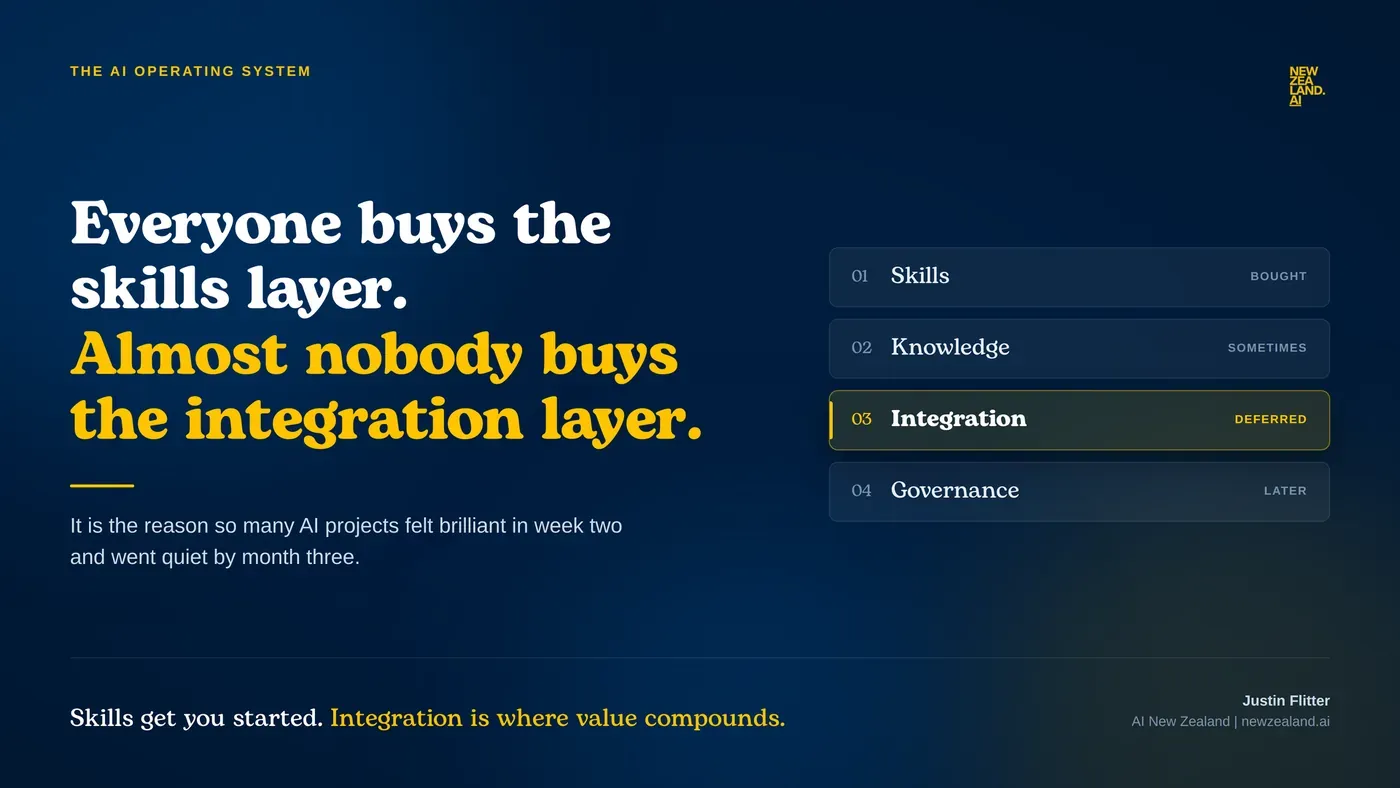
Everyone is buying the skills layer. Almost nobody is buying the integration layer.
Read article →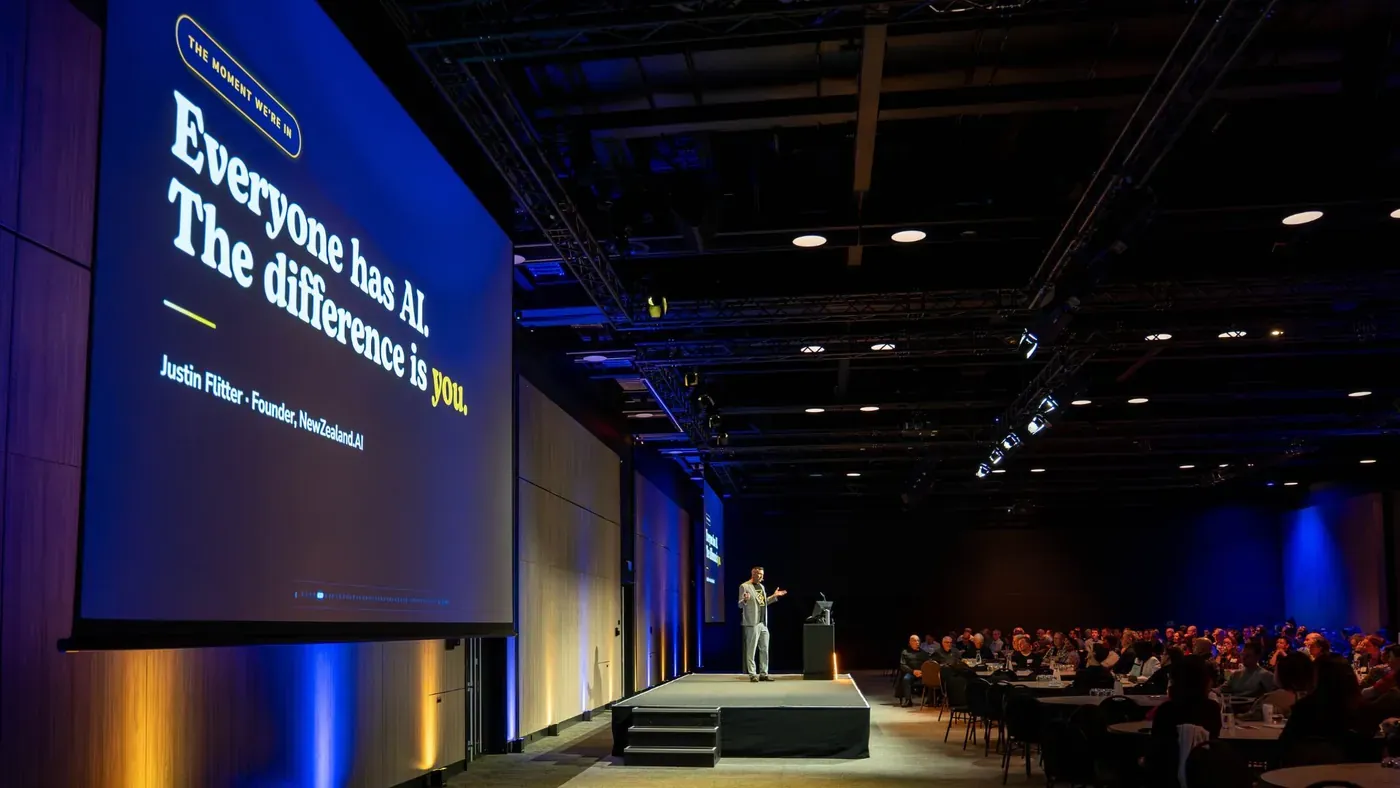
2026 AI Roadshow Notes
AI is no longer just about content generation. It is becoming operational infrastructure.
Read article →
Insights
What comes after LLMs now has a New Zealand face on it.
Read article →Power up your potential with practical AI skills.
Contact us to discuss how Artificial Intelligence could boost your business.