
The 2026 AI Imperative.
In 2026, AI capability will define your relevance. Without it, New Zealand organisations will struggle to remain viable to competitors, customers, or employees.
Executive Summary
The era of incremental improvement is over. With the arrival of autonomous AI Agents, businesses are no longer competing on headcount or human hustle, but on "compute" and capability.
When a competitor can execute core business functions (like auditing, compliance, or customer service) 10x faster and cheaper than you, traditional competitive strategies, hiring more people or working longer hours, become mathematically impossible to sustain.
The only viable response is to transition from a "human-only" workforce to a hybrid workforce where AI agents handle the high-volume, repetitive execution, freeing humans to focus on strategy, judgment, and relationships.
The Shift from Consumption to Contribution
The narrative of Artificial Intelligence in New Zealand has shifted fundamentally. In 2025, the conversation moved from the fear of job displacement to curiosity, leaders asked, "How do we get started?" and teams began experimenting with tools, governance, and pilot programs.
As we look toward 2026, the experimentation phase is closing. AI is becoming table stakes. The latest data reveals that 82–87% of New Zealand businesses are now using AI, with 93% reporting improved worker productivity. We are no longer talking about simple chatbots; we are entering the era of autonomous AI agents capable of executing complex, multi-step workflows across finance, law, and operations without constant human oversight.
In 2026, AI capability will simply define your relevance. Without it, New Zealand organisations will struggle to remain viable to competitors, customers, or talent.
Why This Matters to NZ CEOs
For New Zealand business leaders, this is a competitiveness issue, not just a technology one.
We are outpacing our neighbors: 70% of Kiwi CEOs report AI has made their workforce more efficient, compared to just 42% in Australia. This gives NZ firms a productivity edge in the region.
The "Sinking Lid" on hiring: While only 7% of firms report direct job displacement, 40% report a reduced need for new hires. AI is quietly reshaping workforce demand, allowing companies to grow output without proportionally growing headcount.
Trust is the new currency: Despite high business adoption, consumer trust lags significantly, only 34% of Kiwis trust AI. Closing this gap is a critical leadership challenge.
Regulatory Advantage: New Zealand's "light touch, risk-based" regulatory environment offers a unique sandbox for innovation, allowing local firms to move faster than competitors in more restrictive jurisdictions like the EU.
The Opportunity This Presents
Transitioning from "users" of tools to "leaders" of agents offers three distinct strategic advantages:
- Operational Excellence via Agents: We are moving beyond drafting emails to deploying autonomous agents that can audit financial transactions 24/7 or manage supply chains. Early adopters in NZ are seeing 74% reductions in audit efforts and 63% cuts in compliance downtime.
- Becoming a "Frontier Firm": AI allows NZ businesses to overcome our traditional scale disadvantages. Small teams can now output enterprise-level work, creating competitive moats that large global incumbents cannot easily replicate.
- Cost-Effective Transformation: You do not need to build from scratch. 72% of NZ businesses rely on off-the-shelf solutions (like Microsoft Copilot or ChatGPT), keeping setup costs often under $5,000. The barrier to entry is low; the barrier to mastery is culture.
The Impact on Risk and Governance
The shift to autonomous agents introduces risks that traditional governance frameworks are ill-equipped to handle.
- Autonomous Action Risk: Unlike a tool that waits for a command, an AI agent can independently make decisions, commit resources, or interact with customers. If an agent creates a liability, who is responsible?
- The "Shadow AI" Challenge: With widespread adoption, employees are likely using AI tools informally. Without a formal "embedded compliance" framework, you risk data leakage and reputational damage.
- Cultural Risk: Success is 10% technology and 90% people. If adoption is limited to a few tech enthusiasts rather than being culturally embedded, you will fail to realize ROI. There is a real risk of a "two-speed" workforce where those without AI skills become obsolete.
Questions CEOs Should Be Asking
Use these questions to provoke debate with your Board and Executive Team:
- "If AI agents could handle 60% of our core workflows, what would we stop doing, and what new value would we create?" (Move the conversation from efficiency to business model innovation).
- "Do we have a governance framework for autonomous decisions, or just for human ones?" (Traditional approval chains break down when software acts independently).
- "Are we treating AI as a tool for individuals, or as a 'team member' embedded in our processes?" (ROI comes from systemic integration, not ad-hoc usage
- "How are we measuring the 'sinking lid' effect on our talent pipeline, and are we upskilling our people fast enough to fill the new high-value roles created?"
- "Is our trust gap with customers growing or shrinking as we automate?" (Transparency is essential to overcome the 34% consumer trust figure).
Steps CEOs Should Take Next
Immediate Actions (Next 30 Days):
- Conduct a "Shadow AI" Audit: Survey your teams to find out what tools are already being used. You cannot govern what you cannot see.
- Establish an AI Council: Form a cross-functional group (Legal, HR, IT, Ops) to own the AI strategy. Don't leave this solely to the CTO.
- Identify 3 "Agent" Pilots: Select three internal, low-risk processes (e.g., internal reporting, initial candidate screening, invoice processing) to test autonomous agents, not just chatbo
Medium-Term Actions (Next 6 Months):
- Embed "Human-in-the-Loop" Governance: Update risk frameworks to ensure human oversight exists for all autonomous agent outcomes.
- Invest in "AI Ambassadors": Identify and train power users within every business unit to champion culture change. Remember, the barrier is usually people, not tech.
- Redefine Roles: Rewrite job descriptions to include AI collaboration as a core competency. Make AI proficiency a KPI for performance reviews to signal that this is now "table stakes."
Key Insights
The "10x Gap" is Structural, Not Temporary
We are shifting from "AI as a Tool" (chatbots assisting humans) to "AI as an Agent" (software doing the work independently).
Traditional Firm: 10 staff members take 5 days to audit 100 files.
AI-Enabled Firm: 1 staff member + 1 AI Agent takes 4 hours to audit the same 100 files.
The Result: The competitor is not just "slightly" faster; they are operating at a different order of magnitude. They can lower prices, increase margins, or scale service levels in ways you cannot physically match with human labor alone.
You Cannot "Hire" Your Way Out of This
In the past, if a competitor moved faster, you could hire more staff to catch up. This logic no longer holds.
The Cost Asymmetry: Adding human headcount adds linear cost and complexity. Adding AI agents adds exponential capacity at near-zero marginal cost.
The "Sinking Lid": Smart companies are already enforcing a "sinking lid" on administrative hiring, using attrition to replace back-office roles with automated agents. If you continue to hire for these roles, you are baking in structural inefficiency that will make your business uncompetitive within 18–24 months.
The Only Way to Compete: "Adopt or Die"
To survive against a 10x competitor, you must adopt the same leverage points.
Internal Efficiency: You must deploy agents to handle your "operational debt", the low-value, repetitive tasks that clog up your teams (e.g., inbox management, invoice matching, meeting scheduling).
External Speed: Your customer response times must move from "business days" to "seconds." If a competitor's AI agent answers a query instantly at 2 AM, your 9-to-5 support team is already obsolete.
The Human Advantage: Where You Can Win
If AI wins on speed and volume, humans win on trust and nuance.
Differentiation: When everyone has 10x speed, the competitive differentiator shifts to experience and trust. Use the time saved by AI to double down on high-touch, human relationships that AI cannot replicate.
The New Skillset: Your team's value is no longer "doing the work"; it is managing the agents that do the work. The most valuable employees will be those who can orchestrate AI workflows effectively.
Actionable Takeaways for Leaders
Identify "10x" Pilots: Don't use AI for small 10% gains (like writing emails). Look for processes where you can achieve a 10x reduction in time/cost (e.g., automating the entire accounts payable process).
Stop Hiring for "Robot Work": Review every open role. If the job description is primarily processing data or moving files, cancel the hire and build an agent instead.
Continue reading
More from AI New Zealand.
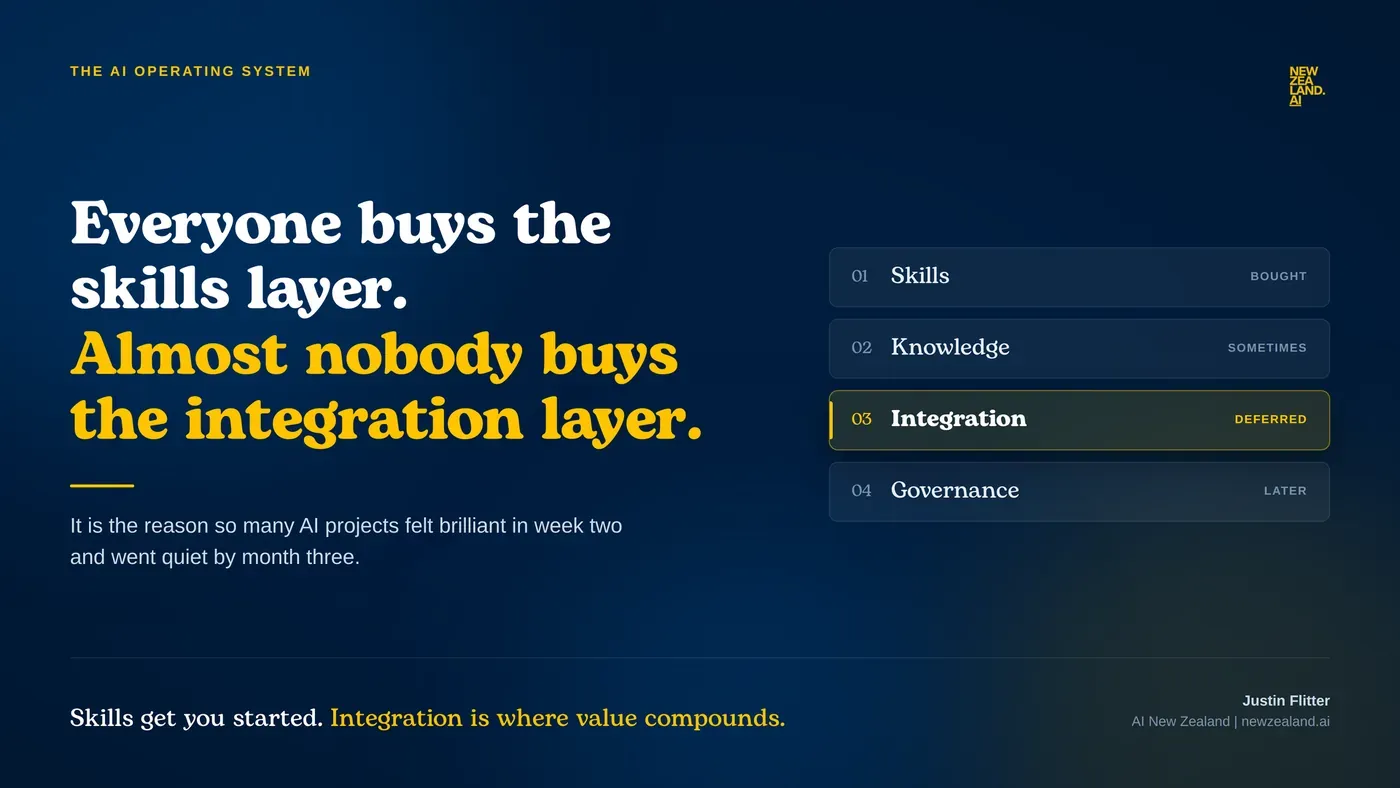
AI Operating System
Everyone is buying the skills layer. Almost nobody is buying the integration layer.
Read article →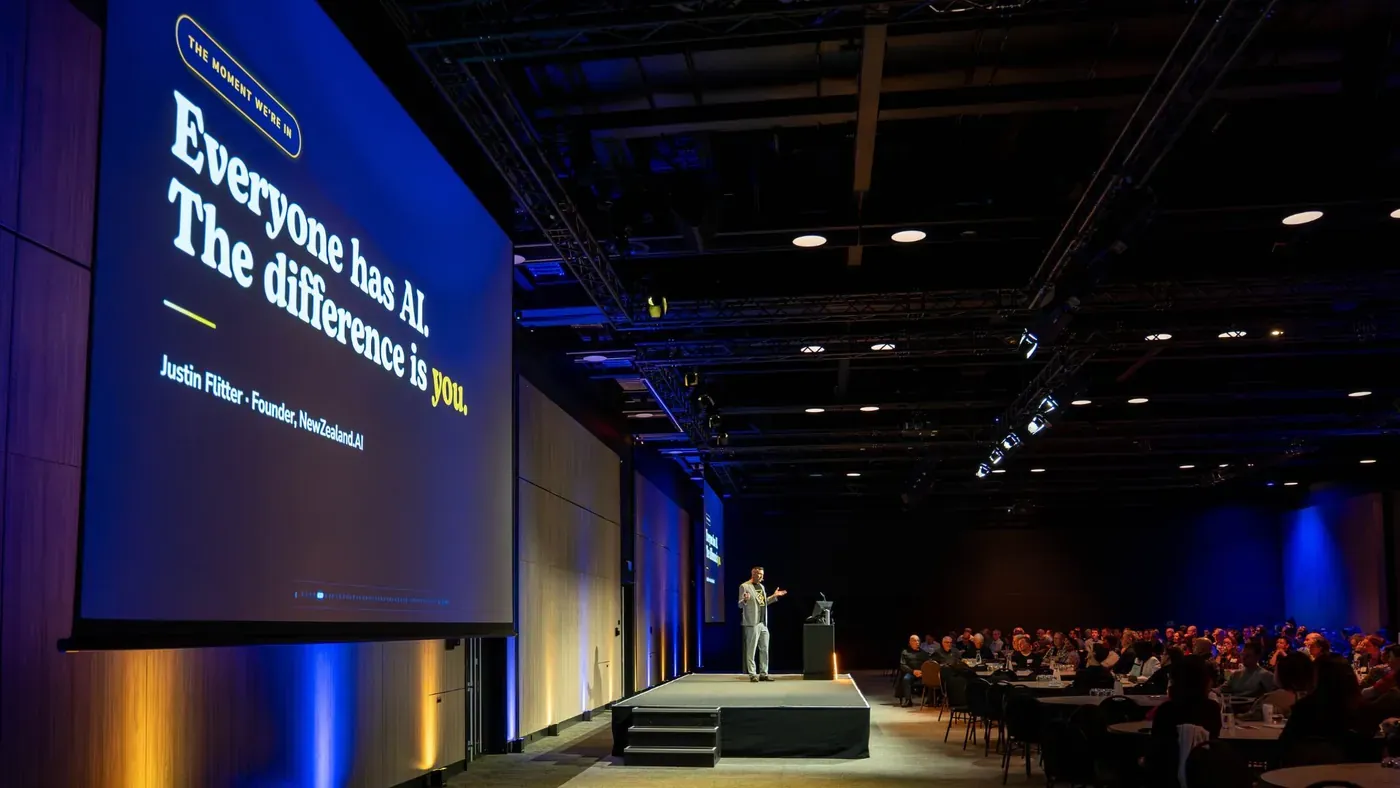
2026 AI Roadshow Notes
AI is no longer just about content generation. It is becoming operational infrastructure.
Read article →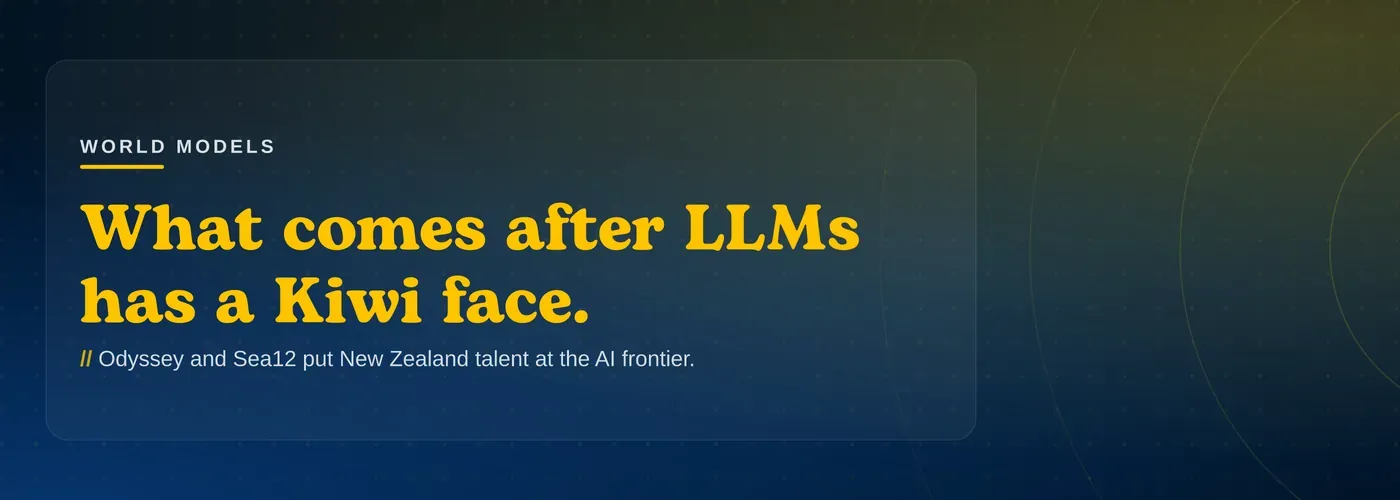
Insights
What comes after LLMs now has a New Zealand face on it.
Read article →Power up your potential with practical AI skills.
Contact us to discuss how Artificial Intelligence could boost your business.